
An environmental water sample collected near a facility outfall has a tritium concentration of 1,000 pCi/L. What is this concentration expressed in SI units of becquerels per cubic meter (Bq/m³)?
Select an answer to reveal the explanation.
Short Explanation
Converting environmental concentrations means scaling both the activity unit and the volume unit at the same time. Watch out for the classic trap of converting picocuries to becquerels while forgetting that a cubic meter holds a thousand liters, or you will underestimate the SI value.
Full Explanation
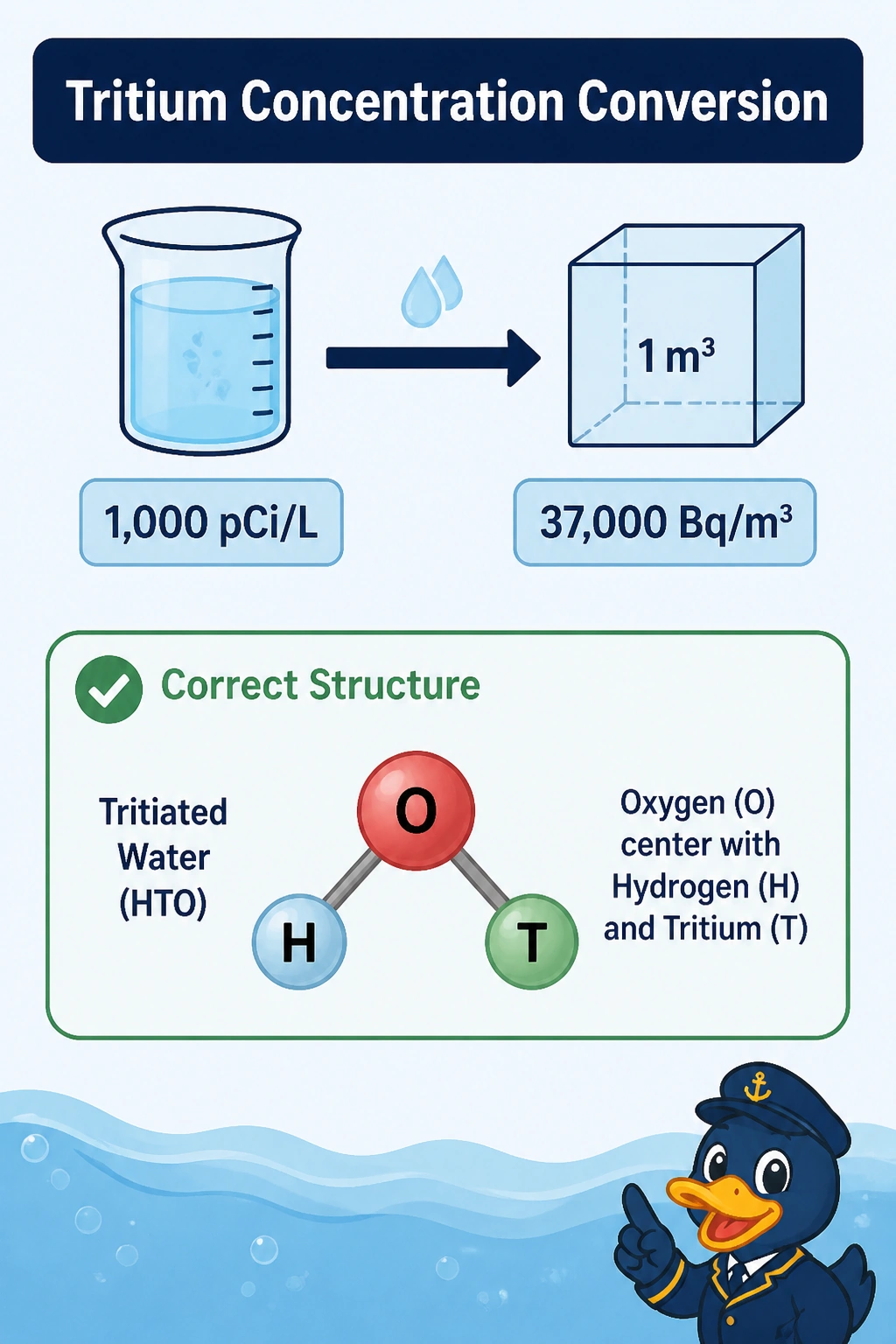
To convert 1,000 pCi/L into becquerels per cubic meter, apply both the curie-to-becquerel factor and the liter-to-cubic-meter factor. One picocurie equals 10^-12 curies, and 1 curie equals 3.7 × 10^10 Bq, so 1 pCi equals 0.037 Bq. Multiplying 1,000 pCi/L by 0.037 Bq/pCi gives 37 Bq/L. Because 1 cubic meter contains 1,000 liters, multiplying 37 Bq/L by 1,000 L/m³ yields 37,000 Bq per cubic meter. Selecting 37 Bq per cubic meter correctly converts 1,000 pCi to 37 Bq but forgets to scale from per liter to per cubic meter. Choosing 370 Bq per cubic meter or 3,700 Bq per cubic meter reflects power-of-ten errors when scaling from liters to cubic meters or converting the pico prefix. As a caveat, always track numerator and denominator units explicitly because environmental reports mix liters, milliliters, and cubic meters across water and air media. As an operational check, remember the benchmark that 1 pCi/L equals 37 Bq/m³, then multiply 1,000 by 37 to confirm 37,000 Bq per cubic meter on the laboratory worksheet.
Prefer to study offline? Printable PDF study book + test engine ($7.50, unofficial). These questions stay free here.