
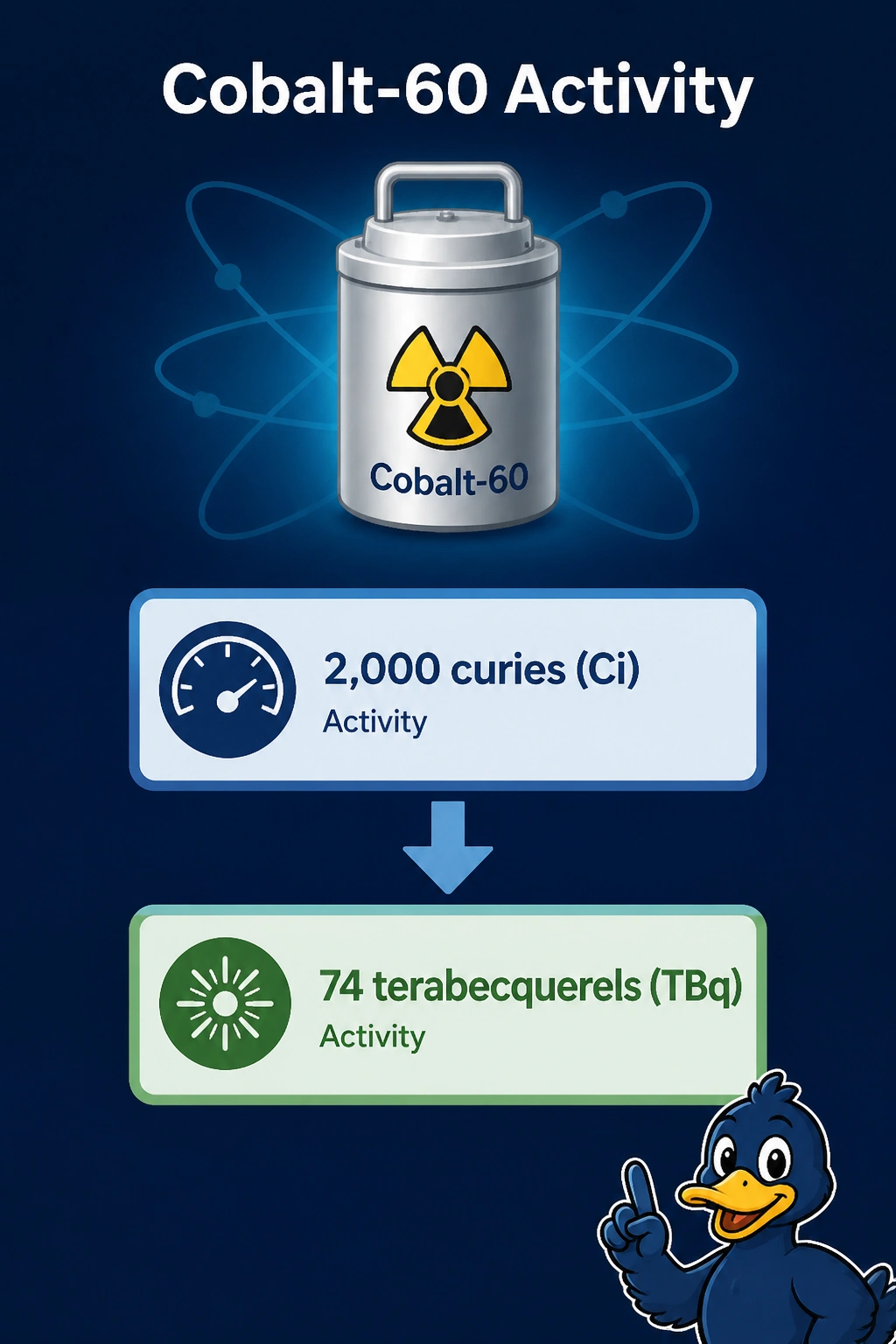
An industrial irradiator uses a Cobalt-60 sealed source with a certified activity of 2,000 curies (Ci). What is this activity expressed in SI units of terabecquerels (TBq)?
Select an answer to reveal the explanation.
Short Explanation
To jump from curies to terabecquerels, remember that 1 curie equals 3.7 x 10^10 becquerels, or 37 gigabecquerels. Multiply your 2,000 curies by 37 GBq and slide the decimal three places to reach TBq. The trap is dividing by 37 instead of multiplying, or slipping a power of ten.
Full Explanation
By definition, 1 curie (Ci) equals exactly 3.7 x 10^10 disintegrations per second, or 3.7 x 10^10 becquerels (Bq), which is equivalent to 37 gigabecquerels (GBq). Multiplying 2,000 Ci by 3.7 x 10^10 Bq/Ci gives 7.4 x 10^13 Bq; because 1 terabecquerel (TBq) equals 10^12 Bq, dividing 7.4 x 10^13 Bq by 10^12 Bq/TBq yields 74 terabecquerels (TBq). Choosing 7.4 terabecquerels (TBq) understates the source activity by a factor of 10 due to a decimal-place error when converting from 10^13 Bq to 10^12 Bq. Selecting 54 terabecquerels (TBq) results from dividing 2,000 by 37 instead of multiplying by 37, which is a frequent unit-conversion inversion mistake. Choosing 740 terabecquerels (TBq) overstates the activity by a factor of 10 from miscounting the exponent between gigabecquerels and terabecquerels. As an exam caveat, always write out the powers of ten explicitly (Ci to 3.7 x 10^10 Bq, then to 10^12 Bq/TBq) rather than relying on mental metric shifts. As an operational check, use the quick benchmark that 1,000 Ci equals 37 TBq, so doubling 1,000 Ci to 2,000 Ci must double 37 TBq to 74 TBq.
Prefer to study offline? Printable PDF study book + test engine ($7.50, unofficial). These questions stay free here.