
A smear sample analyzed in a radiochemistry laboratory has a certified net activity of 50 becquerels (Bq). What is this activity expressed in disintegrations per minute (dpm)?
Select an answer to reveal the explanation.
Short Explanation
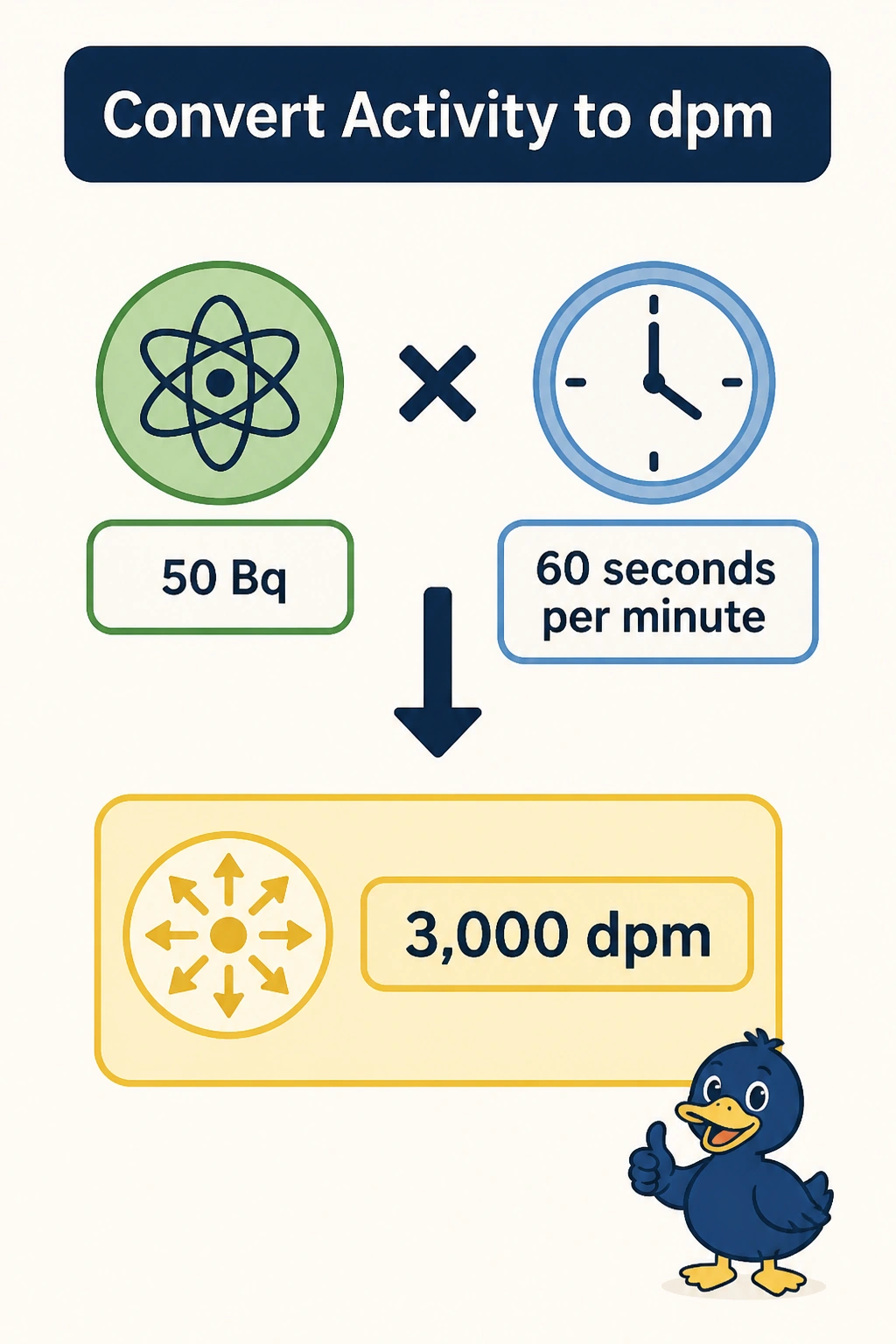
A becquerel is simply one decay per second, so turning Bq into dpm is just like turning your per-second rate into a per-minute rate by multiplying by 60. The trap is slipping in a base-10 metric factor or an extra zero instead of 50 times 60 equals 3,000 dpm.
Full Explanation
One becquerel (Bq) is defined in the International System of Units as exactly one nuclear disintegration per second (dps). Converting 50 Bq into disintegrations per minute requires multiplying 50 dps by 60 seconds per minute, which gives 3,000 dpm, multiplying by 60 seconds per minute. Choosing 500 dpm, using a factor of ten seconds per minute applies a base-10 metric factor instead of the 60-second time conversion. Selecting 1,800 dpm, multiplying by 36 seconds per minute uses an incorrect time factor, likely confusing 60 seconds per minute with 3,600 seconds per hour. Picking 30,000 dpm, converting from kilobecquerels to dpm introduces an extra factor of ten, which would correspond to 500 Bq rather than 50 Bq. As a caveat, remember that becquerels and dpm measure true nuclear disintegration rate (activity), which requires dividing raw counts per minute by detector efficiency before comparing against surface contamination limits. As an operational check, verify whether your counter readout is already efficiency-corrected to dpm or still in raw cpm before converting to becquerels.
Prefer to study offline? Printable PDF study book + test engine ($7.50, unofficial). These questions stay free here.