
A facility's removable beta-gamma surface contamination action level is 6,000 dpm per 100 cm². Expressed in SI units of becquerels per square centimeter (Bq/cm²), what is this contamination limit?
Select an answer to reveal the explanation.
Short Explanation
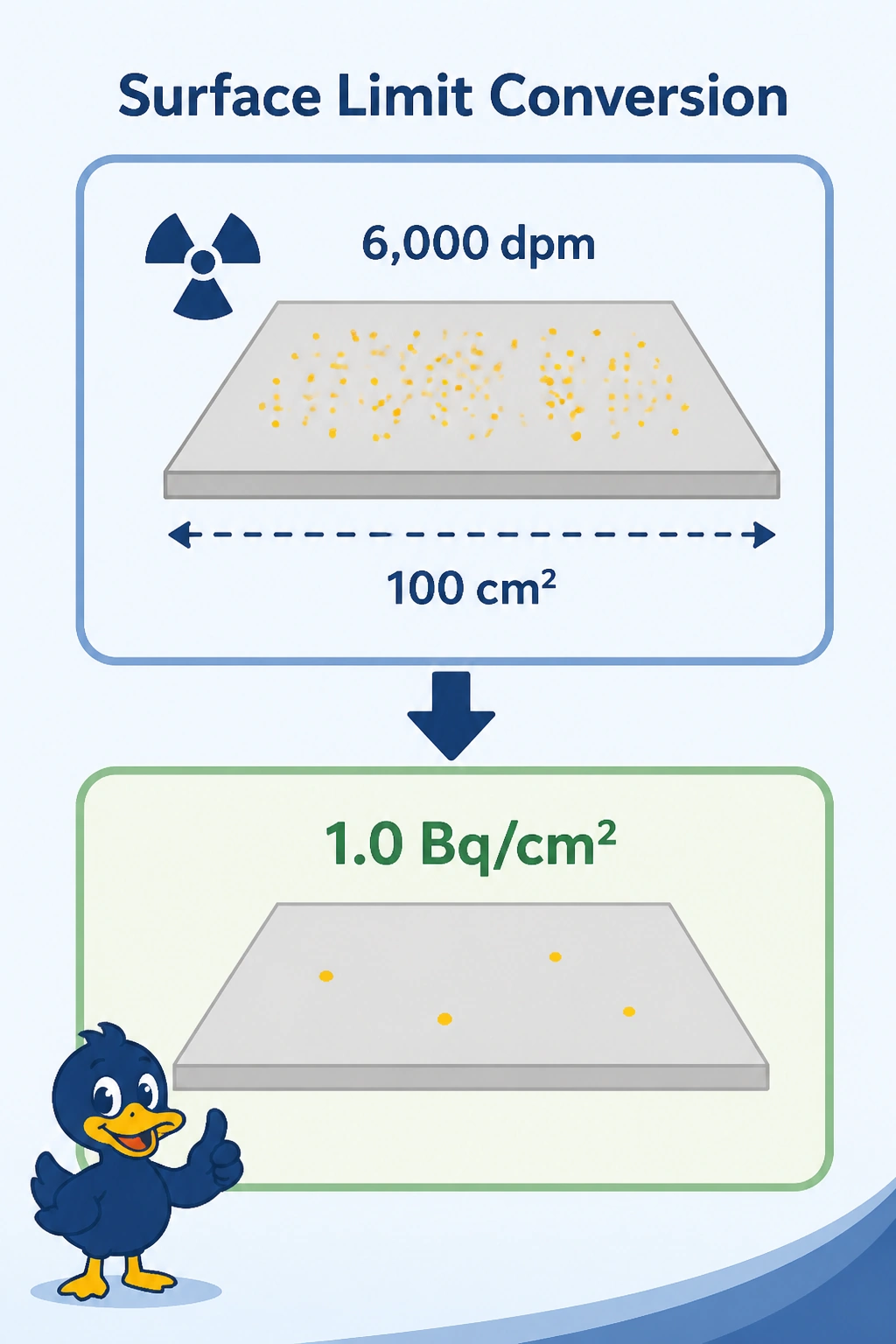
Two-step unit conversions can trip you up if you convert the activity to becquerels and forget to divide by the 100-square-centimeter area. Dividing 6,000 dpm by 60 gives 100 Bq over 100 cm², which equals 1.0 Bq/cm², while the trap is stopping early at 100 Bq/cm².
Full Explanation
Converting a surface contamination limit from dpm per 100 cm² to Bq/cm² requires two steps: converting disintegrations per minute to becquerels (1 Bq = 1 disintegration per second = 60 dpm) and normalizing the area from 100 cm² to 1 cm². Dividing 6,000 dpm by 60 dpm/Bq yields 100 Bq across 100 cm², and dividing 100 Bq by 100 cm² gives 1.0 Bq/cm². Selecting 0.01 Bq/cm² results from dividing by 100 twice or misplacing the decimal point during the area conversion. Choosing 60 Bq/cm² comes from dividing 6,000 by 100 cm² while forgetting to divide by 60 seconds per minute to convert dpm to dps. Reporting 100 Bq/cm² happens when you convert 6,000 dpm to 100 Bq but forget that the 100 Bq is distributed over 100 cm² rather than 1 cm². As a caveat, always check whether a regulatory table specifies total activity per 100 cm² or activity per cm² before comparing smear results to release criteria. As an operational check, write out every unit factor with cancellation lines on your survey sheet so both time and area conversions are visibly verified.
Prefer to study offline? Printable PDF study book + test engine ($7.50, unofficial). These questions stay free here.