
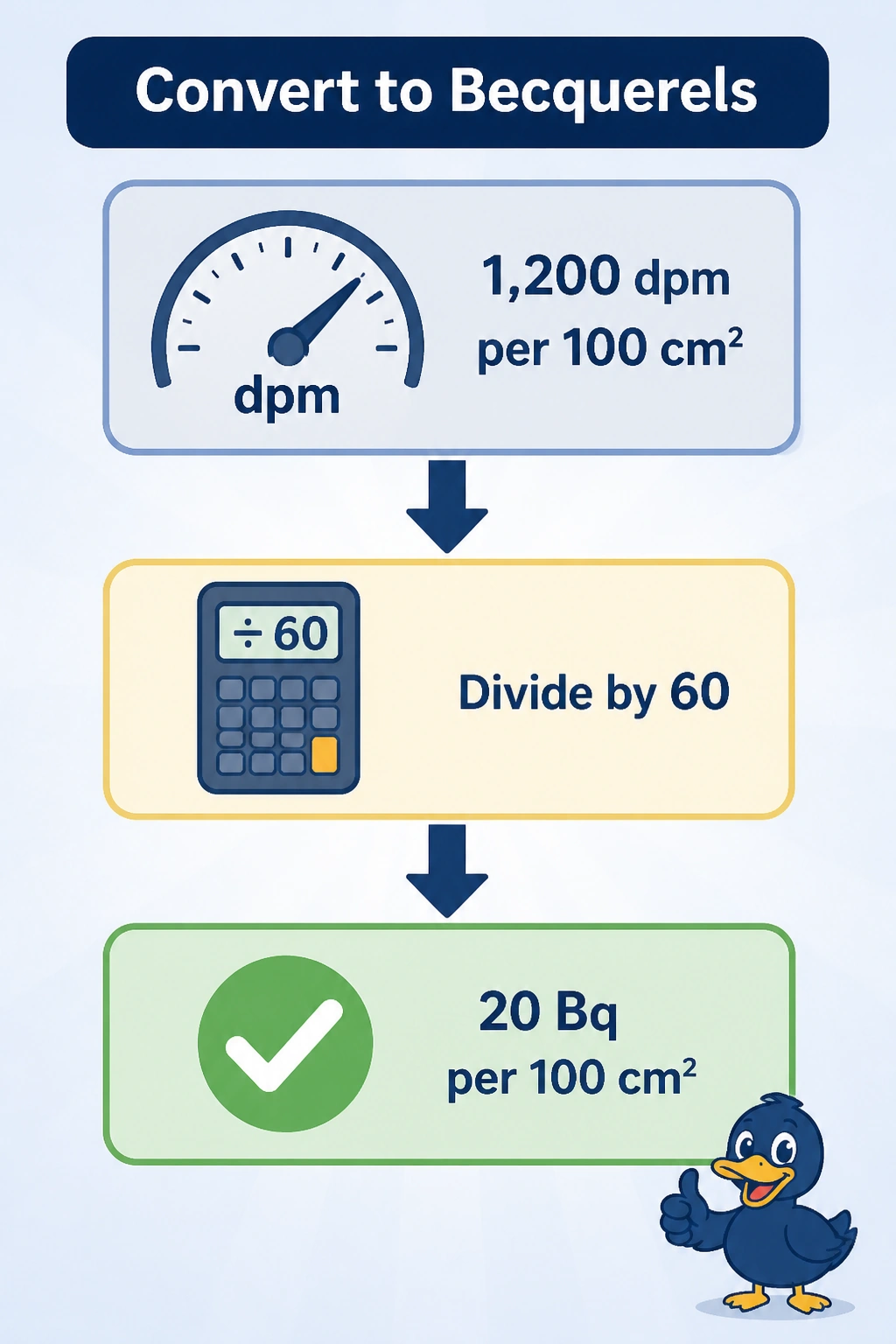
A removable surface contamination smear from a workbench measures 1,200 dpm per 100 cm². Expressed in SI units, what is this contamination level in becquerels (Bq) per 100 cm²?
Select an answer to reveal the explanation.
Short Explanation
A becquerel counts decays per second, while dpm counts them per minute—so you always divide dpm by 60 to get becquerels. Watch out for the trap of multiplying by 60 or reaching for the 2.22 dpm-per-picocurie factor when the question only asks for becquerels.
Full Explanation
One becquerel (Bq) is defined in the International System of Units as 1 nuclear disintegration per second (dps), which equals 60 disintegrations per minute (dpm), so dividing 1,200 dpm by 60 seconds per minute gives 20 Bq per 100 cm², dividing disintegrations per minute by 60. Selecting 72,000 Bq per 100 cm², multiplying by 60 seconds applies the time conversion in the wrong direction and overstates the activity by a factor of 3,600. Choosing 541 Bq per 100 cm², using the picocurie factor confuses becquerels with picocuries, since 1 pCi equals 2.22 dpm rather than 1 Bq. Reporting 1,200 Bq per 100 cm², since 1 Bq equals 1 dpm forgets that the SI unit is based on seconds rather than minutes. As a caveat, always verify that raw counts per minute (cpm) from a survey instrument have already been divided by the calibrated detector efficiency to obtain true dpm before converting to becquerels. For an operational check, perform a quick order-of-magnitude check: because a second is shorter than a minute, the numerical value in Bq must always be 60 times smaller than the value in dpm.
Prefer to study offline? Printable PDF study book + test engine ($7.50, unofficial). These questions stay free here.