
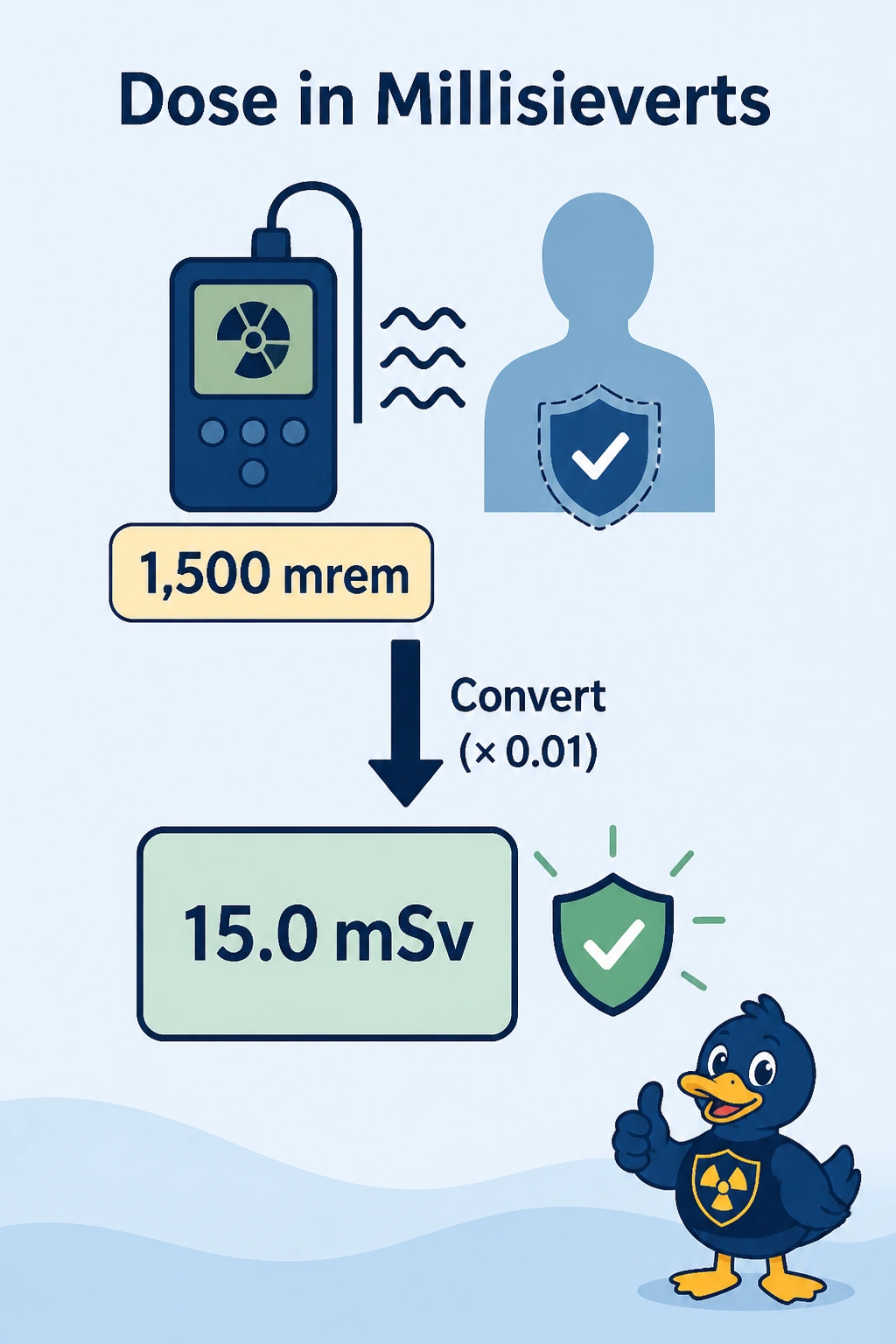
An occupational worker's dosimetry record shows an annual whole-body effective dose of 1,500 mrem. What is this dose expressed in millisieverts (mSv)?
Select an answer to reveal the explanation.
Short Explanation
Converting between rem and sieverts gets easy once you lock in one anchor: 1 rem equals 10 millisieverts, or 100 mrem equals 1 mSv. The trap is slipping a decimal place when jumping between milli-prefixes on both sides of the equation.
Full Explanation
In radiation protection, the SI unit for dose equivalent and effective dose is the sievert (Sv), while the traditional unit is the rem, with an exact conversion factor of 1 Sv equal to 100 rem. Applying the metric milli-prefix to both sides gives 1,000 millisieverts equal to 100,000 millirem, which simplifies directly to the practical working ratio of 100 mrem per 1 mSv. Dividing the worker's 1,500 mrem dose by 100 mrem/mSv yields 15.0 mSv. Choosing 1.5 mSv understates the effective dose by a factor of ten because it mistakenly treats 1,000 mrem as equal to 1 mSv. Selecting 150 mSv overstates the effective dose by a factor of ten because it divides 1,500 mrem by 10 instead of 100, confusing the 1 rem = 10 mSv relationship with the millirem-to-millisievert ratio. Choosing 1.50 Sv confuses millirem with sieverts and misses both the 100-fold rem-to-sievert conversion factor and the milli-prefix, representing an enormous 150,000 mrem. As an important regulatory caveat, always verify that both the starting and ending quantities represent dose equivalent or effective dose (rem and Sv) rather than absorbed dose (rad and Gy), which omit radiation weighting factors. To double-check your arithmetic on a dose report, multiply 15.0 mSv by 100 mrem/mSv to confirm you recover 1,500 mrem.
Prefer to study offline? Printable PDF study book + test engine ($7.50, unofficial). These questions stay free here.