
An air sample collected in a radiologically controlled work area yields an airborne concentration of 2.0 x 10^-9 microcuries per milliliter (µCi/mL). What is this concentration expressed in SI units of becquerels per cubic meter (Bq/m³)?
Select an answer to reveal the explanation.
Short Explanation
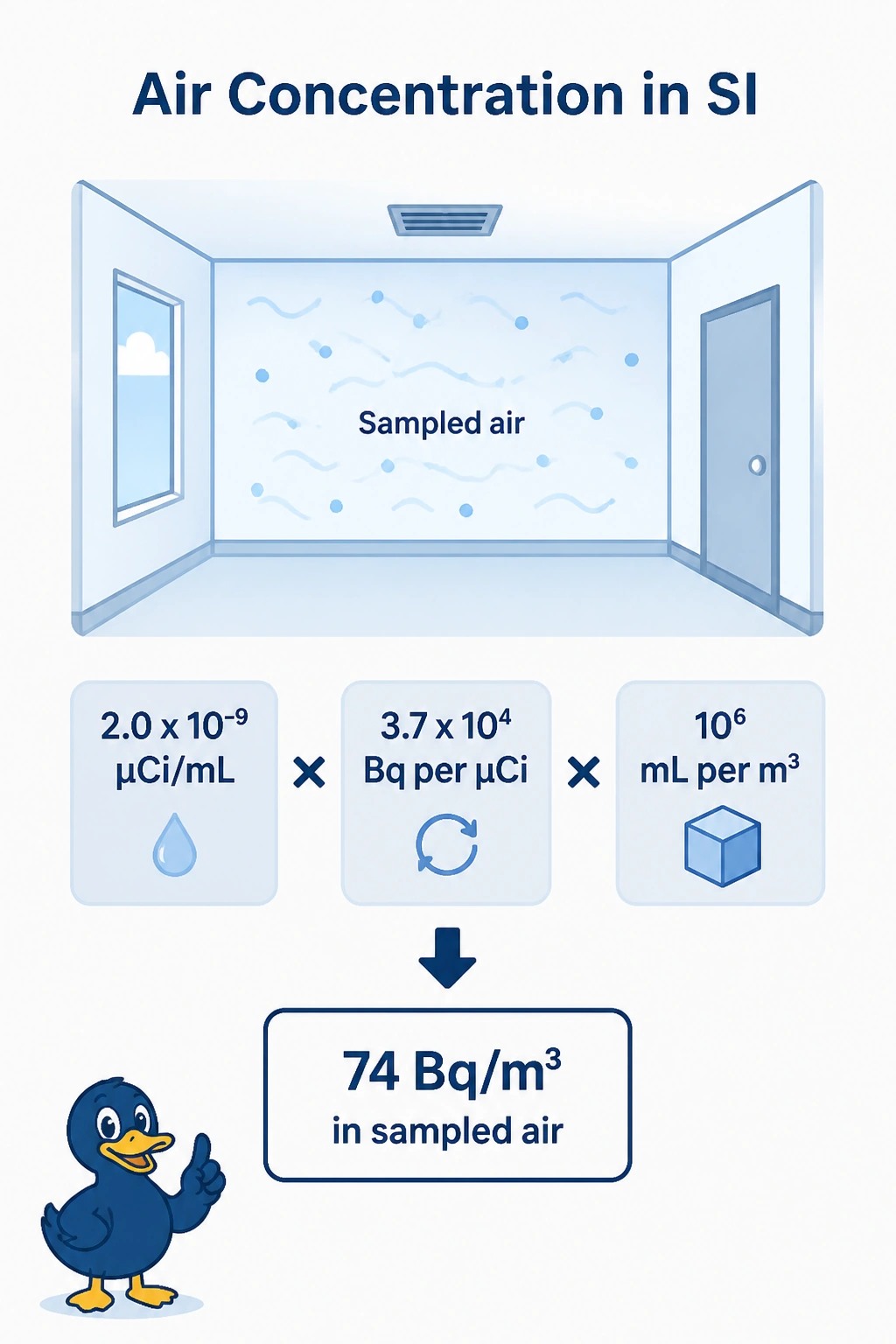
Converting air concentrations from traditional units to SI feels like juggling powers of ten, because both the activity and the volume scale up at once. Since one cubic meter holds one million milliliters and one microcurie equals 37,000 becquerels, your sample equals 74 Bq/m³ in sampled air. The usual trap is forgetting that cubic conversions cube the factor of 100, which throws you off by orders of magnitude.
Full Explanation
To convert an airborne radioactivity concentration from microcuries per milliliter to becquerels per cubic meter, apply both the activity conversion and the volume conversion together. One microcurie equals 3.7 x 10^4 becquerels, and one cubic meter equals 10^6 milliliters (10^6 cubic centimeters). Multiplying 2.0 x 10^-9 microcuries per milliliter by 3.7 x 10^4 becquerels per microcurie and by 10^6 milliliters per cubic meter yields 74 Bq/m³ in sampled air. Reporting 0.074 Bq/m³ in air results from dropping a factor of 1,000 when converting volume, such as treating one cubic meter as 1,000 milliliters instead of one million. Reporting 7.4 Bq/m³ in air and reporting 740 Bq/m³ in air both stem from single-digit decimal-point errors when multiplying exponents of ten. As an important caveat, always confirm whether your air-sampling procedure reports activity per actual cubic meter or standard cubic meter corrected for temperature and pressure. For an operational check, verify that your calculated SI concentration matches the units on your Derived Air Concentration reference table before comparing against regulatory limits.
Prefer to study offline? Printable PDF study book + test engine ($7.50, unofficial). These questions stay free here.