
A sealed calibration check source has a certified activity of 5.0 mCi. What is this source's activity expressed in megabecquerels (MBq)?
Select an answer to reveal the explanation.
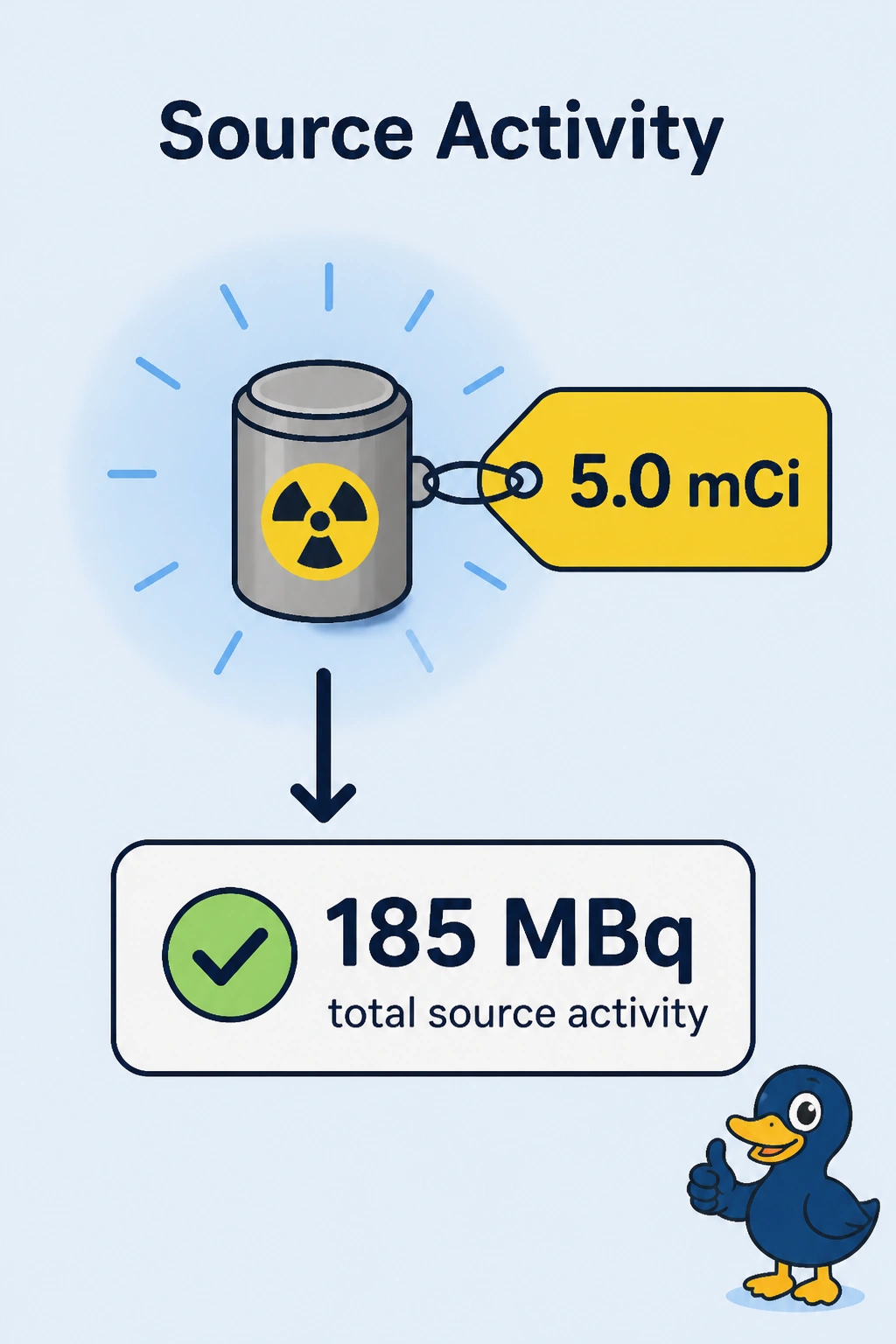
Short Explanation
Converting between curies and becquerels is a classic decimal-place minefield, so anchor yourself to one rock-solid number: 1 mCi equals 37 MBq. From there, your math is as simple as multiplying 5.0 by 37. The trap here is slipping a power of ten when juggling milli- and mega- prefixes.
Full Explanation
By definition, 1 curie equals 3.7 x 10^10 disintegrations per second (3.7 x 10^10 Bq). Scaling down by a factor of 1,000 for millicuries shows that 1 mCi equals 3.7 x 10^7 Bq, which is exactly 37 MBq since mega represents 10^6. Multiplying the 5.0 mCi source activity by 37 MBq per mCi yields 185 MBq total source activity. Selecting 0.185 MBq total activity reflects a three-orders-of-magnitude error, typically from dividing by 1,000 instead of multiplying when converting to becquerels. Selecting 18.5 MBq total activity drops a factor of 10 by using 3.7 MBq per mCi instead of 37 MBq per mCi. Selecting 1,850 MBq total activity shifts the decimal one place too high, treating 1 mCi as 370 MBq or multiplying 5.0 by 3.7 x 10^8 instead of 3.7 x 10^7. As a practical caveat, always check whether a certificate reports activity at a reference date or the current date, because short-lived isotopes require decay correction alongside unit conversion. Operationally, confirm the unit setting on any dose calibrator or inventory log before entering source values so shipping manifests and postings match.
Prefer to study offline? Printable PDF study book + test engine ($7.50, unofficial). These questions stay free here.