
An industrial X-ray cabinet operates with an aluminum filter placed directly across the tube exit port. What primary effect does this added filtration have on the emitted X-ray beam?
Select an answer to reveal the explanation.
Short Explanation
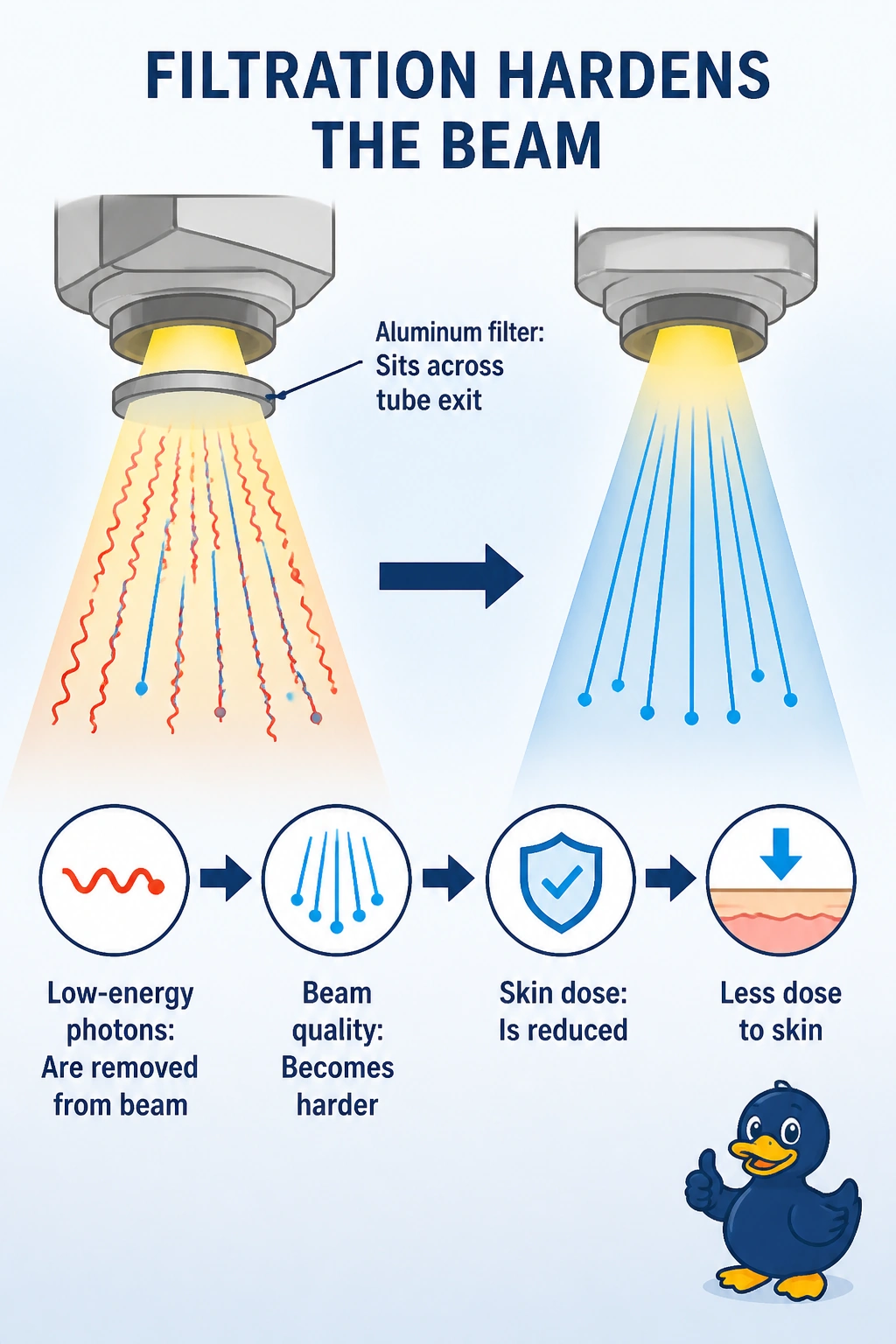
Think of added aluminum filtration like a bouncer turning away weak photons that only cause trouble at the surface. On the exam, you might assume filtration raises peak photon energy, but only tube voltage sets that ceiling; your filter simply strips out soft X-rays that would otherwise deposit useless skin dose.
Full Explanation
It removes low-energy photons to harden the beam and cut skin dose because photoelectric attenuation in aluminum rises sharply as photon energy drops, selectively absorbing soft bremsstrahlung rays while letting higher-energy photons pass. Raising the average energy of the transmitted beam is called beam hardening, which protects superficial tissue or reduces low-energy scatter without sacrificing penetration. It increases the maximum photon energy of the bremsstrahlung spectrum is false because maximum photon energy depends solely on the peak kilovoltage applied across the X-ray tube. It eliminates characteristic X-rays emitted by the tungsten target is incorrect because characteristic peaks from high-Z tungsten lie near 59 to 69 keV and pass readily through thin aluminum. It collimates scattered photons leaving the side of the tube housing is wrong because leakage shielding and beam-defining collimators, not exit-port filters, restrict off-axis radiation. As an exam caveat, adding too much filtration eventually reduces useful beam intensity and forces longer exposure times. Operationally, verify the specified total filtration thickness and perform a half-value layer check after tube maintenance to confirm proper beam quality.
Prefer to study offline? Printable PDF study book + test engine ($7.50, unofficial). These questions stay free here.