
A nuclear instrumentation laboratory uses a sealed Californium-252 (Cf-252) source to calibrate neutron survey meters. By what primary nuclear mechanism does Cf-252 emit neutrons?
Select an answer to reveal the explanation.
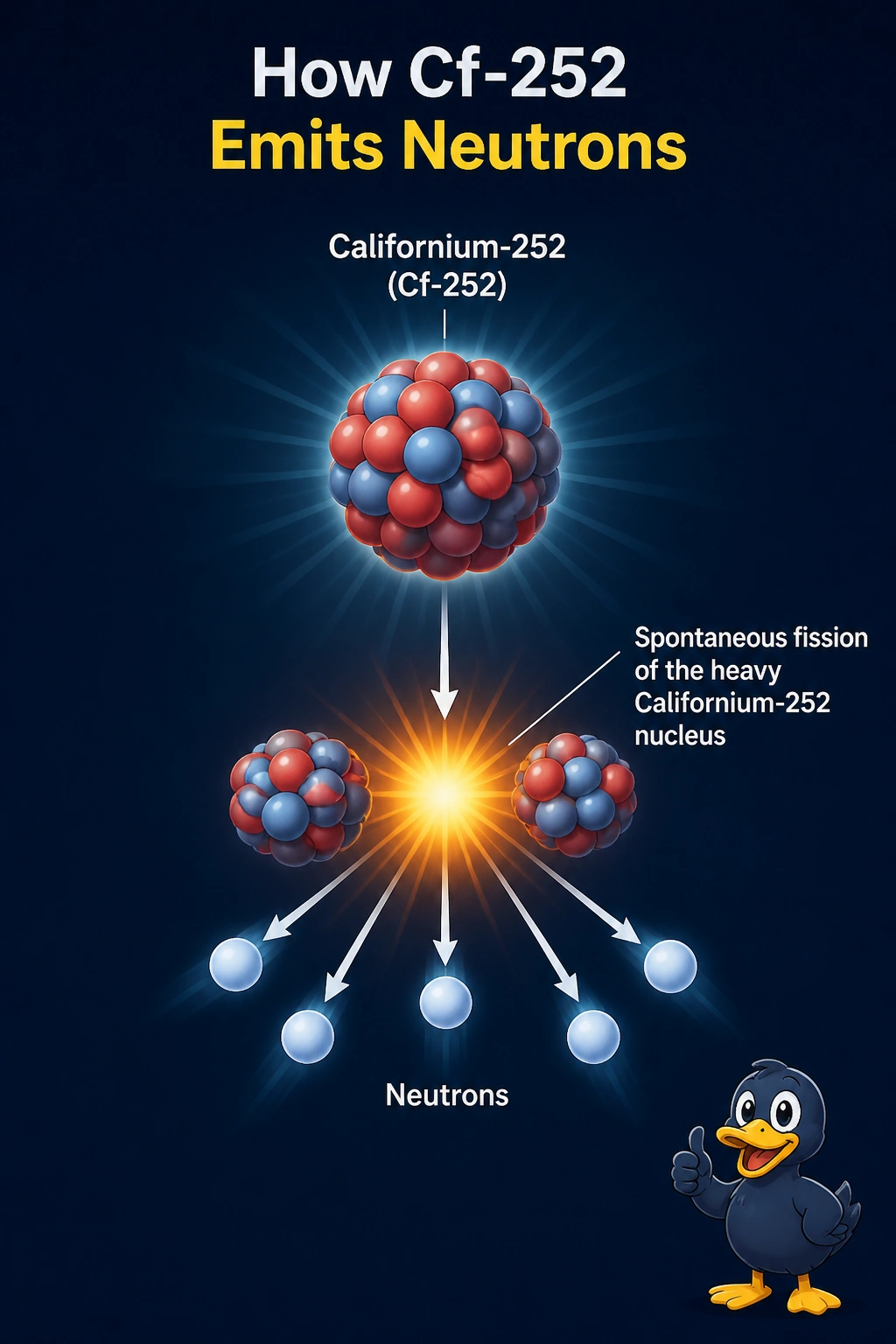
Short Explanation
Unlike Am-Be sources that rely on an alpha particle hitting beryllium, Californium-252 splits all on its own without needing a target material. When you calibrate with Cf-252, your neutrons come from spontaneous fission; the trap is assuming every isotopic neutron source uses an alpha-beryllium mix.
Full Explanation
Californium-252 is a transuranic isotope with a 2.645-year physical half-life that decays primarily by alpha emission (about 96.9 percent) and by Spontaneous fission of the heavy Californium-252 nucleus (about 3.1 percent), releasing an average of roughly 3.76 fast neutrons per fission event. Because the neutrons come directly from the splitting nucleus, Cf-252 requires no secondary target material and provides a compact, high-output fission-spectrum neutron source. An Alpha-neutron reaction with a beryllium target describes sources such as Americium-Beryllium (Am-Be) or Plutonium-Beryllium (Pu-Be), not Cf-252. Photoneutron emission triggered by internal gamma rays applies to gamma-neutron sources like Antimony-Beryllium (Sb-Be), where high-energy gamma photons eject neutrons from beryllium or deuterium. Deuterium-tritium fusion induced by alpha decay heat does not occur in sealed isotopic sources; D-T neutron generation requires an accelerator-driven neutron generator. As a caveat, Cf-252 also emits intense prompt and fission-product gamma rays alongside neutrons, so personnel shielding requires both hydrogenous moderation and high-Z gamma attenuation. Always perform both neutron and gamma dose rate surveys around Cf-252 storage casks.
Prefer to study offline? Printable PDF study book + test engine ($7.50, unofficial). These questions stay free here.