
A portable moisture-density gauge uses a sealed Americium-Beryllium (Am-Be) source to generate a steady neutron flux. By what nuclear reaction does this source produce neutrons?
Select an answer to reveal the explanation.
Short Explanation
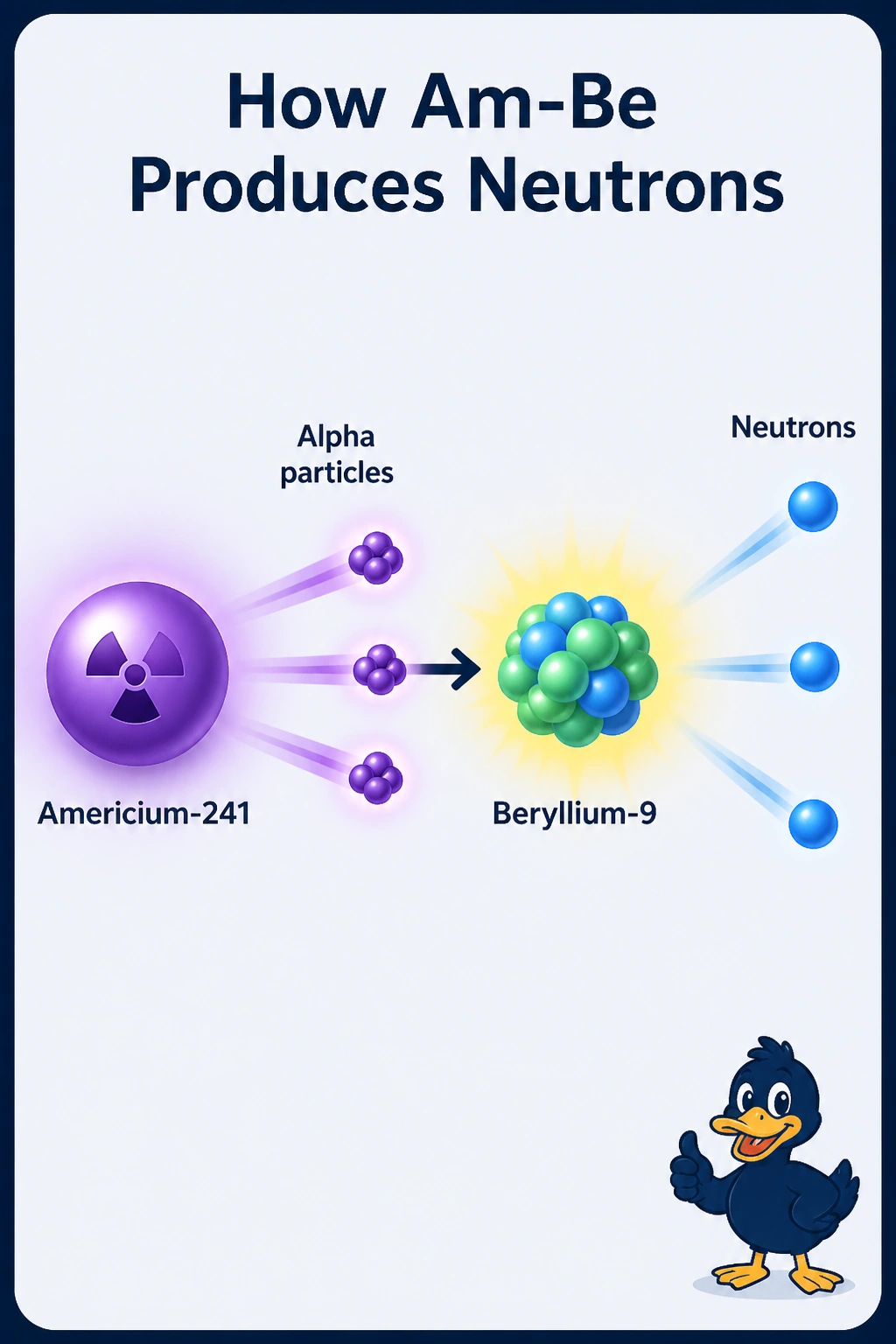
An Am-Be source pairs an alpha emitter with a light target metal so alpha particles can knock neutrons loose from beryllium nuclei. When you review neutron sources, the trap is assuming americium-241 undergoes spontaneous fission like californium-252 instead of driving an alpha-neutron reaction.
Full Explanation
In an Am-Be sealed source, americium-241 powder is intimately mixed with beryllium-9 so that Alpha particles from americium-241 interact with beryllium-9 nuclei in an (alpha, n) reaction, producing carbon-12 and a fast neutron. Spontaneous fission of heavy americium-241 nuclei occurs at a negligible rate compared with its alpha decay and is instead the primary neutron mechanism in sources such as californium-252. High-energy gamma photoneutron emission in beryllium-9 requires photons above roughly 1.67 MeV—used in Sb-Be sources—whereas americium-241 primarily emits a low-energy 59.5 keV gamma ray. Beta-minus decay of unstable beryllium-9 nuclei does not occur because beryllium-9 is stable and does not emit neutrons by beta decay. As a radiation protection caveat, Am-Be sources produce both fast neutrons and gamma rays (including 59.5 keV photons from Am-241 and 4.4 MeV photons from excited C-12), so shielding requires hydrogenous moderator plus photon attenuation. Always verify current leak-test records and survey both neutron and gamma dose rates around gauge storage.
Prefer to study offline? Printable PDF study book + test engine ($7.50, unofficial). These questions stay free here.