
A hospital radiopharmacy needs Fluorine-18 (half-life 110 minutes) for positron emission tomography (PET) imaging. Why is Fluorine-18 produced in a cyclotron rather than a nuclear fission reactor?
Select an answer to reveal the explanation.
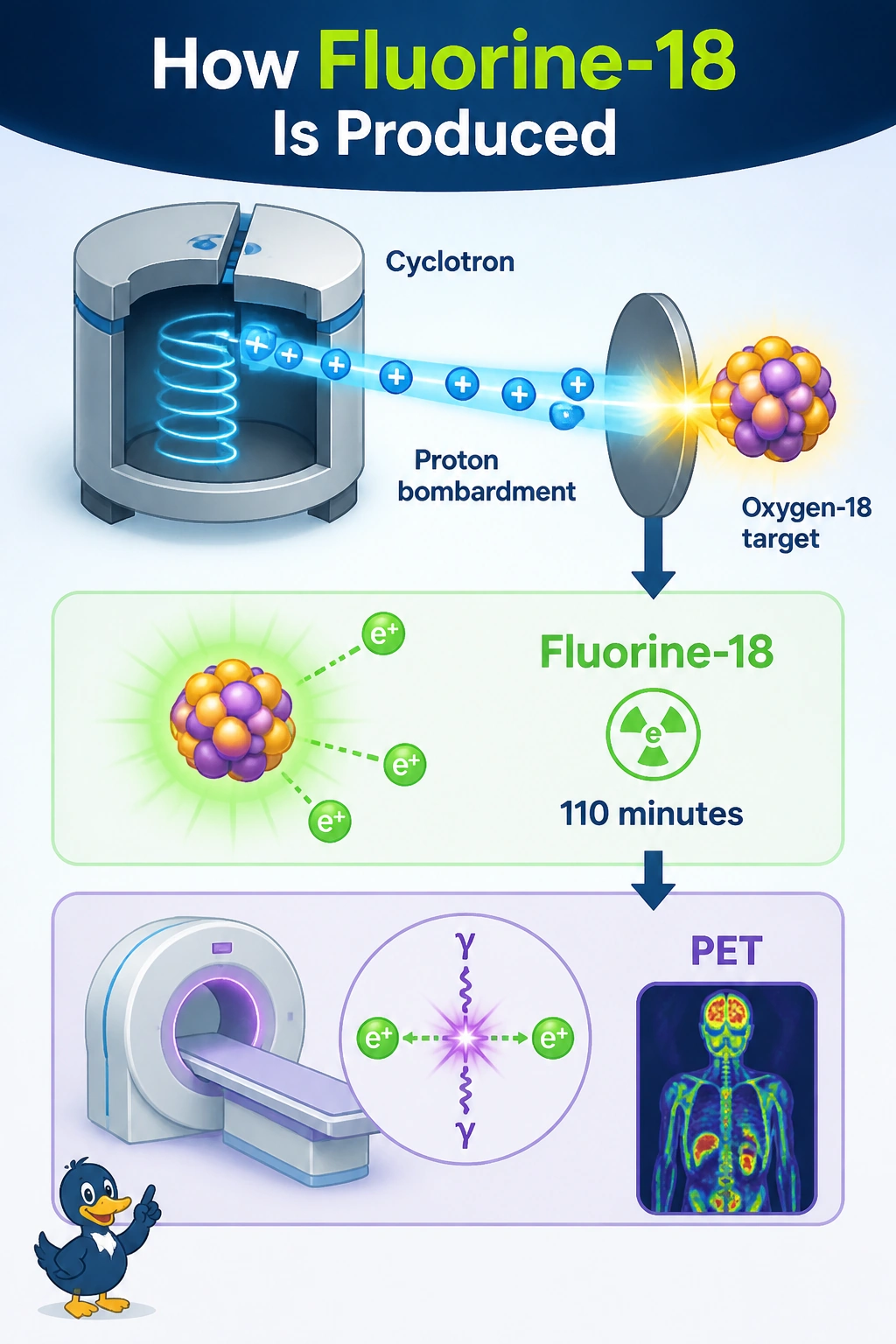
Short Explanation
If you want a nuclide to sit on the proton-rich side of stability, you have to push protons in rather than neutrons. The trap is assuming any medical isotope can be cooked in a research reactor. Your cyclotron accelerates charged protons into an oxygen-18 target, creating proton-rich Fluorine-18 right where PET imaging needs it.
Full Explanation
Because positron emitters lie below the line of stability with an excess of protons, Cyclotron proton bombardment produces proton-rich nuclides for positron decay, such as bombarding oxygen-18 with protons to yield Fluorine-18 and a neutron. Nuclear reactors supply high fluxes of neutrons, which drive nuclei toward the neutron-rich side of stability and typically yield beta-minus emitters. Reactors only generate alpha-emitting actinides rather than light medical isotopes is incorrect because reactors produce major beta-gamma medical isotopes including Molybdenum-99 and Iodine-131. Cyclotrons use thermal neutron capture to convert stable oxygen into Fluorine-18 misstates the projectile; cyclotrons accelerate charged particles like protons or deuterons, not thermal neutrons. Fluorine-18 requires neutron-rich target material that only cyclotrons can irradiate is wrong because Fluorine-18 itself is proton-rich and reactors, not cyclotrons, are designed for bulk neutron irradiation. As a caveat, cyclotron targetry and beamline shielding must still manage secondary neutrons and 511 keV annihilation photons. For an operational check, verify local cyclotron vault interlocks and stack effluent monitors for short-lived positron-emitting gases before target irradiation.
Prefer to study offline? Printable PDF study book + test engine ($7.50, unofficial). These questions stay free here.