
Cobalt-60 is widely used in industrial irradiators and teletherapy units because of its high-energy gamma emissions. How is Cobalt-60 commercially produced?
Select an answer to reveal the explanation.
Short Explanation
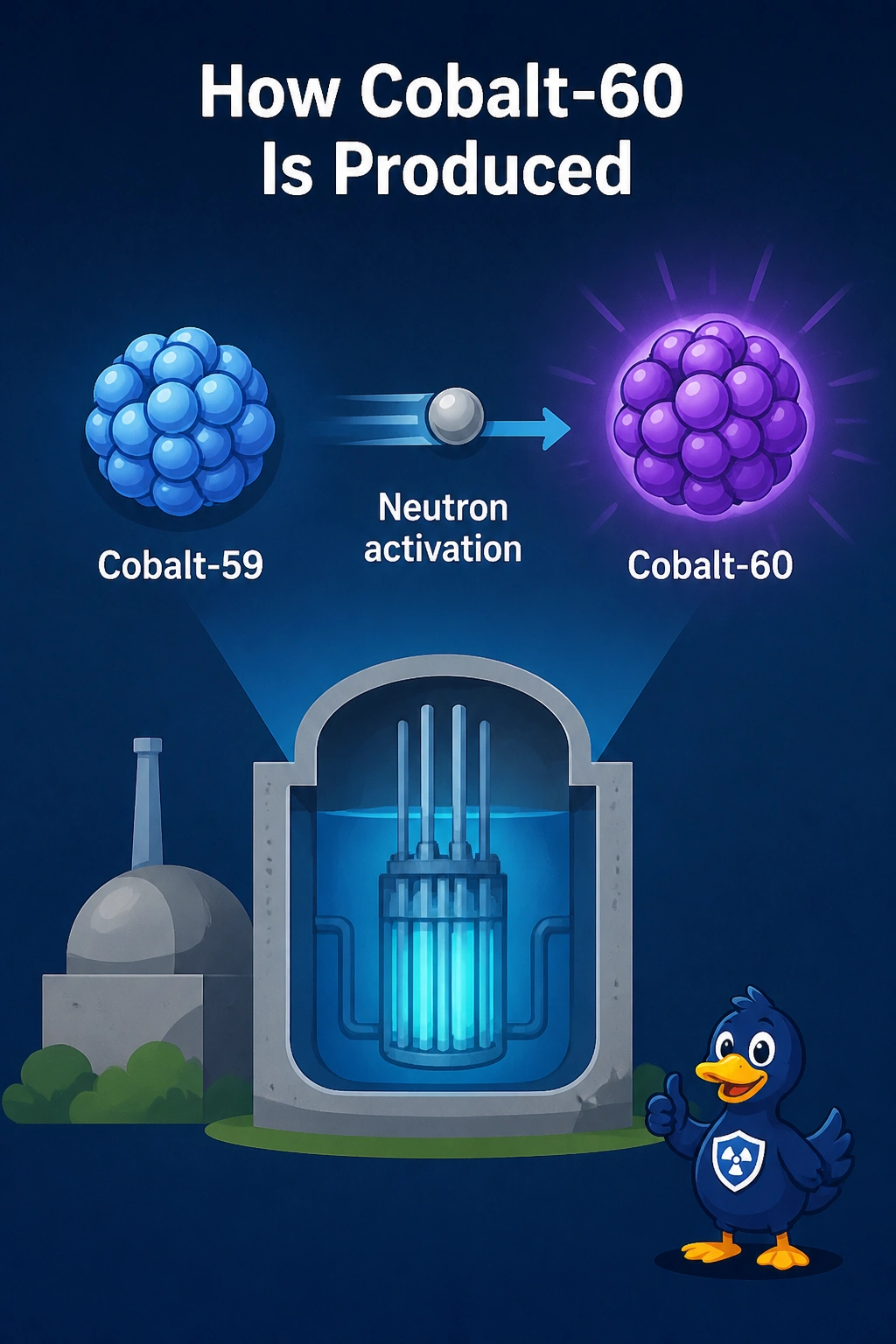
Think of making Cobalt-60 as adding just one extra neutron to ordinary, stable cobalt. Exposing stable Cobalt-59 to thermal neutrons inside a reactor creates Cobalt-60, so you produce it by neutron activation of stable Cobalt-59 inside a nuclear reactor. The trap is mixing up activation products with fission products separated from spent fuel.
Full Explanation
Cobalt-60 is an activation product rather than a primary fission product. When naturally occurring, stable Cobalt-59 (100 percent natural abundance) is placed in the high thermal-neutron flux of a nuclear reactor, a Cobalt-59 nucleus captures a neutron via an (n, gamma) reaction to become radioactive Cobalt-60, which is why it is produced "By neutron activation of stable Cobalt-59 inside a nuclear reactor". Producing it "By bombarding stable nickel targets with high-energy cyclotron protons" describes charged-particle accelerator production used for neutron-deficient medical nuclides rather than neutron-rich Co-60. Producing it "By chemically separating it from spent uranium fission-product waste" confuses Cobalt-60 with true fission products such as Cesium-137 and Strontium-90 that are recovered from nuclear fuel reprocessing. Producing it "By alpha-particle bombardment of beryllium inside a sealed capsule" describes an (alpha, n) neutron source such as Americium-Beryllium, not a Cobalt-60 gamma source. As a caveat, reactor-activated Cobalt-60 sources also contain trace impurities and require double-walled stainless steel encapsulation before commercial use. For an operational check, verify the source certificate for nuclide identity, initial activity, and current decay-corrected output before placing a unit into service.
Prefer to study offline? Printable PDF study book + test engine ($7.50, unofficial). These questions stay free here.