
Why is tungsten commonly selected as the anode target material in high-output diagnostic and industrial X-ray tubes?
Select an answer to reveal the explanation.
Short Explanation
X-ray tubes turn most of their electrical energy into brutal heat, so your target metal has to take a thermal beating while still forcing electrons to brake hard. The trap is thinking a low-Z or low-density target helps, when you actually need heavy nuclei to generate bremsstrahlung.
Full Explanation
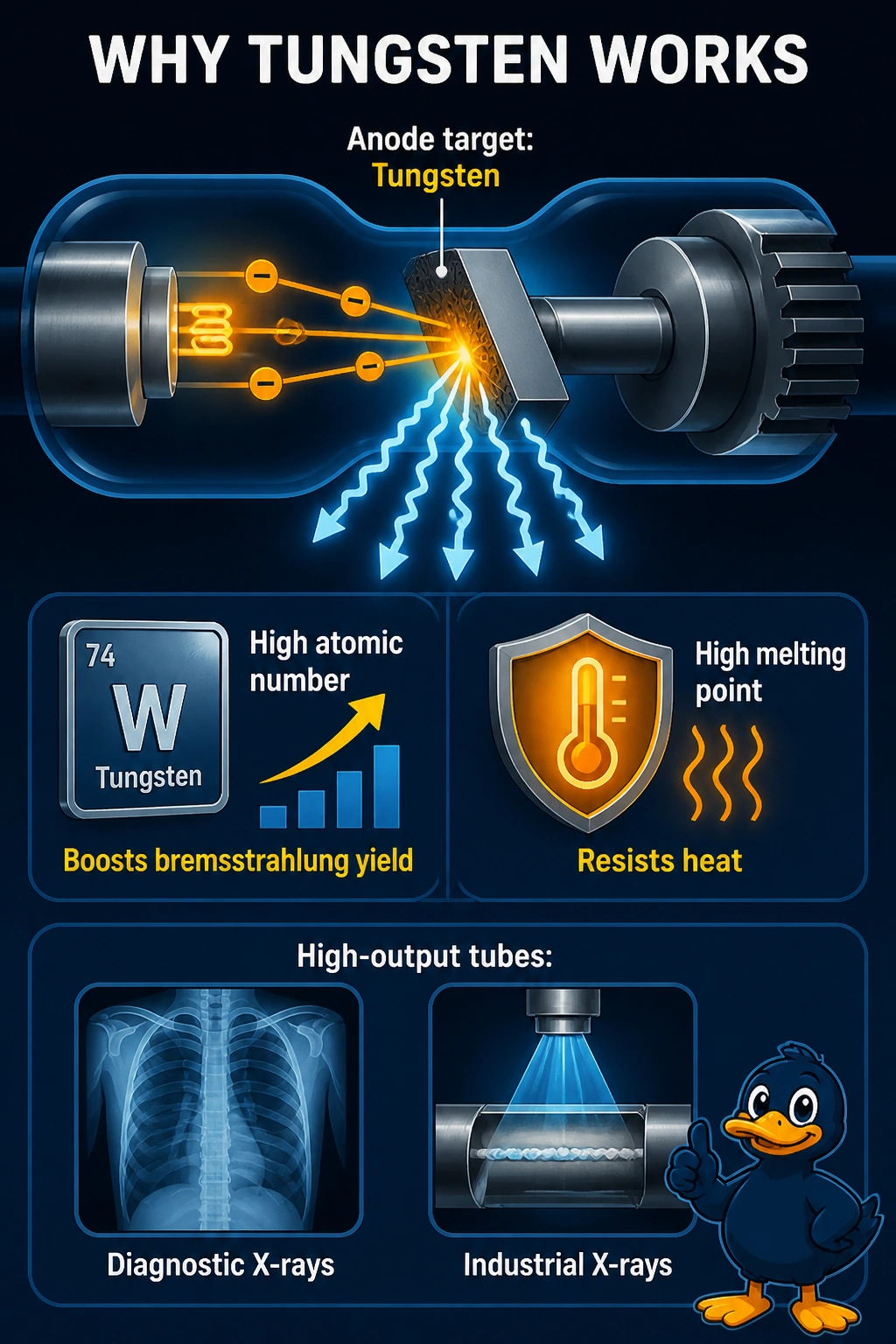
Its high atomic number boosts bremsstrahlung yield and its high melting point resists heat explains why tungsten (Z=74) is the standard X-ray anode target: bremsstrahlung production efficiency scales roughly with atomic number, and over 99% of electron kinetic energy converts to heat that would melt lower-melting-point metals. Its low atomic number minimizes bremsstrahlung production and reduces anode heat is backwards, because X-ray tubes rely on high-Z nuclei to decelerate electrons efficiently and produce usable photon output. Its high neutron cross section allows continuous radioisotope activation inside the tube is wrong because conventional X-ray tubes accelerate electrons below photodisintegration thresholds and do not generate neutrons or activate the anode. Its low density lets accelerated electrons pass completely through the target without scattering describes a transmission window rather than a stopping target, and tungsten is actually a very dense metal. A caveat is that for specialized low-energy mammography applications, lower-Z targets such as molybdenum or rhodium are chosen to exploit specific characteristic X-ray energies. As an operational check before high-mA exposures, verify anode heat-unit limits and cooling intervals against the tube rating chart.
Prefer to study offline? Printable PDF study book + test engine ($7.50, unofficial). These questions stay free here.