
During a routine six-month leak test of a sealed Cesium-137 radiography source, the wipe sample analysis measures 0.012 microcuries (444 Bq) of removable activity. What action must the licensee take immediately?
Select an answer to reveal the explanation.
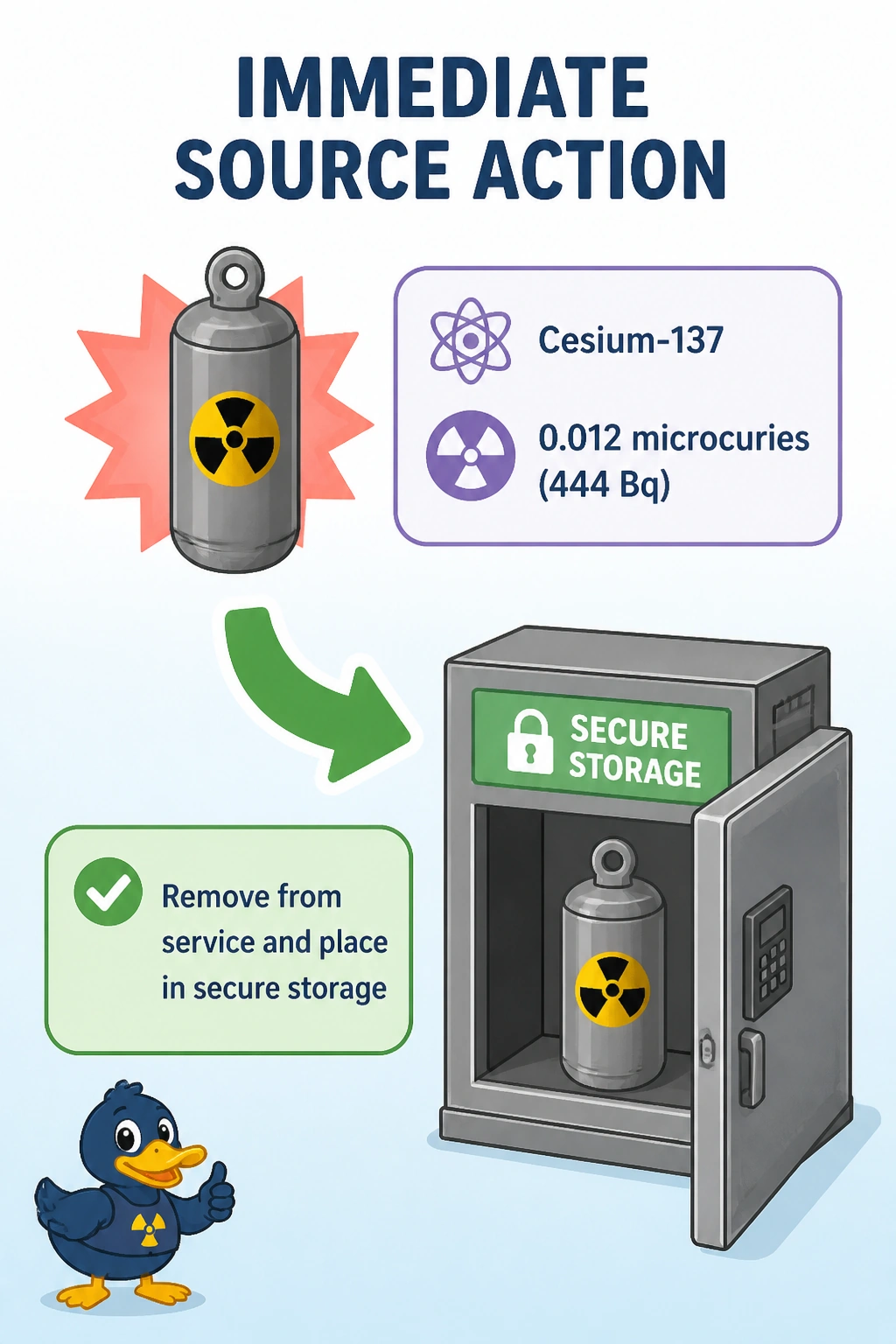
Short Explanation
When a wipe sample reaches 0.005 microcuries (185 Bq) or more, you need to act right away: remove the source from service and put it in secure storage. You can’t fix a confirmed leak by cleaning the capsule or testing more often; containment comes first.
Full Explanation
Under NRC regulations such as 10 CFR 34.27 and 10 CFR 35.67, a sealed-source leak test result of 0.005 microcuries (185 Bq) or more of removable contamination indicates a compromised capsule. You must immediately remove the source from service and place it in secure storage to prevent further spread of radioactive material, then arrange for decontamination, repair, or disposal. Wiping the capsule with mild detergent and retesting after twenty-four hours could spread contamination to tools, personnel, and workspaces, and does not address the confirmed failure. Doubling routine leak testing from six months to three months leaves a defective source in active operation and does not meet the mandatory withdrawal requirement. Applying clear lacquer over the capsule weld is an unauthorized field modification; it does not restore capsule integrity and may trap or flake contamination. A caveat: leak tests are normally performed on the accessible housing or nearest surface rather than directly on a high-activity bare capsule, to keep dose ALARA. As a practical check, verify the wipe sample’s net count rate against the detector’s calibrated efficiency and minimum detectable activity before releasing any source back to work.
Prefer to study offline? Printable PDF study book + test engine ($7.50, unofficial). These questions stay free here.