
Under NRC 10 CFR 20.1301, what is the maximum allowable radiation dose from external sources in any unrestricted area at a licensed facility?
Select an answer to reveal the explanation.
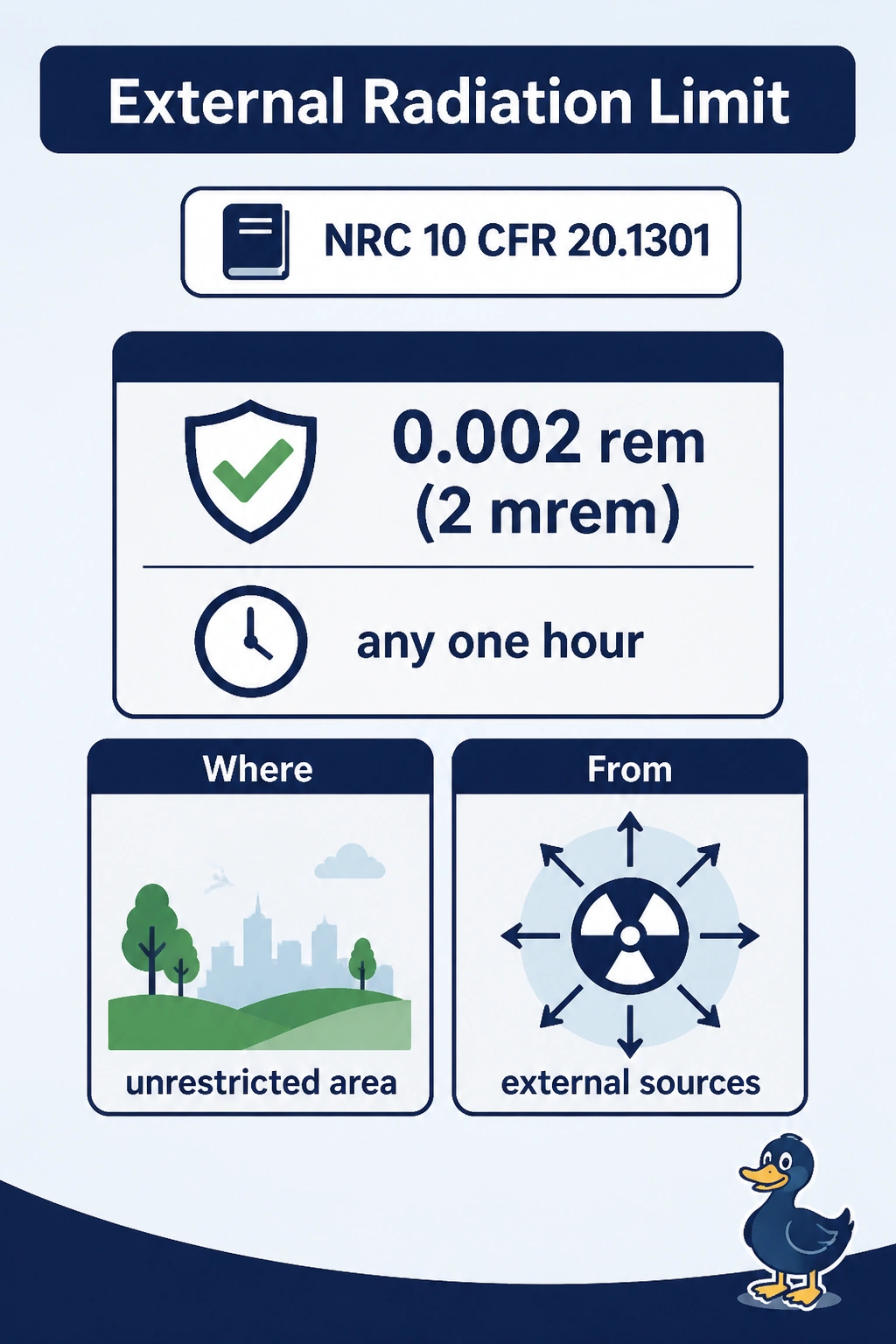
Short Explanation
You can think of an unrestricted area as a place where the general public may walk freely without dosimeters or radiation training, so the NRC sets a tight hourly ceiling. Remember that you are guarding against a brief public spike: the 2 mrem hourly limit is not the 100 mrem annual public limit.
Full Explanation
Under NRC 10 CFR 20.1301, licensees must ensure that the dose in any unrestricted area from external sources does not exceed 0.002 rem (2 mrem) in any one hour. This ceiling helps prevent transient high-dose-rate beams or unshielded source movements from delivering significant acute exposure to members of the public outside the controlled boundary. The proposed 0.005 rem (5 mrem) in an 8-hour shift confuses the unrestricted-area hourly limit with the 5 mrem/hr threshold used to define a Radiation Area inside a controlled facility. The proposed 0.050 rem (50 mrem) in a calendar week is a weekly figure that does not appear in 10 CFR 20.1301. The proposed 0.100 rem (100 mrem) in a 24-hour day misapplies the 0.1 rem annual Total Effective Dose Equivalent limit for a member of the public as a daily external dose limit. As an exam caveat, compliance evaluation for an unrestricted area excludes dose contributions from patients administered radioactive material and released under 10 CFR 35.75. For a practical check, perform boundary surveys with an integrating or rate ion chamber during peak source-use configurations and verify that unrestricted areas remain below 2 mrem in any one hour.
Prefer to study offline? Printable PDF study book + test engine ($7.50, unofficial). These questions stay free here.