
Under NRC 10 CFR 20.1301, what is the annual Total Effective Dose Equivalent (TEDE) limit for individual members of the public from licensed operations?
Select an answer to reveal the explanation.
Short Explanation
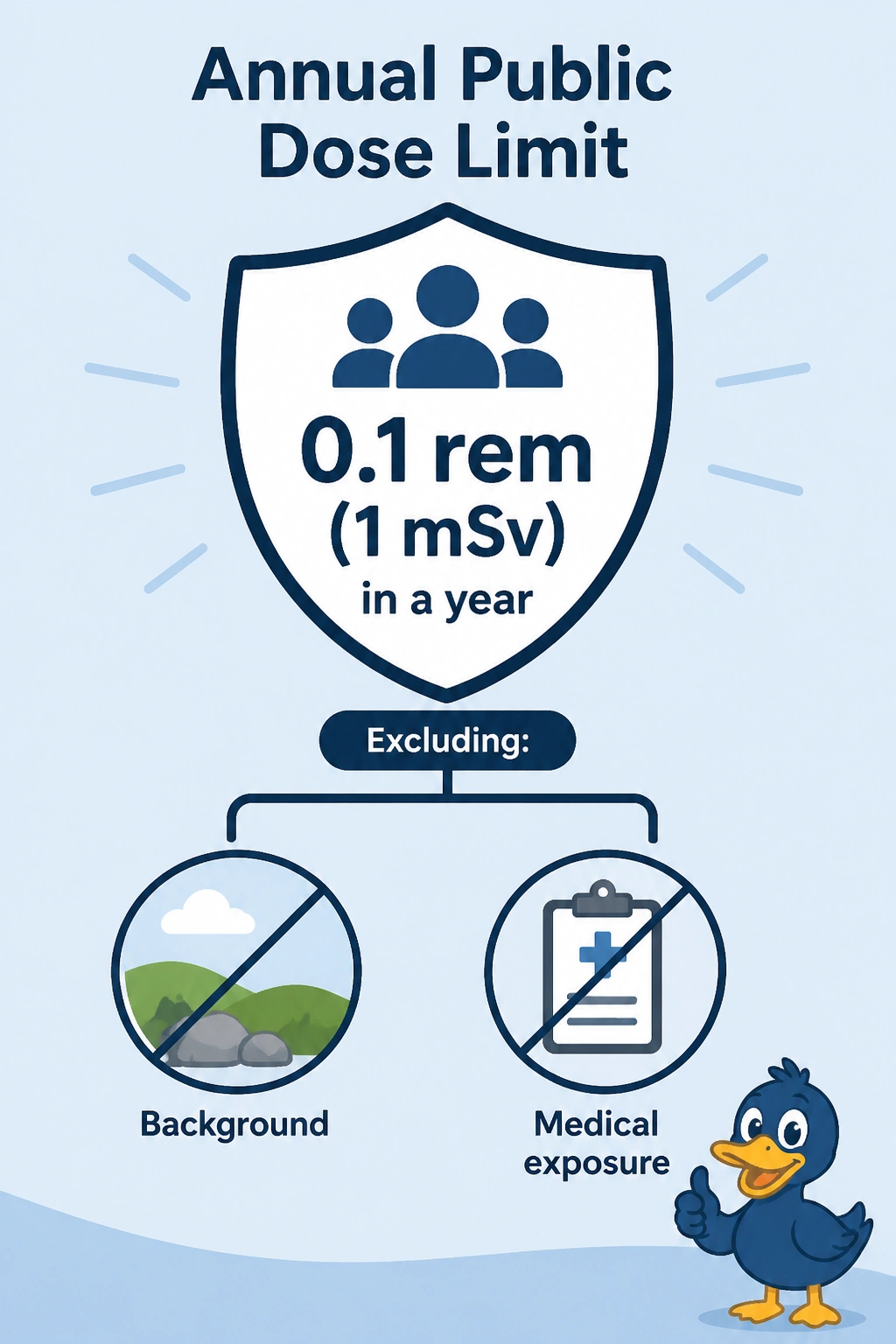
Members of the public do not sign up for occupational radiation risk, so regulators keep their annual cap fifty times tighter than an adult worker's limit. The trap is mixing up the public limit with the embryo/fetus limit or forgetting what gets excluded. Under 10 CFR 20.1301, your public cap is 0.1 rem per year.
Full Explanation
NRC 10 CFR 20.1301 requires each licensee to conduct operations so that the public dose stays within 0.1 rem (1 mSv) in a year, excluding background and medical exposure. This limit applies to the maximally exposed individual member of the public in unrestricted areas and excludes doses from natural background, medical procedures, or voluntary participation in medical research. 0.5 rem (5 mSv) in a year, including natural background confuses the public limit with the 0.5 rem gestation limit for a declared pregnant worker's embryo or fetus and wrongly includes background. 1.0 rem (10 mSv) in a year, excluding medical exposure overstates the standard 10 CFR 20.1301 annual limit by a factor of ten. 5.0 rem (50 mSv) in a year, including medical exposure cites the adult occupational TEDE limit under 10 CFR 20.1201 rather than the public limit and improperly adds medical dose. As a caveat, 10 CFR 20.1301 also limits dose in any unrestricted area from external sources to 0.002 rem (2 mrem) in any one hour, and allows an infrequent 0.5 rem annual exception only with prior NRC approval. For an operational check, review perimeter TLD records and unrestricted-area survey logs quarterly to confirm compliance well below 100 mrem per year.
Prefer to study offline? Printable PDF study book + test engine ($7.50, unofficial). These questions stay free here.