
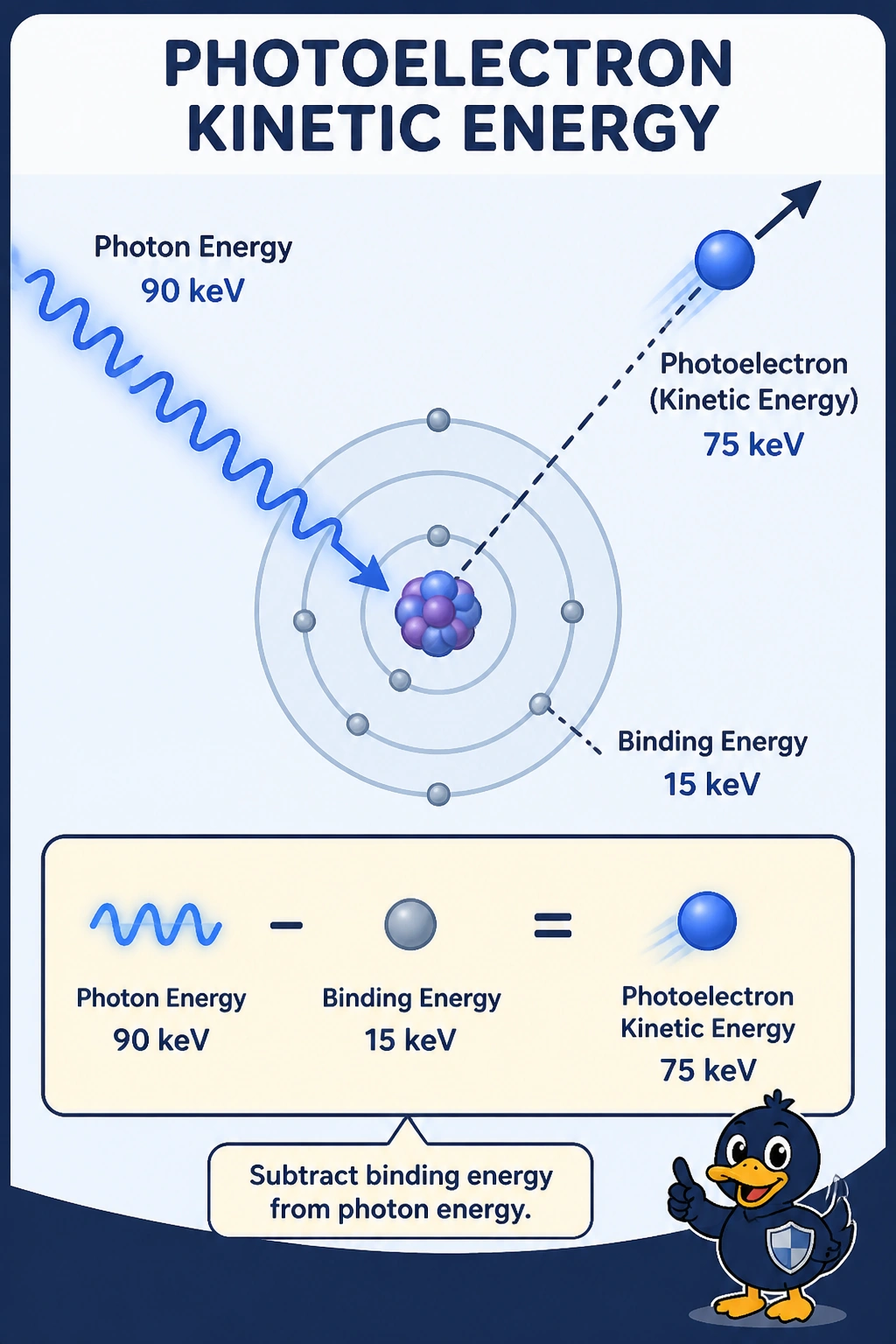
A 90 keV X-ray photon undergoes photoelectric absorption with an inner K-shell electron that has a binding energy of 15 keV. Neglecting the tiny recoil energy of the atom, what is the kinetic energy of the ejected photoelectron?
Select an answer to reveal the explanation.
Short Explanation
Imagine buying a 90-dollar ticket with a 15-dollar fee taken off the top—what is left in your pocket is 75 dollars. In photoelectric absorption, the photon spends the binding energy just to free the electron, so the trap is forgetting to subtract that fee or adding it by mistake.
Full Explanation
During the photoelectric effect, the incident photon disappears completely and transfers all of its energy to a bound orbital electron, so subtracting the 15 keV binding energy from 90 keV leaves 75 keV, subtracting binding from photon energy. Selecting 15 keV, matching the K-shell binding energy gives the energy required to liberate the electron from the atom—and the maximum energy of the subsequent characteristic X-ray—rather than the photoelectron's kinetic energy. Choosing 105 keV, adding the photon and binding energies violates conservation of energy because binding energy must be overcome, not added to the photon energy. Picking 90 keV, matching the full incident photon energy ignores the energy needed to break the electron free from the nucleus. As a caveat, photoelectric absorption can only occur when the incident photon energy equals or exceeds the shell binding energy, which explains why absorption jumps sharply at a material's K-edge. When reviewing photon shielding or detector spectra, check the target element's K-shell binding energy to verify whether photoelectric escape peaks or characteristic X-rays will appear below the photopeak.
Prefer to study offline? Printable PDF study book + test engine ($7.50, unofficial). These questions stay free here.