
During a wide-field industrial X-ray exposure, a radiographer measures noticeably lower photon intensity toward the anode end of the beam than toward the cathode end. What physical phenomenon in the X-ray tube causes this intensity gradient?
Select an answer to reveal the explanation.
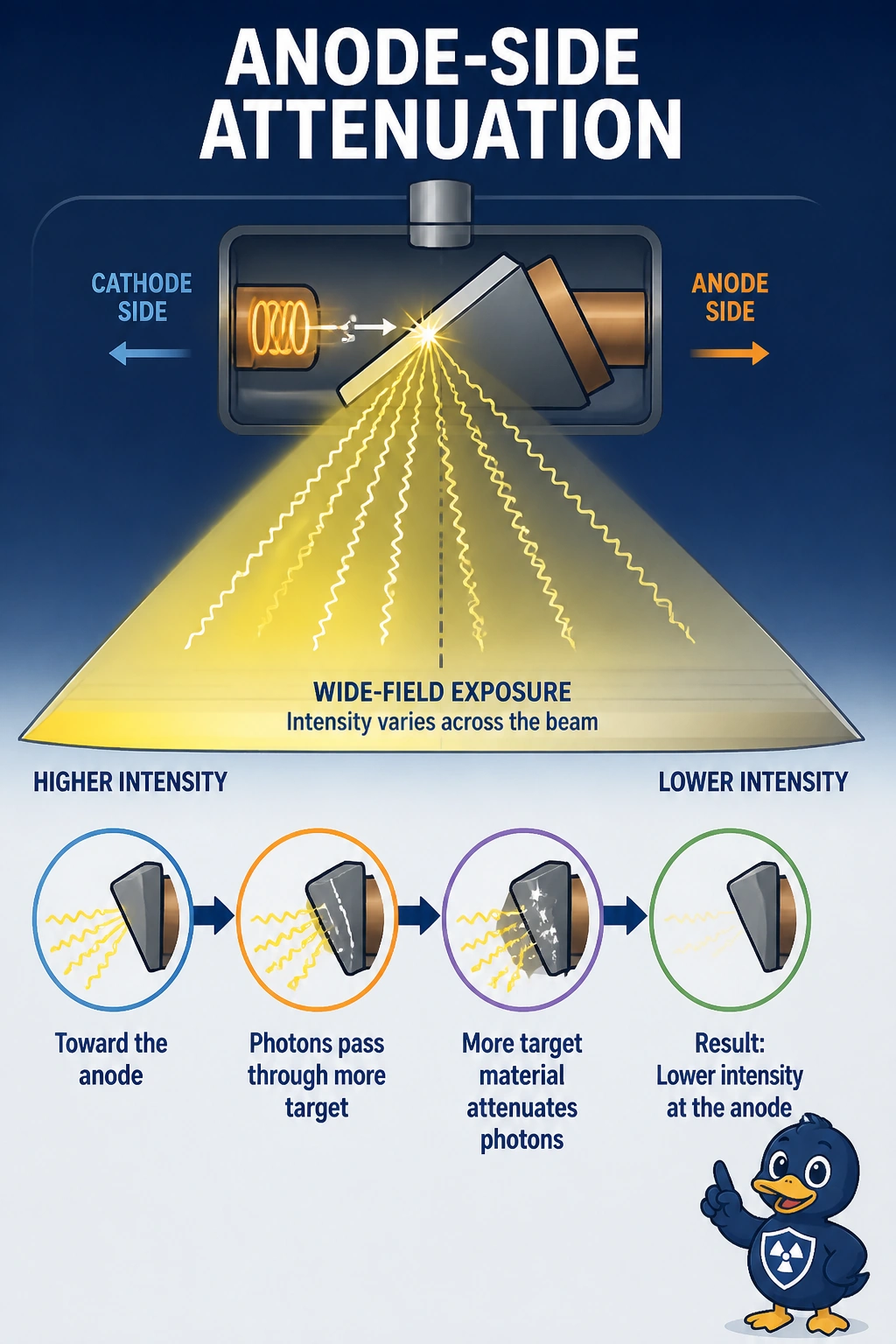
Short Explanation
Think of the angled X-ray target like a sloped roof: when you measure toward the anode side, photons have to fight through more tungsten before escaping. That extra path causes self-attenuation, known as the heel effect; your trap is blaming electron deflection or external filters.
Full Explanation
Because the tungsten anode target is angled relative to the electron beam, X-rays produced slightly beneath the target surface travel different path lengths through the tungsten depending on their emission angle. Photons emitted toward the anode side traverse more target material and self-attenuate, producing the anode heel effect where beam intensity is lower on the anode side and higher on the cathode side. The option Thermionic electrons strike only the outer edge of the cathode filament is incorrect because electrons are boiled off the cathode filament and accelerated toward the anode focal spot, not the reverse. Choosing Space-charge repulsion deflects bremsstrahlung photons toward the cathode fails because photons are electrically neutral and are unaffected by electric space-charge fields. Selecting Aluminum exit-port filtration preferentially absorbs photons emitted toward the cathode is wrong because a uniform flat exit filter attenuates symmetrically rather than creating an anode-to-cathode gradient. As a caveat, the heel effect becomes more pronounced with steeper target angles and larger field sizes at short source-to-detector distances. Operationally, orient thicker sections of an inspected part toward the cathode side and verify beam uniformity with dosimetric film or ion chamber profiling.
Prefer to study offline? Printable PDF study book + test engine ($7.50, unofficial). These questions stay free here.