
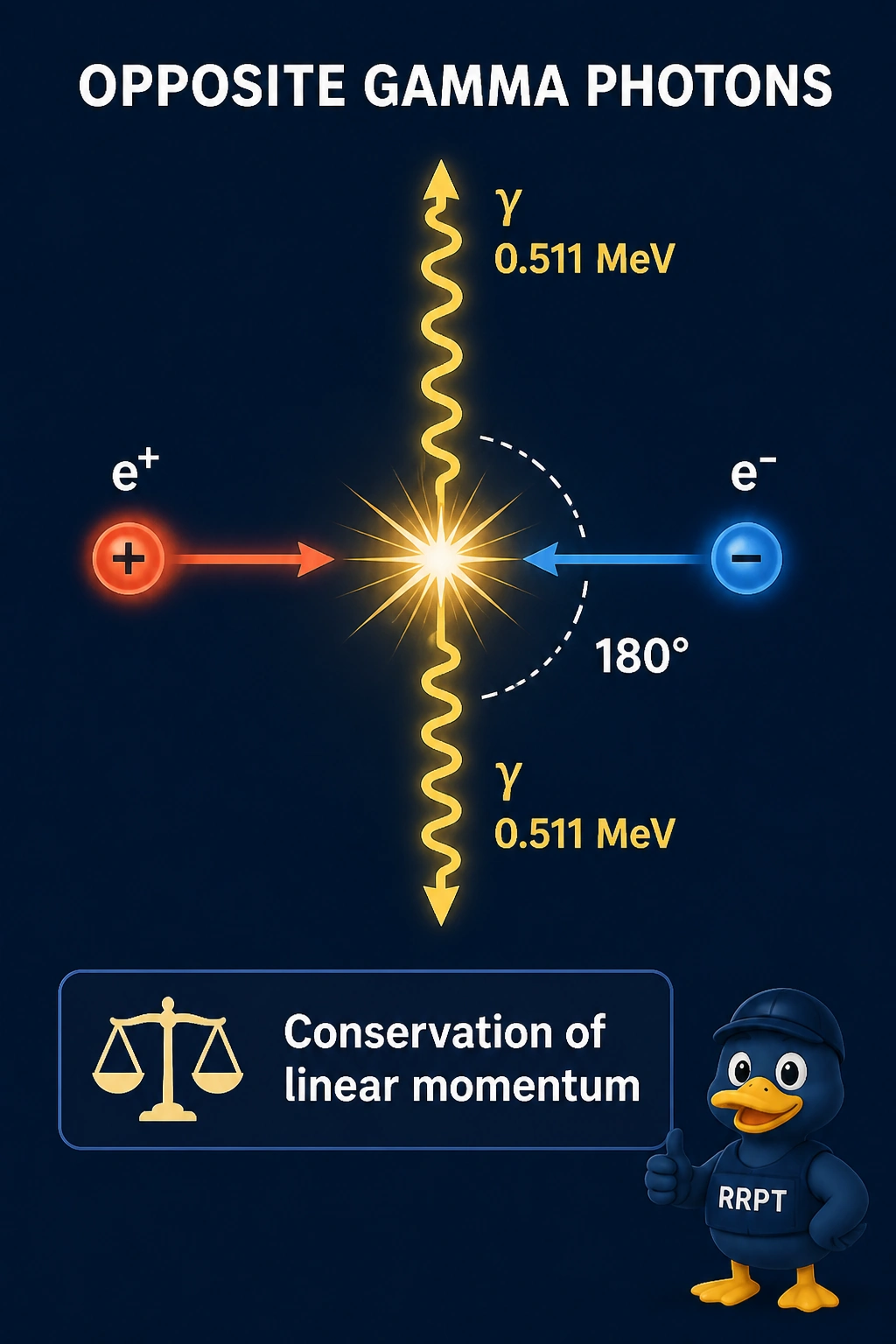
When a thermalized positron annihilates with an atomic electron, two 0.511 MeV gamma photons are emitted in nearly opposite directions (180 degrees apart). Which fundamental physics principle requires the photons to travel in opposite directions?
Select an answer to reveal the explanation.
Short Explanation
When a stationary positron and electron vanish into pure light, the total momentum before and after must stay zero—just like two identical billiard balls flying apart from a dead stop. The trap is confusing charge balance with the directional recoil that keeps your momentum ledger even.
Full Explanation
Conservation of linear momentum requires the two 0.511 MeV annihilation photons to travel in opposite directions because the thermalized positron-electron pair has nearly zero net linear momentum prior to annihilation, so the two resulting photons must carry equal and opposite momenta to keep the system's total momentum near zero. Conservation of electric charge explains why the +1 positron and -1 electron can annihilate into neutral photons (net charge zero before and after), but it imposes no directional requirement on the emitted gamma rays. Pauli exclusion principle for leptons governs quantum state occupancy for fermions such as electrons and does not dictate the angular distribution of emitted annihilation photons. Heisenberg uncertainty principle relates conjugate pairs such as position and momentum or energy and time, rather than enforcing back-to-back photon emission. An important caveat is that if the electron still possesses significant orbital momentum at the instant of annihilation, the two photons will deviate slightly from an exact 180-degree angle. As an operational check in PET or coincidence gamma spectroscopy, verify that opposing detector pairs are aligned at 180 degrees and gated within a narrow coincidence timing window.
Prefer to study offline? Printable PDF study book + test engine ($7.50, unofficial). These questions stay free here.