
When 100 keV electrons strike a tungsten target in an industrial X-ray tube, both bremsstrahlung and characteristic X-rays are produced. How do their energy spectra differ?
Select an answer to reveal the explanation.
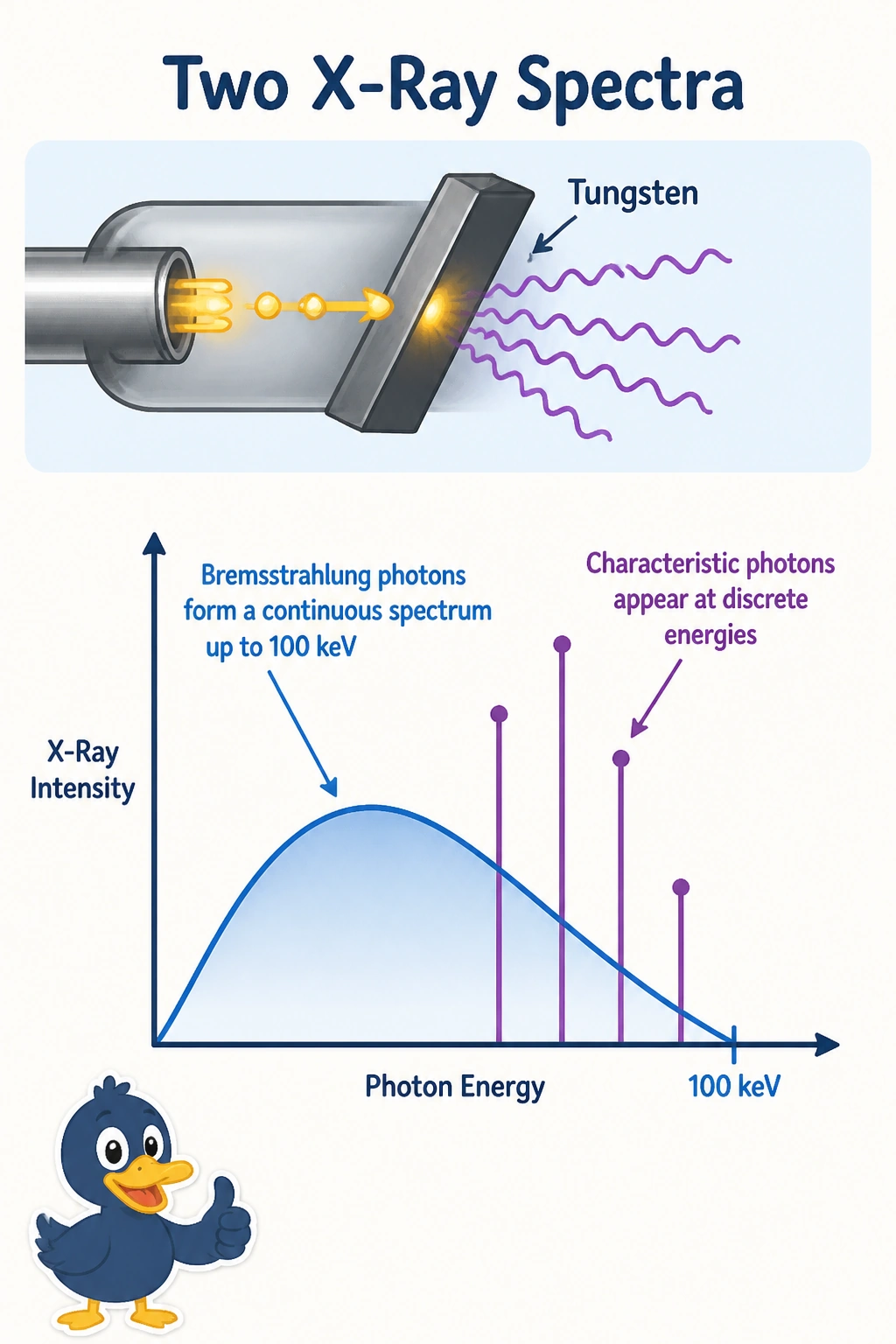
Short Explanation
Bremsstrahlung is like slamming on the brakes at random speeds—electrons swerve past tungsten nuclei and lose varying amounts of energy, creating a smooth rainbow of photon energies up to 100 keV. Characteristic X-rays are like notes on a tuned piano, appearing only at exact energy differences between electron shells. The trap you want to avoid is flipping those two mechanisms or assuming every 100 keV electron produces a 100 keV photon.
Full Explanation
An X-ray tube produces two distinct photon components when accelerated electrons strike the target. Choosing "Bremsstrahlung photons form a continuous spectrum up to 100 keV while characteristic photons appear at discrete energies" correctly reflects that radiative braking near target nuclei can transfer any fraction of an electron's kinetic energy up to the peak 100 keV limit, whereas inner-shell electron transitions emit photons at fixed, target-specific binding-energy differences. Selecting "Bremsstrahlung photons appear only at discrete electron shell binding energies while characteristic photons form a continuous curve" reverses the two physical mechanisms. Picking "Both bremsstrahlung and characteristic X-rays are emitted exclusively at a single monoenergetic peak of 100 keV" ignores both the continuous distribution of braking interactions and the lower discrete K- and L-shell energies of tungsten. Choosing "Bremsstrahlung photons are emitted at 511 keV while characteristic photons span a continuous spectrum up to 100 keV" confuses positron annihilation radiation with X-ray tube braking radiation. As a caveat, K-shell characteristic peaks of tungsten (around 59 to 69 keV) only appear when the tube potential exceeds the K-shell binding energy of roughly 69.5 keV. As an operational check, review the tube kVp setting and added filtration whenever beam quality or half-value layer measurements shift unexpectedly.
Prefer to study offline? Printable PDF study book + test engine ($7.50, unofficial). These questions stay free here.