
Why is the conventional radiation unit roentgen (R) defined solely for X-rays and gamma rays and not used to express neutron or alpha-particle exposure?
Select an answer to reveal the explanation.
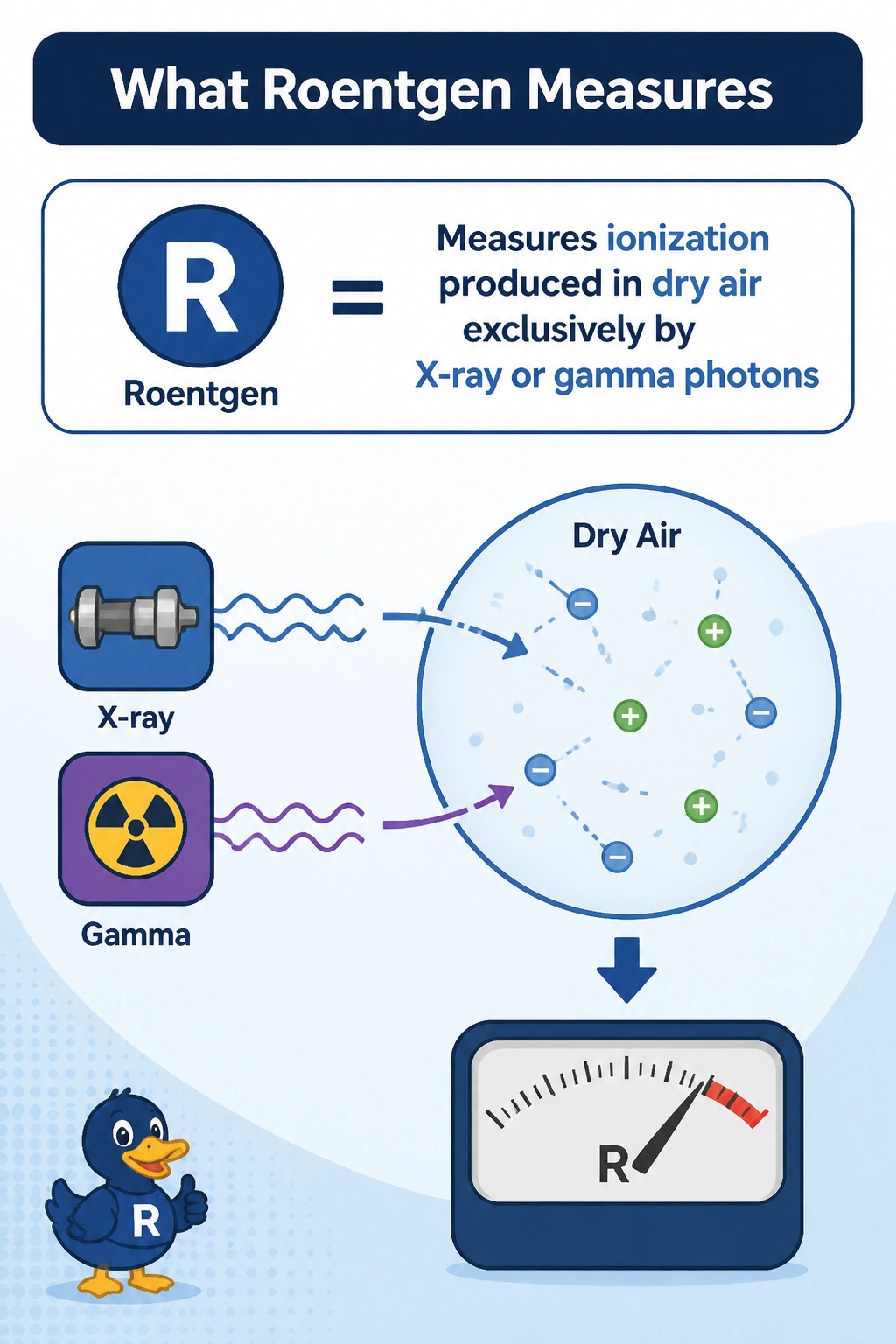
Short Explanation
Think of the roentgen as a strict air-only meter for X-rays and gamma rays—it only tracks the electrical charge photons knock loose in dry air. When you see a question about exposure in roentgens, the trap is confusing that air ionization with energy deposited in soft tissue, nuclear disintegration counts, or heavy charged-particle tracks.
Full Explanation
The conventional unit roentgen (R) is restricted to X-rays and gamma rays because It measures ionization produced in dry air exclusively by X-ray or gamma photons. Specifically, 1 roentgen corresponds to the quantity of X- or gamma radiation that liberates 2.58 x 10^-4 coulombs of charge of either sign per kilogram of dry air under conditions of electronic equilibrium. Choosing It quantifies energy deposited in human soft tissue across all ionizing radiation types describes absorbed dose rather than exposure, since exposure is defined strictly in dry air for photons. Selecting It requires counting individual nuclear disintegrations inside a pressurized gas chamber confuses photon exposure with source activity, which tracks nuclear decay rate rather than air ionization. Claiming It applies only to high-LET heavy charged particles stopping within thin tissue layers is incorrect because heavy charged particles such as alpha particles and neutrons are excluded from the definition of exposure. As an exam caveat, exposure in roentgens is also practically limited to photon energies below roughly 3 MeV because maintaining electronic equilibrium in air becomes impractical at higher energies. As an operational check, verify that portable survey meters reading in mR/hr are used only for photon fields and not to quantify neutron or alpha dose rates.
Prefer to study offline? Printable PDF study book + test engine ($7.50, unofficial). These questions stay free here.