
An industrial X-ray unit is operated at a peak tube potential of 120 kVp and a tube current of 10 mA. What parameter determines the maximum photon energy of the bremsstrahlung X-rays emitted from the target?
Select an answer to reveal the explanation.
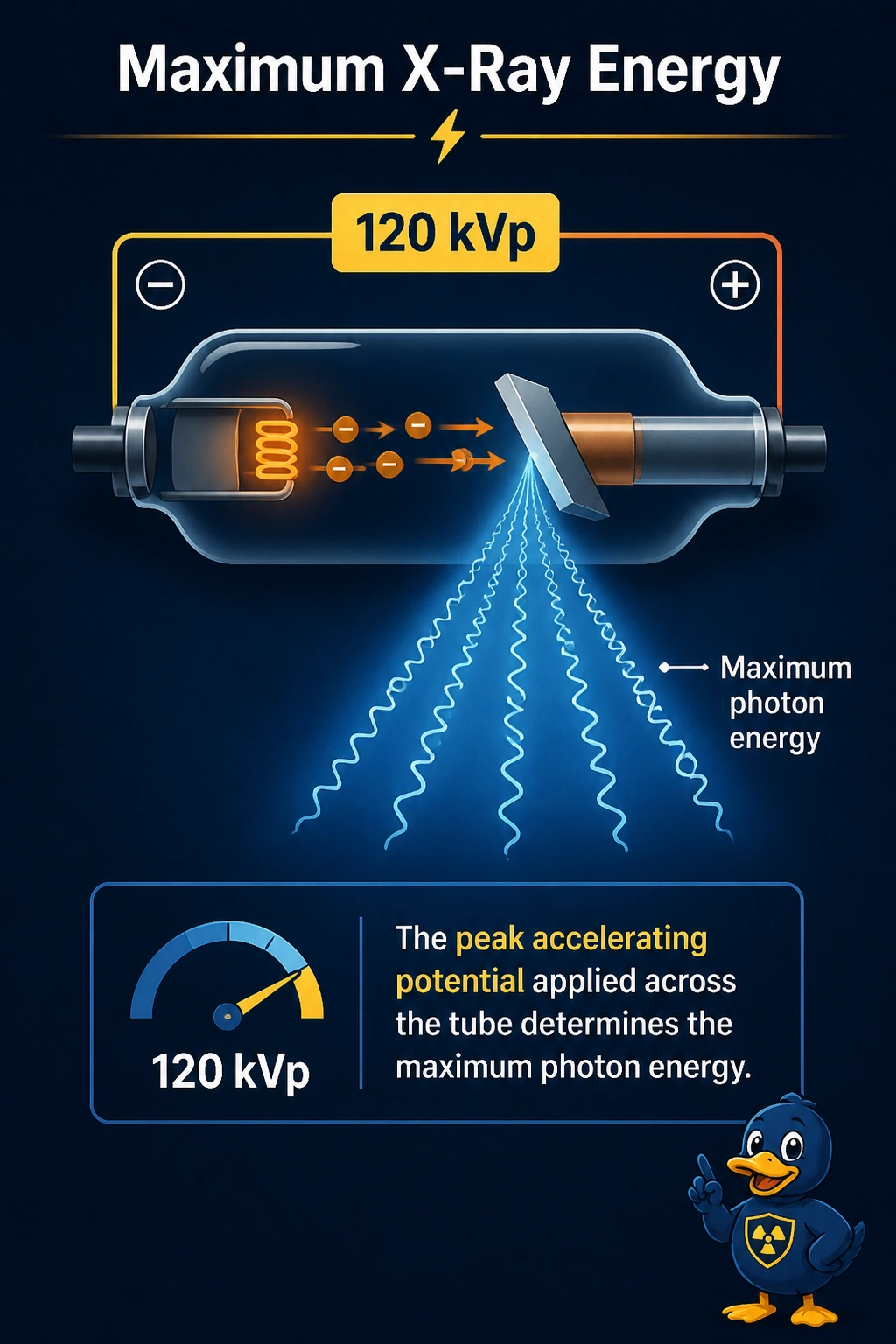
Short Explanation
Inside an X-ray tube, electrons cannot give a single bremsstrahlung photon more energy than they carry themselves, which is set by the peak voltage across the tube. When you tune the controls, the trap is confusing beam quantity with beam quality by thinking higher tube current creates higher-energy X-rays.
Full Explanation
Electrons accelerated across an X-ray tube gain a maximum kinetic energy in keV numerically equal to The peak accelerating potential applied across the tube in kVp. When an electron undergoes a complete radiative stop in the target's Coulomb field, all of that kinetic energy converts into a single photon, fixing the maximum endpoint energy at 120 keV. The atomic number of the tungsten target material increases bremsstrahlung production efficiency and sets characteristic X-ray line energies, but it does not raise the maximum continuous endpoint energy. The filament heating current and resulting tube milliamperage controls the number of electrons striking the target per second, which scales photon intensity (quantity) without increasing individual photon energy. The thickness of the added aluminum filtration preferentially removes low-energy photons to harden the beam's average energy, leaving the maximum endpoint unchanged. As a shielding caveat, remember that while kVp sets the maximum energy needed for barrier calculations, mA and workload govern total exposure rate. Before conducting radiation surveys around an X-ray cabinet, verify the kVp setting and interlock status on the control console.
Prefer to study offline? Printable PDF study book + test engine ($7.50, unofficial). These questions stay free here.