
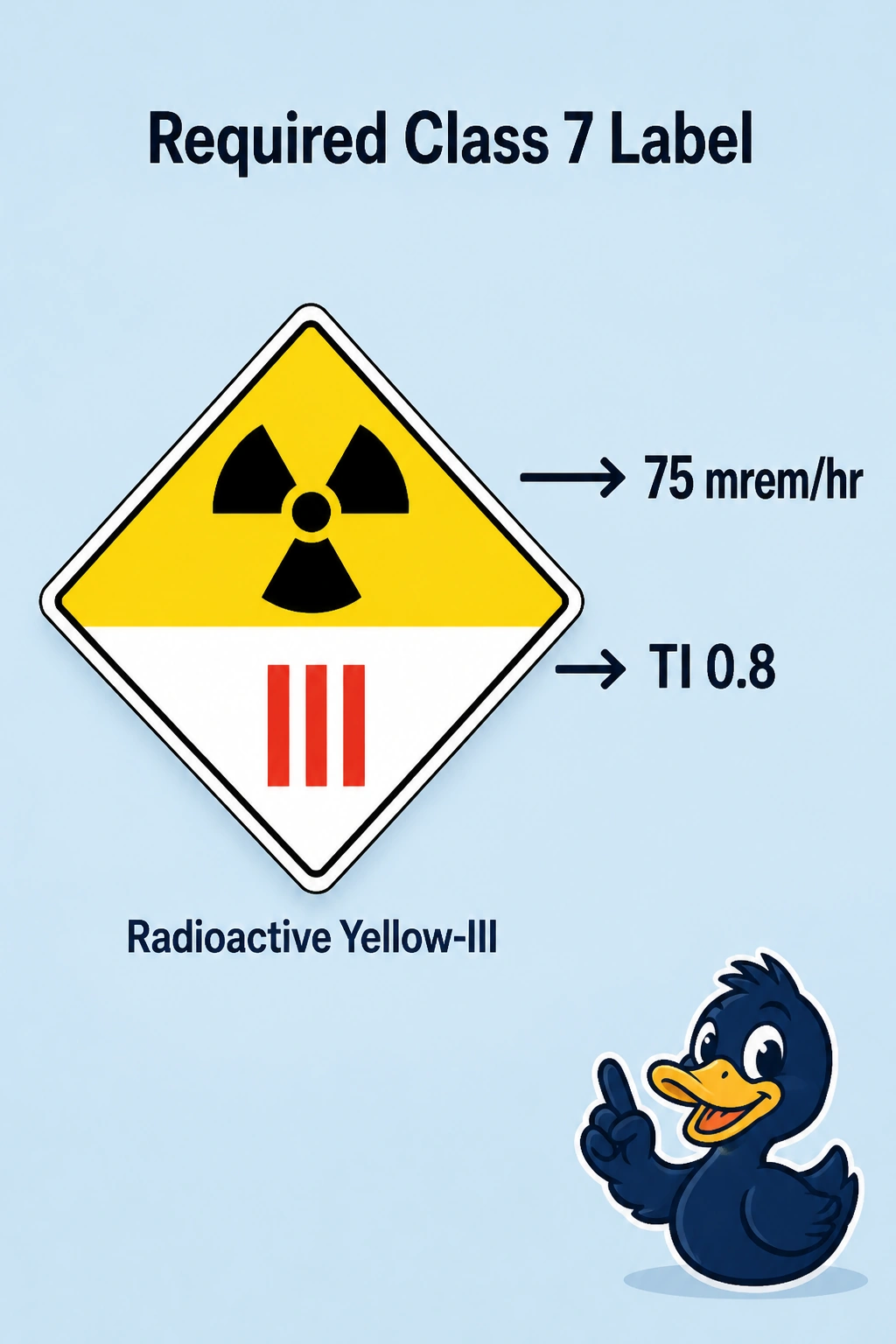
A shipper surveys a non-exclusive-use Type A package and measures a maximum external surface dose rate of 75 mrem/hr and a Transport Index of 0.8. Under DOT 49 CFR 172.403, which Class 7 radioactive label must be applied to the package?
Select an answer to reveal the explanation.
Short Explanation
Always let the stricter measurement win when you pick a DOT radioactive label—a low Transport Index will not save a package with a hot surface. The trap is looking only at the 0.8 Transport Index and stopping at Yellow-II while ignoring the 75 mrem/hr contact reading.
Full Explanation
Under DOT 49 CFR 172.403, package labeling is governed by whichever criterion—external surface radiation level or Transport Index (TI)—places the package in the higher category. A Radioactive Yellow-II label is limited to packages with a surface dose rate above 0.5 mrem/hr up to 50 mrem/hr and a TI not exceeding 1.0. Because this package reads 75 mrem/hr on contact, it exceeds the 50 mrem/hr ceiling for Radioactive Yellow-II and requires Radioactive Yellow-III even though its TI of 0.8 is below 1.0. Radioactive White-I applies only when the surface radiation level does not exceed 0.5 mrem/hr and the TI is zero. Empty Radioactive Packaging is reserved for cleaned, empty Class 7 packagings meeting excepted-package limits rather than loaded Type A shipments reading 75 mrem/hr. As a caveat, for non-exclusive-use shipments, a Radioactive Yellow-III package still cannot exceed 200 mrem/hr on the external surface or a TI of 10 under 49 CFR 173.441. For an operational check, survey all six faces of the package at contact and at 1 meter, record the highest readings on the shipping papers, and apply two identical labels on opposite sides.
Prefer to study offline? Printable PDF study book + test engine ($7.50, unofficial). These questions stay free here.