
A technician surveys a non-fissile Type A package prepared for shipment and records a maximum contact dose rate of 35 mrem/hr on the exterior surface and a maximum dose rate of 2.5 mrem/hr at 1 meter from any external surface. What is the Transport Index (TI) for this package?
Select an answer to reveal the explanation.
Short Explanation
When you calculate a Transport Index, you are measuring how much radiation reaches a person standing a step away from the box, not touching it. The classic trap is grabbing the higher surface contact reading instead of the 1-meter measurement.
Full Explanation
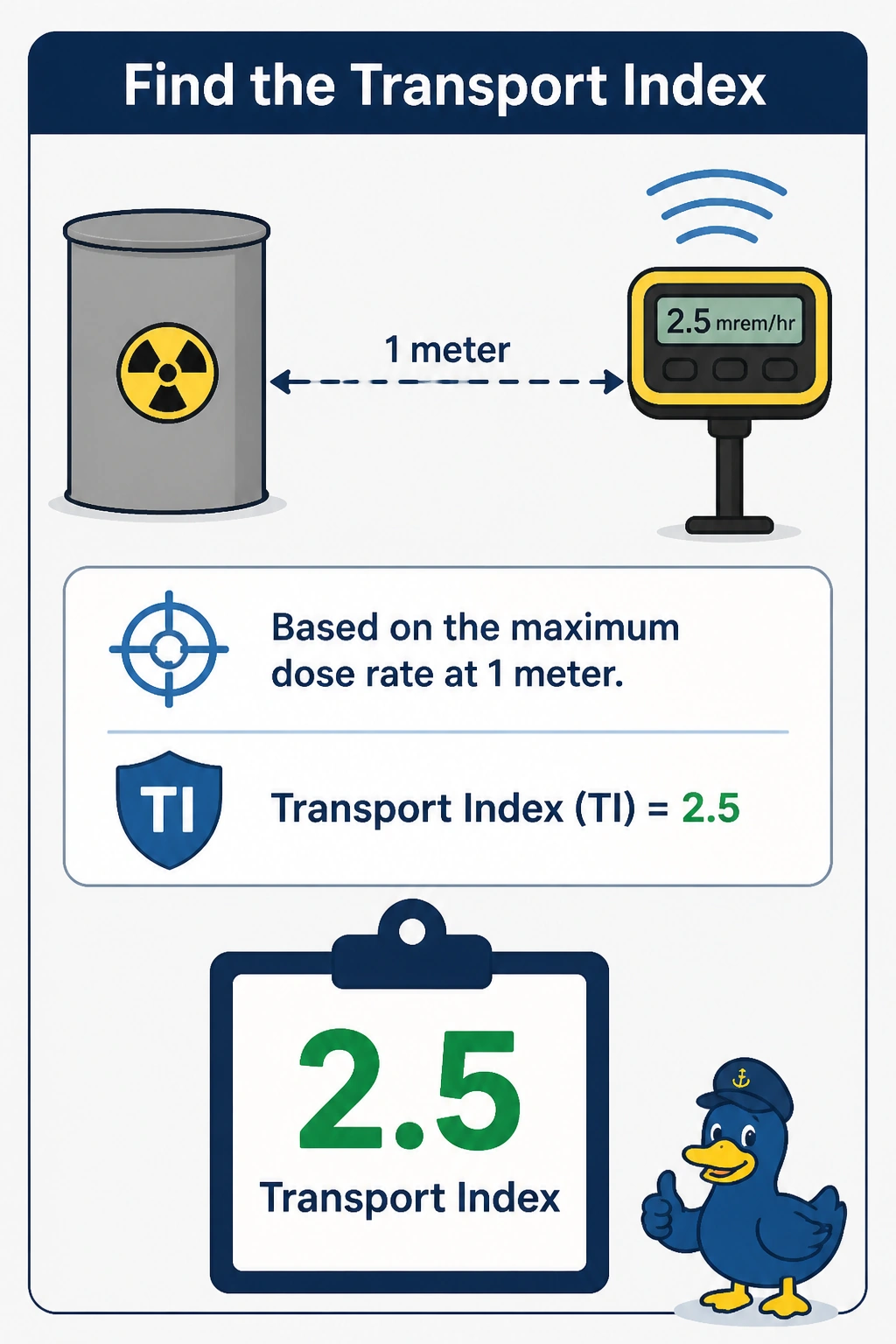
Under 49 CFR 173.403, the Transport Index (TI) for a non-fissile Class 7 radioactive material package is a dimensionless number equal to the maximum radiation level in millirem per hour at 1 meter from the external surfaces of the package, so the correct value is 2.5, based on the maximum dose rate at 1 meter. Carriers use the TI to limit total radiation exposure in transit and storage by capping the sum of TIs in a single vehicle or overpack. Selecting 35.0, based on the maximum surface contact dose rate confuses the surface dose-rate limit used for package category selection with the 1-meter TI measurement. Choosing 3.5, based on one-tenth of the maximum surface dose rate applies an invented scaling factor instead of taking an actual 1-meter survey. Recording 0.25, based on the 1-meter dose rate in millisieverts is wrong by a factor of ten because 2.5 mrem/hr equals 0.025 mSv/hr, and TI is defined as mSv/hr at 1 meter multiplied by 100 (which equals mrem/hr). As a caveat, when the 1-meter reading is not an exact tenth, DOT rules require rounding up to the next tenth, and any reading at or below 0.05 mrem/hr may be reported as zero. For an operational check, survey all six sides of the package at exactly 1 meter using a calibrated, energy-compensated dose-rate meter before completing the shipping papers.
Prefer to study offline? Printable PDF study book + test engine ($7.50, unofficial). These questions stay free here.