
Under DOT 49 CFR 172.403, what is the maximum allowable external surface radiation level for a Class 7 package to qualify for a Radioactive White-I label?
Select an answer to reveal the explanation.
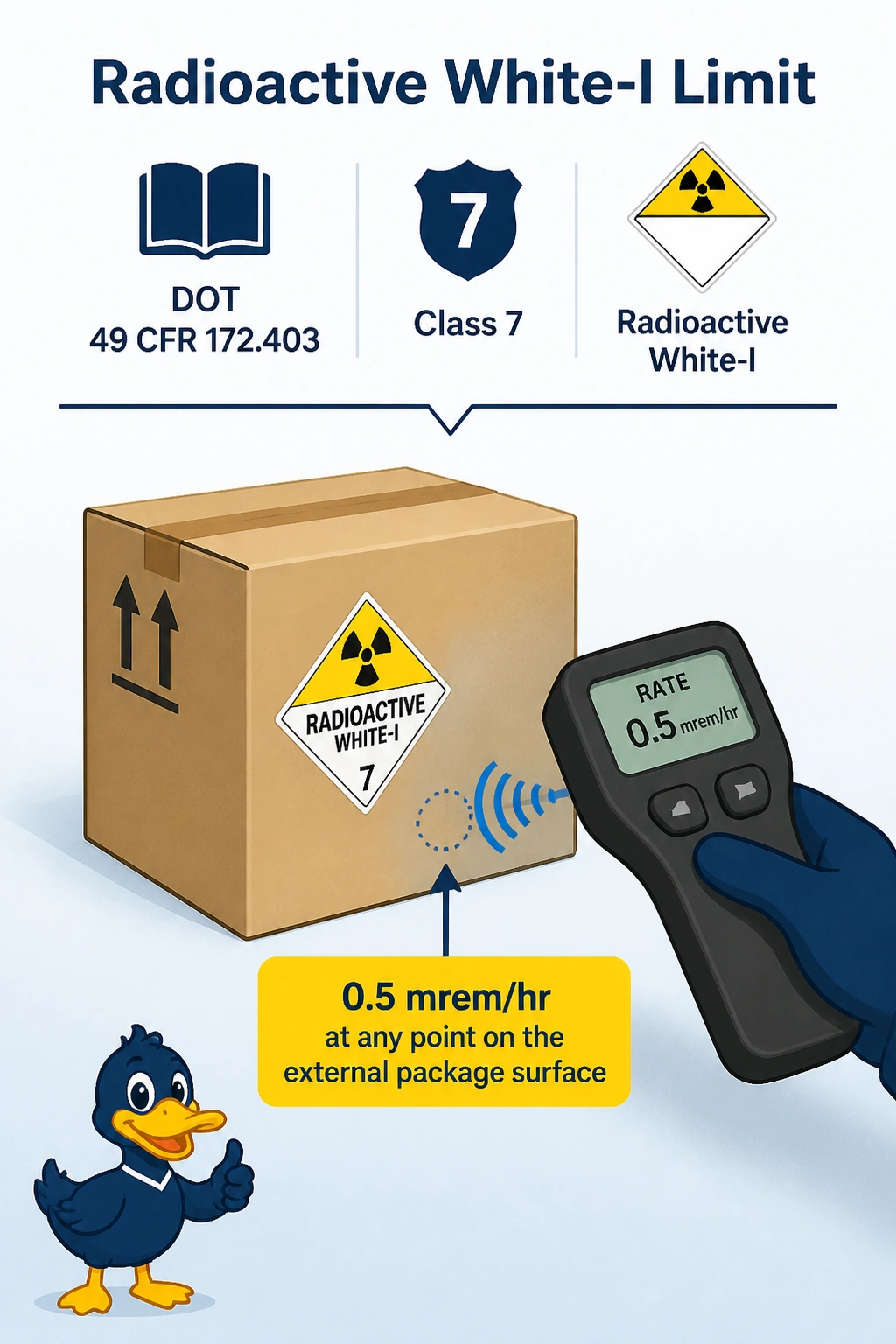
Short Explanation
Think of the lowest DOT Class 7 label as the quietest badge in your shipping lineup, reserved for packages that barely register above background when you survey the outside. The trap is mixing up its tiny 0.5 mrem/hr surface cap with the higher 50 mrem/hr Yellow-II or 200 mrem/hr Yellow-III limits.
Full Explanation
Under DOT 49 CFR 172.403, a Radioactive White-I label is authorized only when the external radiation level does not exceed 0.5 mrem/hr at any point on the external package surface and the Transport Index (TI) is zero. This low threshold ensures that packages bearing a White-I label require no special separation distances during routine transport. 50 mrem/hr at any point on the external shipping surface is the maximum surface radiation level for a Radioactive Yellow-II label, which also limits the TI to 1.0 or less. 200 mrem/hr at any point on the external shipping container is the maximum surface limit for a non-exclusive-use Radioactive Yellow-III package with a TI up to 10. 10 mrem/hr at any point on the external package surface is not a DOT surface-rate category boundary, though 10 is the maximum TI for non-exclusive-use Yellow-III shipments. As a caveat, if either the surface dose rate or the Transport Index exceeds the White-I criterion, the shipper must step up to the higher label category. As an operational check, survey all six faces of the package at contact and at 1 meter with a calibrated ion chamber before applying two opposite-side DOT labels.
Prefer to study offline? Printable PDF study book + test engine ($7.50, unofficial). These questions stay free here.