
When a worker inhales radioactive aerosols, how does the Activity Median Aerodynamic Diameter (AMAD) of the particles primarily influence internal deposition?
Select an answer to reveal the explanation.
Short Explanation
Think of a river carrying boulders and fine silt: the heavy rocks drop out near the shore while the fine silt travels all the way downstream. When you evaluate inhaled aerosols, the trap is assuming big particles reach the deepest part of the lung.
Full Explanation
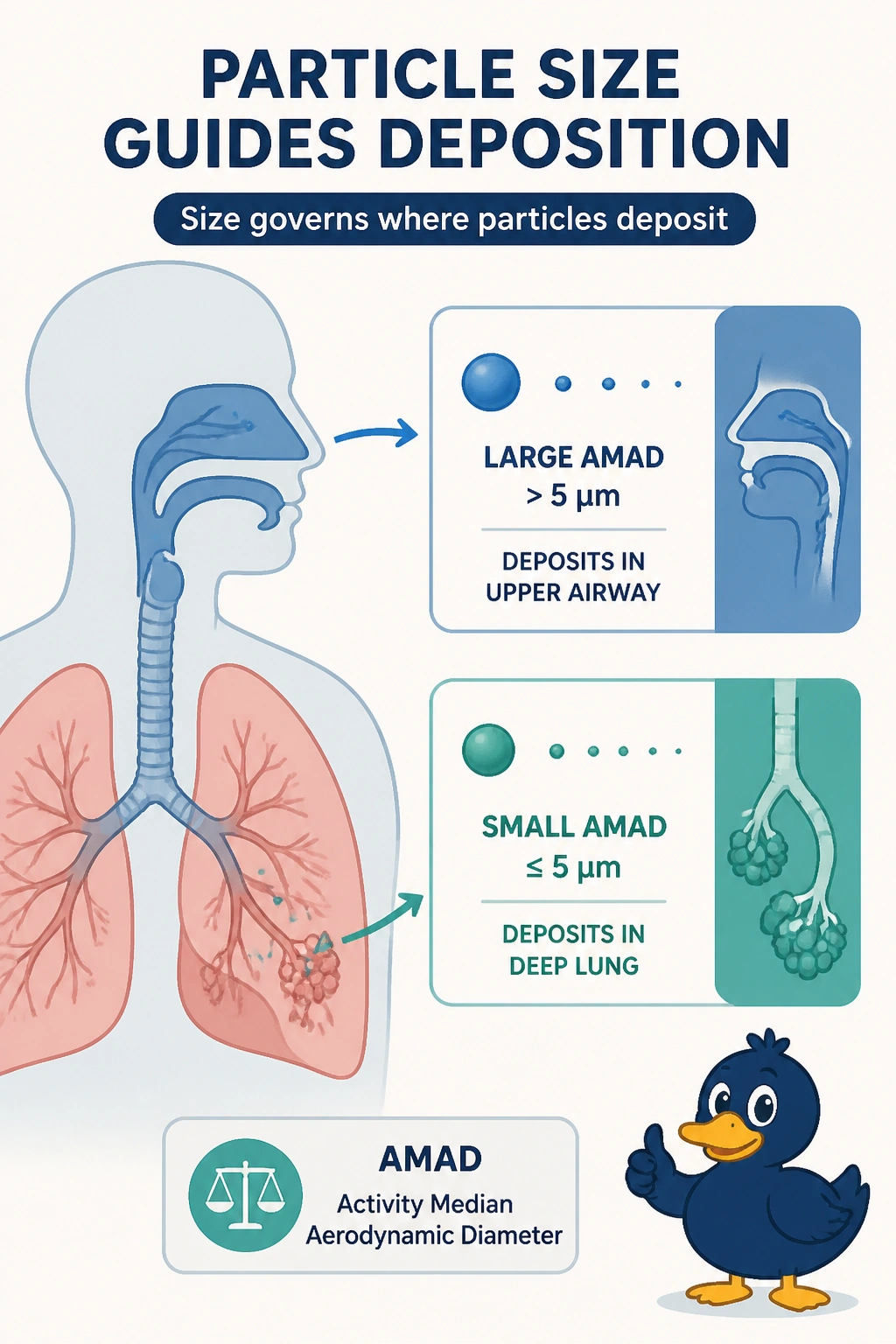
Aerodynamic particle size controls how airborne particulates behave in the branching airways of the human respiratory tract, so Size governs whether particles deposit in the upper airway or deep lung. Larger particles (several micrometers AMAD) have higher inertia and impact in the nasopharyngeal and tracheobronchial regions, where mucociliary clearance sweeps them upward to be swallowed or expelled. Smaller sub-micrometer particles follow air streamlines deeper into the alveolar region, where clearance is much slower. Larger particles bypass the upper airway and deposit exclusively in the alveoli is incorrect because inertial impaction traps larger aerosols in the nose and upper bronchi before they can reach the alveoli. Smaller particles immediately dissolve into bone tissue before reaching the lungs fails because particle size does not bypass lung deposition, and systemic uptake depends on chemical solubility after deposition. Particle size determines the physical half-life of the inhaled radionuclide is wrong because physical half-life is an immutable nuclear property independent of aerosol diameter. As a caveat, lung retention also depends strongly on chemical solubility class alongside AMAD. Review air-sample particle-size assumptions when modeling internal doses after an airborne release.
Prefer to study offline? Printable PDF study book + test engine ($7.50, unofficial). These questions stay free here.