
A worker without respiratory protection spends 5 hours in an airborne radioactivity area where the concentration of a radionuclide is 4 DAC, and the stochastic Annual Limit on Intake (ALI) governs. Using the 10 CFR 20 relationship of 2,000 DAC-hours per 5 rem CEDE, what Committed Effective Dose Equivalent (CEDE) does the worker receive?
Select an answer to reveal the explanation.
Short Explanation
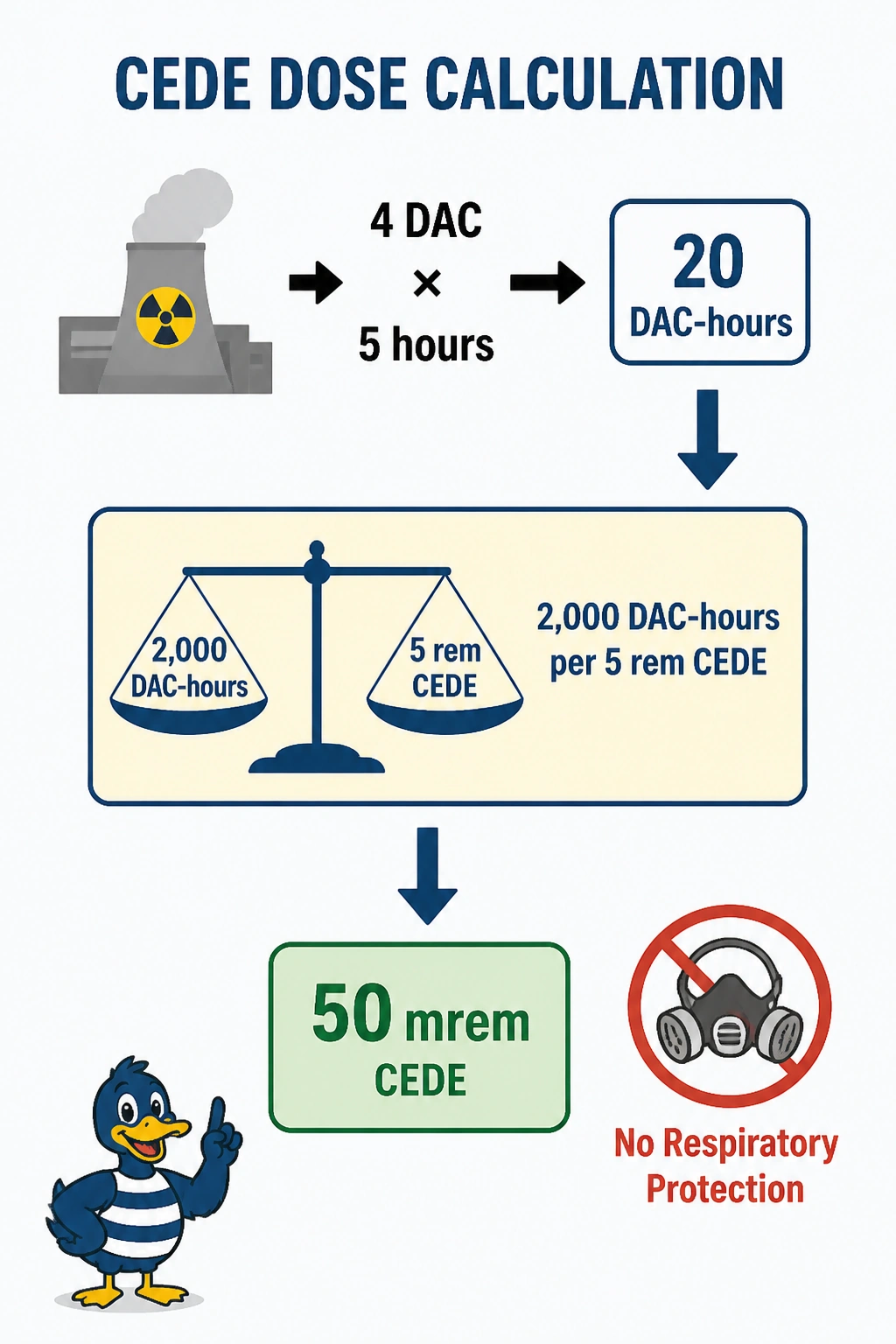
Think of a DAC-hour as a tiny slice of your annual internal dose budget—each one costs you 2.5 mrem of CEDE when the stochastic ALI governs. The trap is stopping after you multiply 4 DAC by 5 hours and calling 20 the dose in millirem. Multiplying those 20 DAC-hours by 2.5 mrem per DAC-hour gives you 50 mrem CEDE.
Full Explanation
Under 10 CFR 20, one Annual Limit on Intake (ALI) based on stochastic effects corresponds to a Committed Effective Dose Equivalent (CEDE) of 5 rem (5,000 mrem), and one Derived Air Concentration (DAC) is the airborne concentration that delivers 1 ALI over a 2,000-hour work year. Dividing 5,000 mrem by 2,000 DAC-hours yields 2.5 mrem CEDE per DAC-hour. Working 5 hours in a 4 DAC atmosphere produces 20 DAC-hours of exposure, which equals 50 mrem from 20 DAC-hours of intake. Choosing 20 mrem from multiplying concentration by hours stops at the DAC-hour product without converting DAC-hours into millirem. Selecting 100 mrem from 40 DAC-hours of intake doubles the actual exposure time or concentration, while 250 mrem from 100 DAC-hours of intake overstates the intake by a factor of five. As a regulatory caveat, this 2.5 mrem per DAC-hour conversion applies when the stochastic ALI governs; if a non-stochastic organ limit (50 rem CDE to a specific organ) governs the radionuclide's ALI, the CEDE per DAC-hour is smaller and organ dose must be tracked separately. Operationally, verify the radionuclide's breathing-zone air concentration and confirm whether an assigned protection factor from respiratory gear applies before posting final DAC-hour records.
Prefer to study offline? Printable PDF study book + test engine ($7.50, unofficial). These questions stay free here.