
Under 10 CFR 20.1003, what does one Derived Air Concentration (DAC) represent for an airborne radionuclide in an occupational setting?
Select an answer to reveal the explanation.
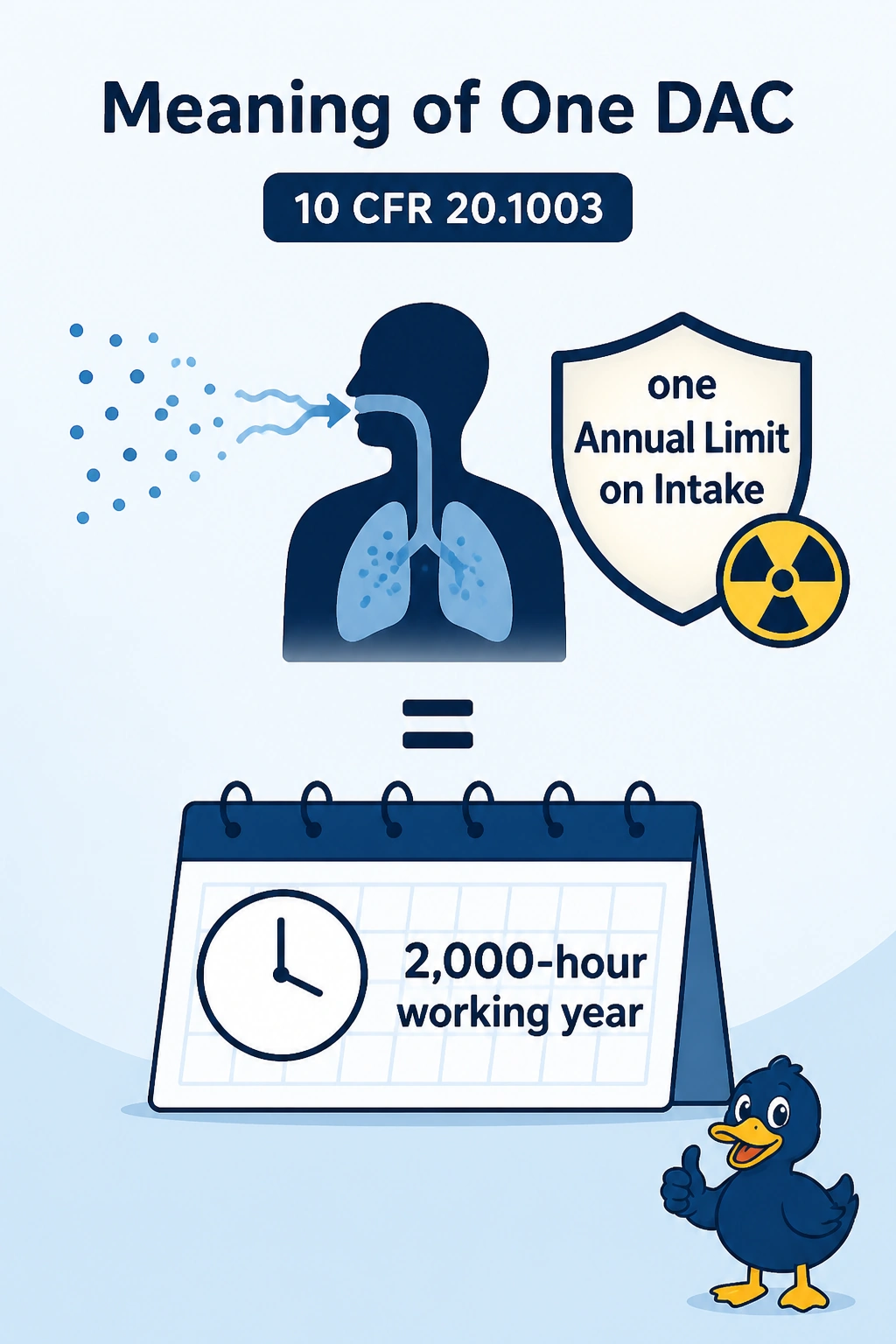
Short Explanation
Think of DAC as your workplace air-concentration speedometer tied to a standard work year. Under 10 CFR 20.1003, breathing air at 1 DAC for 2,000 hours delivers one Annual Limit on Intake. The trap is assuming an 8,760-hour continuous year, which applies to public exposures rather than occupational schedules.
Full Explanation
Under 10 CFR 20.1003, one Derived Air Concentration (DAC) is defined as The concentration that results in one Annual Limit on Intake over a 2,000-hour working year when breathed by Reference Man under conditions of light work. Because the Annual Limit on Intake (ALI) corresponds to a committed effective dose equivalent of 5 rem or a committed dose equivalent of 50 rem to an organ or tissue, tracking exposure in DAC-hours directly tracks internal dose commitment. Choosing The concentration that results in one Annual Limit on Intake over 8,760 hours of continuous exposure confuses occupational working hours with full-year continuous occupancy used for public effluent limits. Selecting The airborne concentration that delivers 50 mrem per hour to the whole body from external submersion misstates both the dose rate and the internal inhalation basis of DAC. Picking The maximum instantaneous airborne concentration permitted in an unrestricted public area confuses occupational DACs with unrestricted area effluent concentration limits in 10 CFR 20 Appendix B. As a regulatory caveat, DAC values apply to specific chemical and physical forms of a radionuclide, and breathing 2,000 DAC-hours in a year equals one ALI. As an operational check, calculate DAC-hours from air sample results and stay time, then verify whether respiratory protection or bioassay is triggered.
Prefer to study offline? Printable PDF study book + test engine ($7.50, unofficial). These questions stay free here.