
An internally deposited radionuclide has a physical half-life of 6.0 days and a biological half-life of 12.0 days. What is its effective half-life in the body?
Select an answer to reveal the explanation.
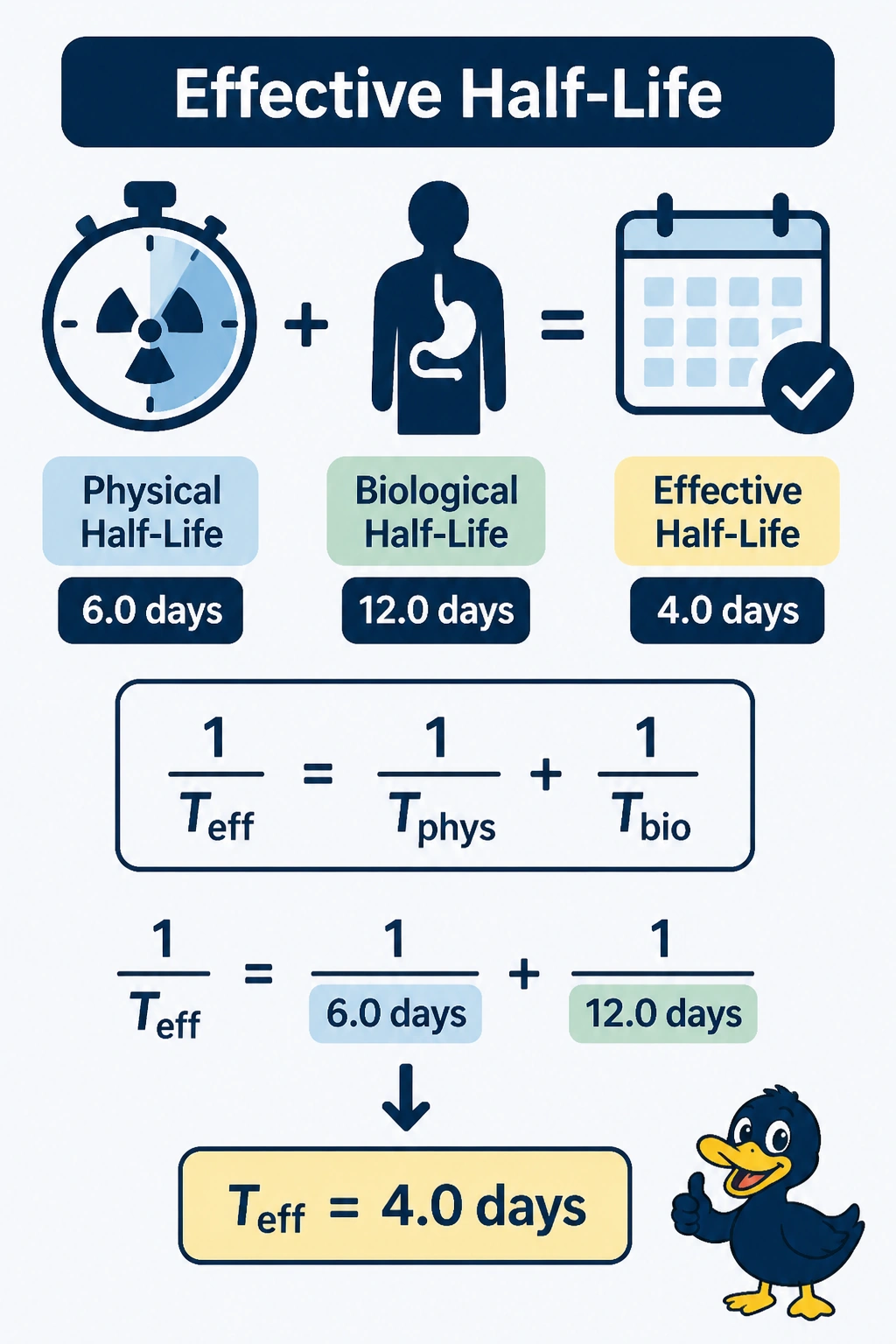
Short Explanation
When a radionuclide is leaving the body both by radioactive decay and by biological clearance, it disappears faster than either clock alone. Combining a 6.0-day physical half-life with a 12.0-day biological half-life gives you an effective half-life of 4.0 days. The classic trap is averaging or adding the two numbers, which wrongly makes the clearance look slower than the physical half-life.
Full Explanation
4.0 days is the effective half-life because physical decay and biological elimination act as independent, parallel removal pathways whose decay constants add together. Using the parallel-rate formula, the effective half-life equals the product of the physical and biological half-lives divided by their sum: (6.0 times 12.0) divided by (6.0 plus 12.0) equals 72.0 divided by 18.0, or 4.0 days. 6.0 days equals the physical half-life alone and ignores the additional clearance occurring through biological excretion. 9.0 days is the simple arithmetic average of 6.0 and 12.0 days, which is physically invalid for parallel exponential processes and exceeds the shorter half-life. 18.0 days is the sum of the two half-lives, which incorrectly treats the two removal mechanisms as sequential delays rather than simultaneous clearance paths. As a caveat, effective half-life must always be shorter than both the physical and biological half-lives, and biological clearance can vary among individuals or with chemical form. As an operational check, perform sequential bioassay measurements (such as whole-body counting or urinalysis) to verify actual retention rather than relying solely on reference biokinetic defaults.
Prefer to study offline? Printable PDF study book + test engine ($7.50, unofficial). These questions stay free here.