
A radiation worker may have inhaled tritiated water vapor (H-3, a pure beta emitter with a 18.6 keV maximum beta energy). Which bioassay method is appropriate to assess this potential internal intake?
Select an answer to reveal the explanation.
Short Explanation
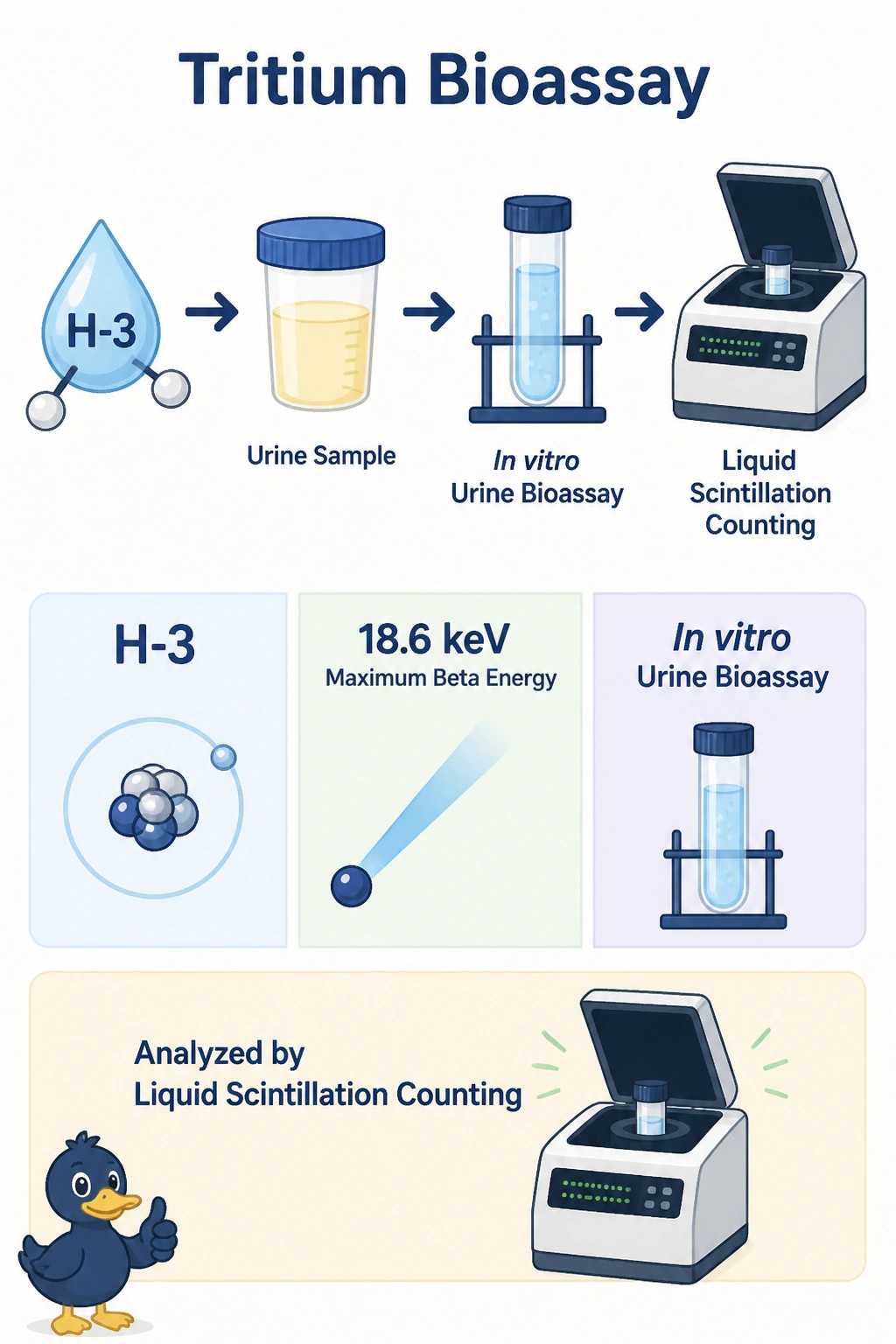
Tritium emits only ultra-soft beta particles that cannot even escape human skin, let alone reach an external gamma detector. The trap is reaching for a whole-body counter when there are no gamma rays to count. Because tritiated water mixes throughout body water, your best tool is a urine sample counted by liquid scintillation.
Full Explanation
Tritium emits no gamma rays and its 18.6 keV maximum beta particles travel only micrometers in tissue, so In vitro urine bioassay analyzed by liquid scintillation counting is the standard method to quantify internal uptake. Tritiated water rapidly equilibrates with total body water, making urine activity concentration directly proportional to body burden and committed effective dose. In vivo whole-body counting using a sodium iodide gamma-ray detector fails because no penetrating photons leave the body for the crystal to detect. In vivo thyroid counting using a collimated germanium crystal probe is designed for radioiodine concentrated in the thyroid gland, not uniformly distributed tritium. External nose-swipe frisking using a standard pancake Geiger-Mueller probe cannot reliably detect tritium because the 18.6 keV betas are absorbed in the probe window, air gap, and sample matrix, and tritiated water vapor does not deposit as insoluble particulates in the nares. As a caveat, allow a brief equilibration period after acute exposure before collecting a representative urine sample, and record void times accurately. For an operational check, confirm the liquid scintillation counter quench curve and tritium window efficiency using a NIST-traceable H-3 standard before counting bioassay vials.
Prefer to study offline? Printable PDF study book + test engine ($7.50, unofficial). These questions stay free here.