
When an adult radiation worker has an internal intake of a long-lived radionuclide such as Plutonium-239, over what integration period following the intake is the Committed Effective Dose Equivalent (CEDE) calculated under NRC 10 CFR 20.1003?
Select an answer to reveal the explanation.
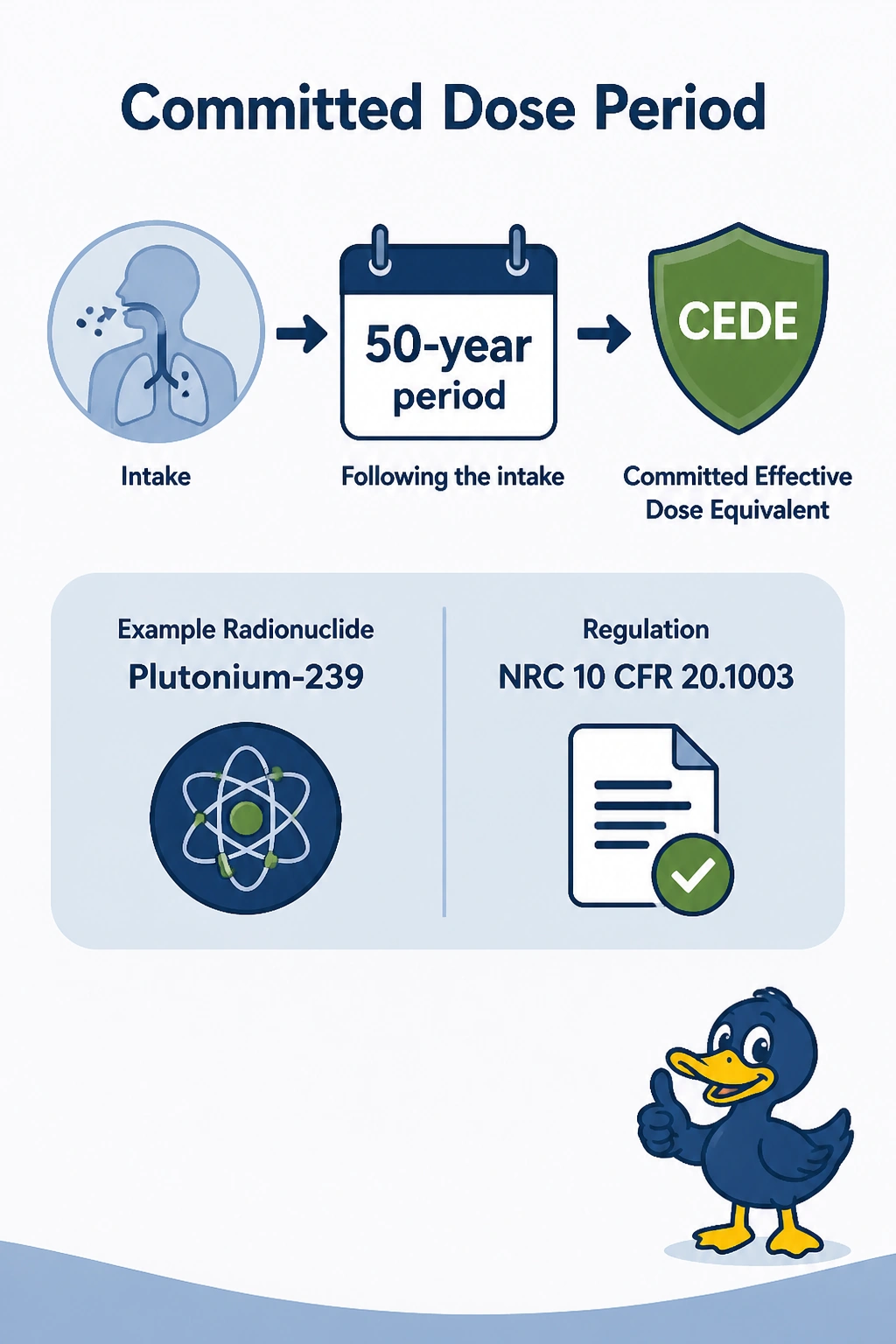
Short Explanation
Long-lived internal emitters do not clock out when your shift ends, so regulatory dosimetry tracks their dose well into the future. The trap is assuming internal dose is summed only over the current year or one effective half-life, when 10 CFR 20.1003 assigns the entire 50-year committed dose to the year of intake.
Full Explanation
Under NRC 10 CFR 20.1003, Committed Effective Dose Equivalent (CEDE) is defined using tissue weighting factors and the committed dose equivalent integrated over The 50-year period following the intake. This 50-year window accounts for protracted irradiation from radionuclides with long physical and biological half-lives that remain in organs such as bone or lung for decades. Choosing The 1-year calendar period in which the intake occurred confuses the annual reporting cycle with the biological integration period, which would severely underestimate dose from long-retained isotopes. Selecting The effective half-life of the radionuclide is incorrect because one effective half-life leaves half of the retained activity still in the body, whereas committed dose sums the total future dose. Choosing The remaining working lifetime until age 65 is wrong because NRC regulations standardize the commitment period at 50 years regardless of a worker's age at intake. As an exam caveat, the full 50-year CEDE is assigned to the calendar year in which the intake occurred when checking compliance with the 5 rem annual TEDE limit. In practice, verify bioassay results against the radionuclide's Annual Limit on Intake and record the assigned CEDE in the worker's annual exposure record.
Prefer to study offline? Printable PDF study book + test engine ($7.50, unofficial). These questions stay free here.