
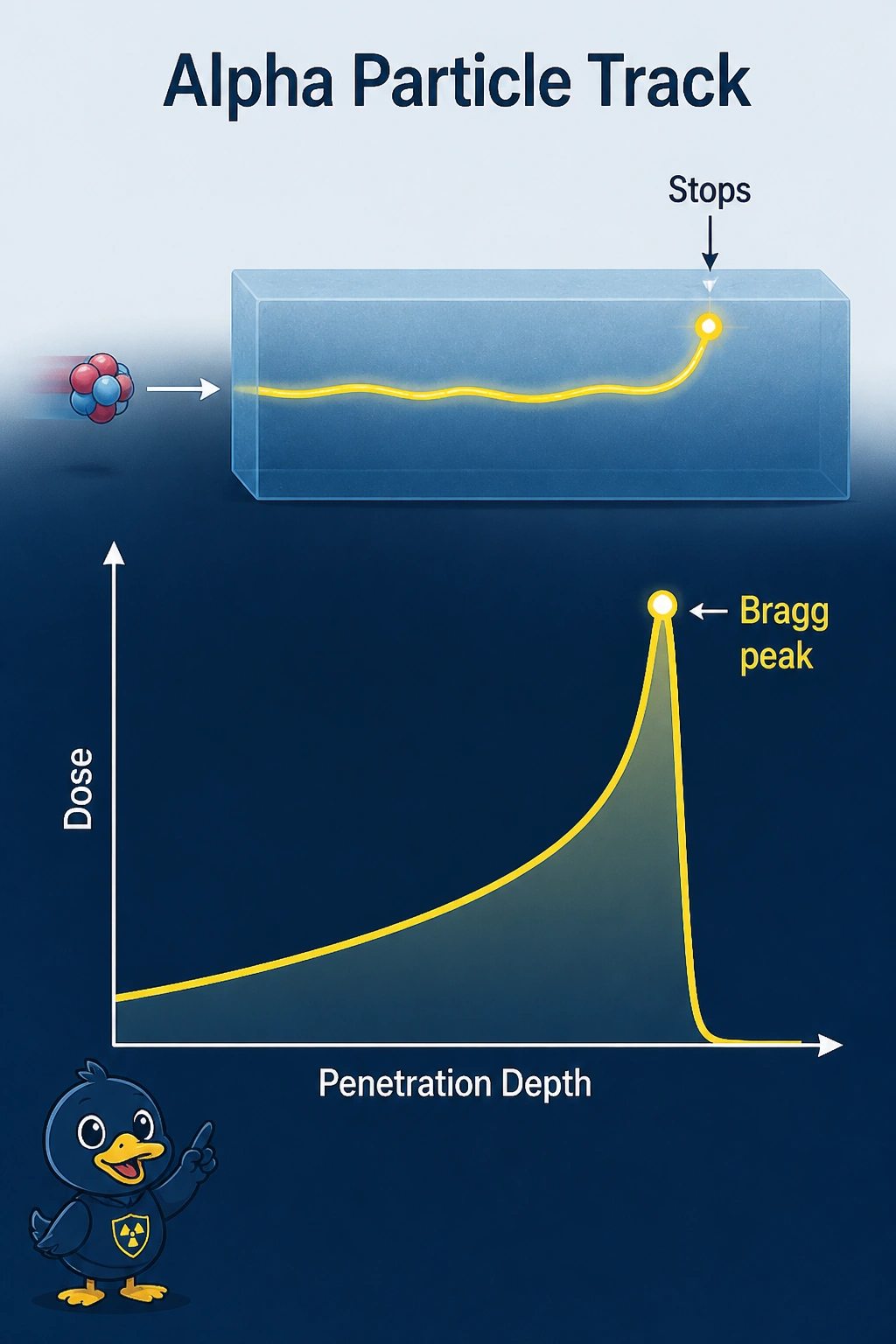
As a monoenergetic alpha particle slows down while traveling through air, how does its specific ionization (ion pairs formed per unit path length) change along the track?
Select an answer to reveal the explanation.
Short Explanation
Picture an alpha particle like a bowling ball rolling through pins—as it slows down, it lingers longer near each atomic electron and knocks more of them loose. On the test, do not let your intuition from exponential gamma attenuation trick you into thinking ionization fades away from the start.
Full Explanation
It rises sharply to a Bragg peak just before the particle stops because as a heavy charged particle loses kinetic energy, its velocity drops and it spends more time in the Coulomb field of each passing atom, transferring energy much more efficiently until it neutralizes by capturing electrons and halts abruptly. It decreases steadily from entry until stopping is false because energy loss per unit path length varies inversely with the square of particle velocity, so slower speed increases rather than decreases ionization density prior to neutralization. It stays constant across the entire track length is wrong because continuous energy loss steadily slows the particle and changes the interaction cross section throughout its path. It drops exponentially like a narrow gamma beam is incorrect because uncharged photons undergo probabilistic attenuation rather than continuous Coulomb drag with a finite range. As an exam caveat, the sharp Bragg peak is well defined for a monoenergetic beam, whereas straggling smears the peak slightly at the very end of the track. Operationally, when surveying alpha contamination with a thin-window probe, keep the detector face within a few millimeters of the surface so air absorption does not stop the particles before they reach the active volume.
Prefer to study offline? Printable PDF study book + test engine ($7.50, unofficial). These questions stay free here.