
A radiation protection technologist compares the mass attenuation coefficients of water, tissue-equivalent plastic, and aluminum for 1.0 MeV gamma photons and finds they are nearly identical. Which photon interaction mechanism explains this Z-independence?
Select an answer to reveal the explanation.
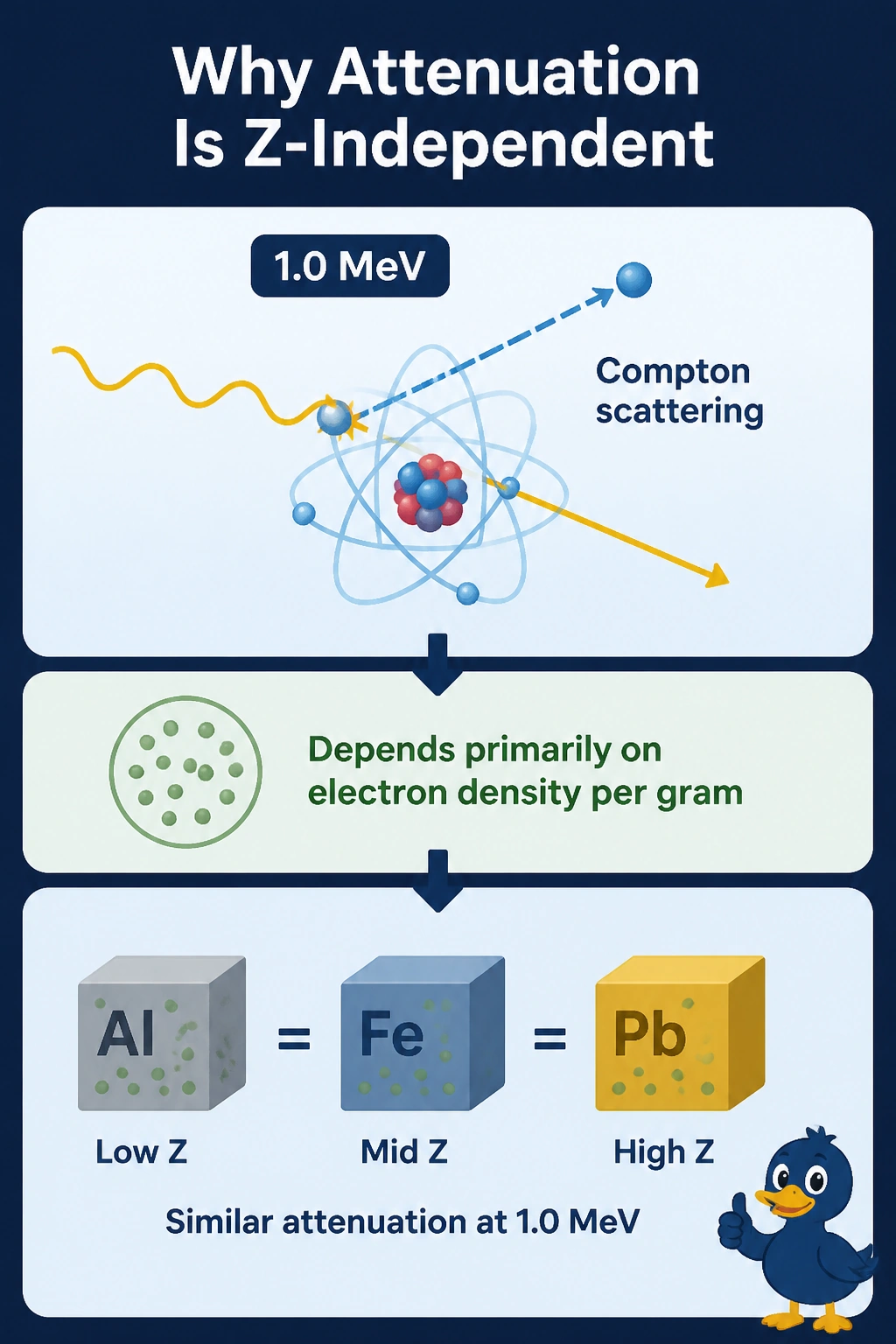
Short Explanation
At 1.0 MeV, gamma photons behave like billiard balls bouncing off loose electrons rather than caring which element owns them. Because most light-to-medium elements pack nearly the same number of electrons into every gram, your shielding mass matters far more than atomic number here, unlike low-energy X-ray work.
Full Explanation
In the intermediate photon energy range around 1.0 MeV, Compton scattering, which depends primarily on electron density per gram governs photon attenuation in low-to-medium atomic number materials. Because the ratio of atomic number to atomic mass is approximately 0.5 for most elements other than hydrogen, water, plastic, and aluminum all present nearly the same number of target electrons per gram, giving similar mass attenuation coefficients. Photoelectric absorption, which scales strongly with atomic number (roughly Z cubed to Z fourth) dominates at low photon energies below about 100 keV, not at 1.0 MeV. Pair production, which scales with the square of atomic number cannot occur at 1.0 MeV because it requires a 1.022 MeV threshold and only becomes major at multi-MeV energies in high-Z absorbers. Coherent scattering, which dominates only at multi-MeV energies is incorrect because Rayleigh coherent scattering is a minor low-energy elastic process, not a high-energy mechanism. As a caveat, hydrogenous materials like water have a slightly higher electron-to-mass ratio (~10 percent higher) than aluminum, causing a small difference in mass attenuation. For an operational check, verify material density and thickness in grams per square centimeter when substituting tissue-equivalent phantoms for 1.0 MeV gamma calibrations.
Prefer to study offline? Printable PDF study book + test engine ($7.50, unofficial). These questions stay free here.