
A facility needs to design temporary shielding around a fast-neutron source before adding outer gamma shielding. Which material most effectively slows down fast neutrons through elastic collisions?
Select an answer to reveal the explanation.
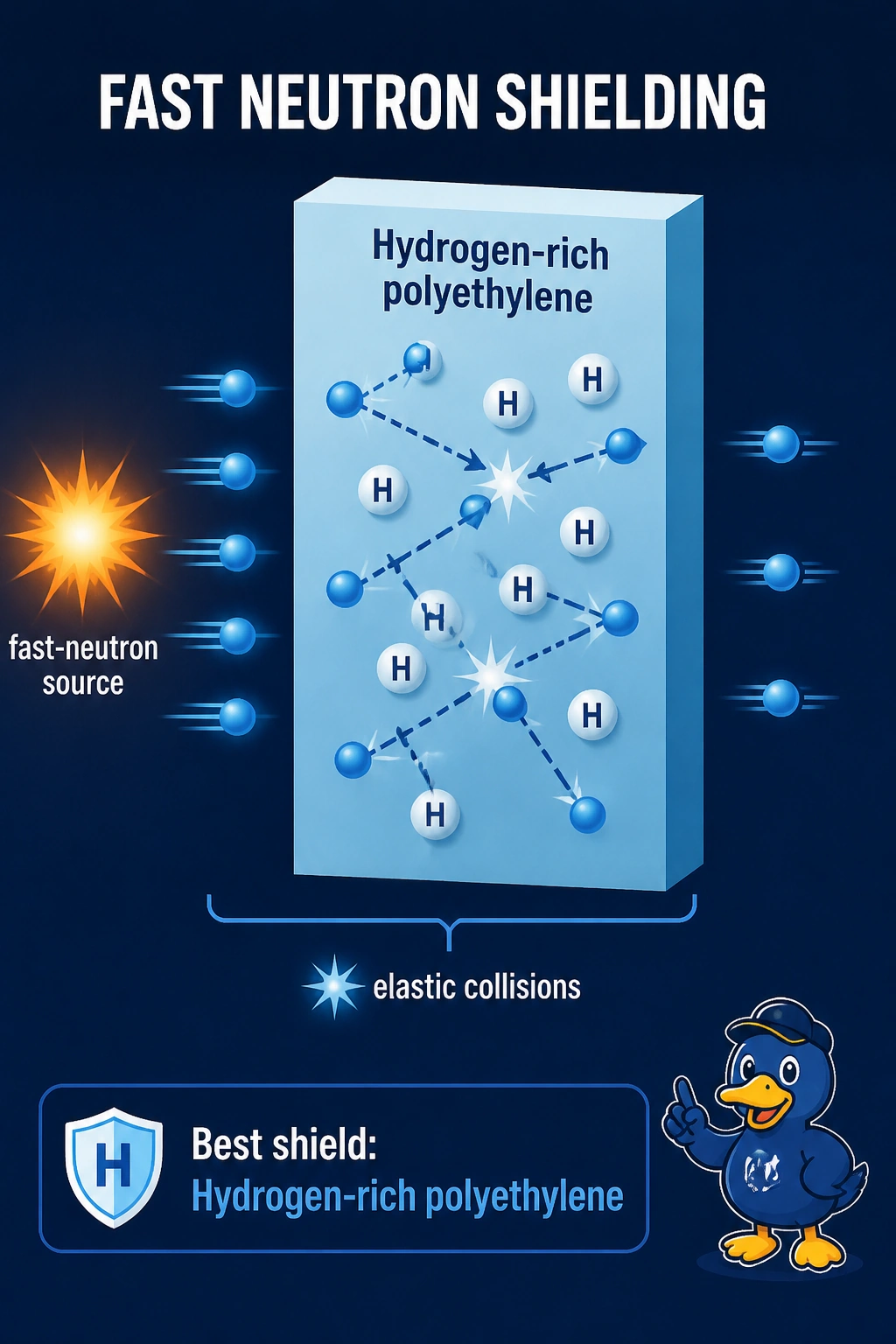
Short Explanation
You can picture a fast neutron as a runaway billiard ball: hydrogen gives it protons of nearly equal mass to collide with, so it sheds energy quickly. High-density lead sheets, depleted uranium plates, and thick tungsten blocks have much heavier nuclei, so they slow fast neutrons poorly and may produce secondary gamma rays.
Full Explanation
Hydrogen-rich polyethylene is the most effective choice for moderating fast neutrons because it contains a high concentration of hydrogen nuclei (protons). In an elastic collision, a neutron transfers the greatest fraction of its kinetic energy to a target nucleus of nearly equal mass; a single head-on collision with a proton can remove almost all of the neutron’s kinetic energy. High-density lead sheets are poor moderators because lead nuclei are over two hundred times heavier than a neutron, so elastic collisions transfer little energy. Depleted uranium plates also contain massive nuclei that transfer energy poorly and may undergo fast fission or radiative capture, adding secondary radiation. Thick tungsten blocks have the same large mass mismatch and can emit capture gamma rays without efficiently thermalizing the neutron spectrum. A caveat is that hydrogenous moderation produces 2.2 MeV capture gamma rays when thermal neutrons are absorbed by hydrogen, so boron-loaded polyethylene is often paired with outer high-Z gamma shielding. As a practical check, perform both neutron and gamma dose-rate surveys outside a newly assembled shield wall to verify that secondary capture photons are adequately attenuated.
Prefer to study offline? Printable PDF study book + test engine ($7.50, unofficial). These questions stay free here.