
When 40 keV X-ray photons strike a lead apron, which photon interaction mechanism dominates attenuation and why does lead absorb them so effectively?
Select an answer to reveal the explanation.
Short Explanation
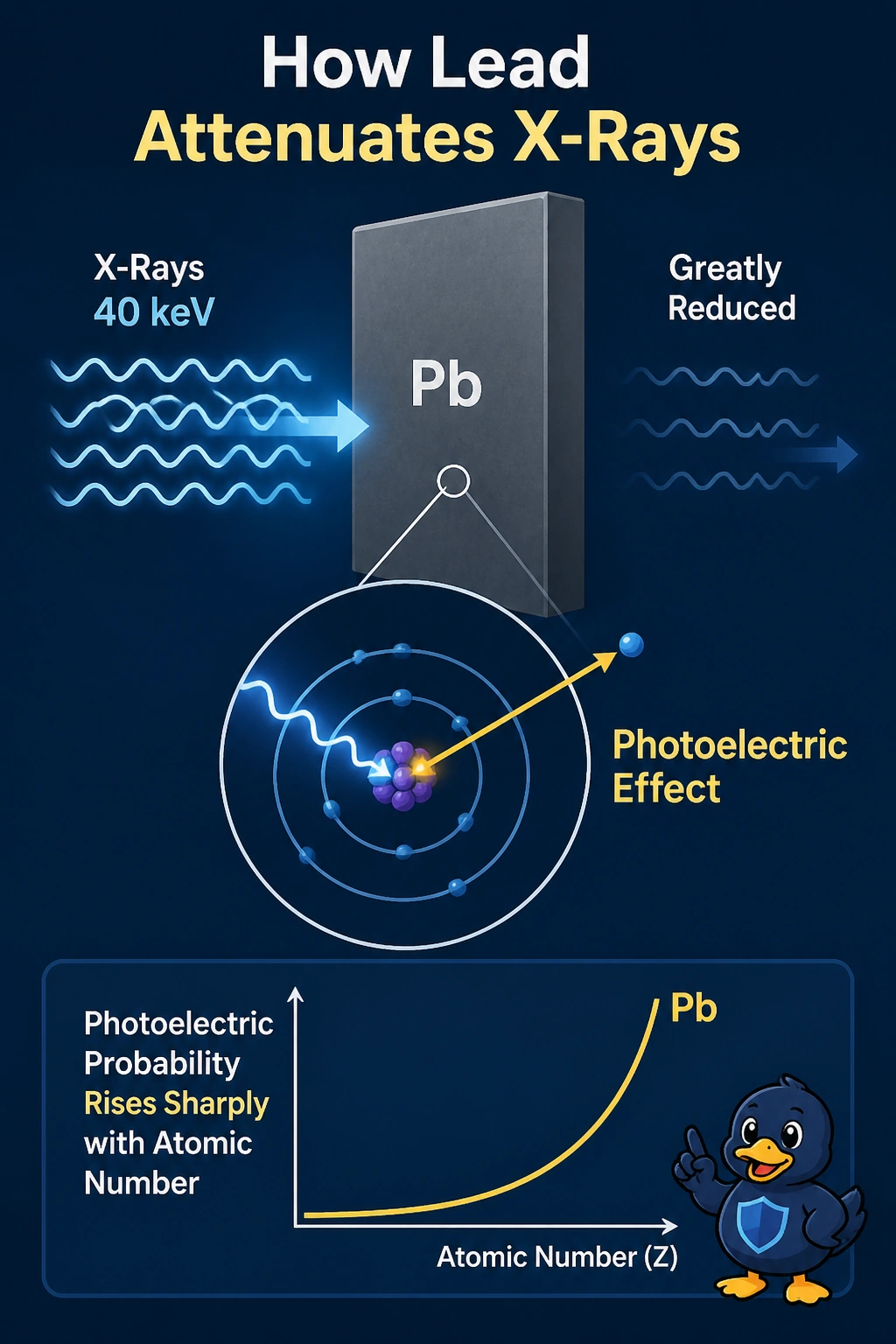
At low diagnostic X-ray energies, high-Z lead acts like a brick wall because tightly bound inner electrons snatch photons whole via the photoelectric effect. The trap is crediting Compton scattering, which barely cares about your absorber's atomic number.
Full Explanation
Photoelectric effect, because its probability rises sharply with atomic number is correct because photoelectric cross section scales strongly with atomic number (roughly Z^4 to Z^5) and inversely with photon energy (roughly E^-3), making high-Z lead extraordinarily effective at absorbing 40 keV X-rays. Compton scattering, because its probability increases sharply with the cube of atomic number is wrong because Compton scattering depends on electron density (electrons per gram), which varies only slightly across most elements rather than scaling strongly with Z. Pair production, because 40 keV photons exceed the nuclear threshold energy is incorrect because pair production requires a minimum photon energy of 1.022 MeV to create an electron-positron pair. Photodisintegration, because lead nuclei eject neutrons at diagnostic energies is false because nuclear photodisintegration thresholds are several MeV, far above 40 keV. An important caveat is that lead shielding emits characteristic K-shell X-rays around 75 to 88 keV when higher-energy photons eject K-electrons, though 40 keV photons lack enough energy to excite lead's K-edge. As an operational check, verify the lead-equivalent thickness rating of protective aprons against the peak tube kilovoltage in use.
Prefer to study offline? Printable PDF study book + test engine ($7.50, unofficial). These questions stay free here.