
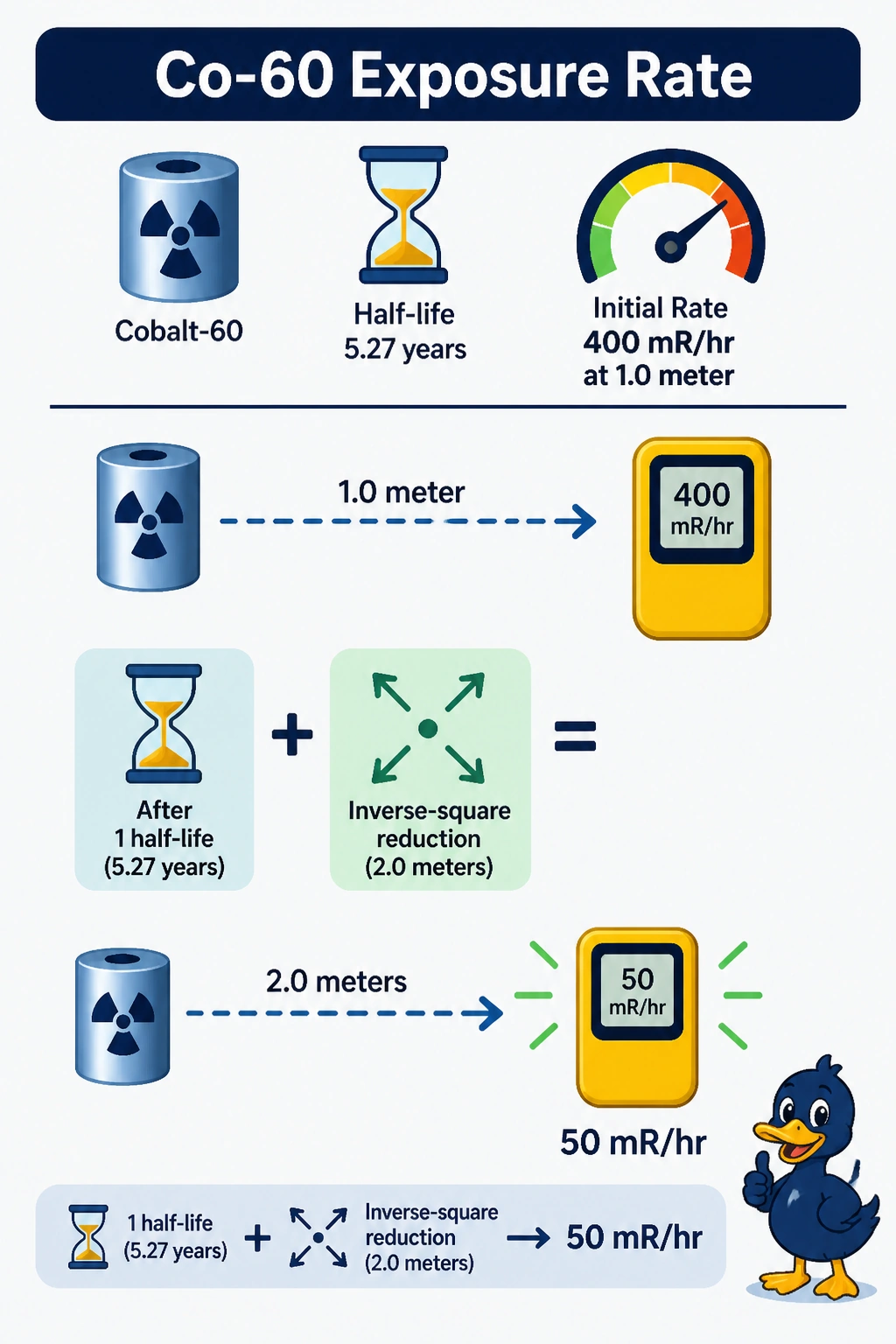
A sealed Cobalt-60 source (physical half-life 5.27 years) initially produces an unshielded exposure rate of 400 mR/hr at 1.0 meter. After 5.27 years have elapsed, what unshielded exposure rate should a technologist expect at 2.0 meters from the same source?
Select an answer to reveal the explanation.
Short Explanation
When both time and distance change between surveys, you need to apply both physics rules in sequence rather than stopping after the first step. Doubling your distance from a point source cuts the field to one-fourth, and one half-life of Cobalt-60 cuts the remaining rate in half again. Your trap is forgetting one of the two factors and landing on 100 or 200 mR/hr.
Full Explanation
For an unshielded point gamma source with negligible air attenuation, the exposure rate is directly proportional to source activity and inversely proportional to the square of the distance. Moving from 1.0 meter to 2.0 meters doubles the distance, which reduces the exposure rate by a factor of (1.0 / 2.0)² = 1/4, from 400 mR/hr down to 100 mR/hr. Meanwhile, 5.27 years equals one physical half-life of Cobalt-60, halving the source activity and reducing 100 mR/hr to 50 mR/hr. This yields "50 mR/hr, combining one half-life of decay with the fourfold inverse-square reduction." The distractor "100 mR/hr, accounting only for the inverse-square reduction at double the distance." omits the 50 percent activity loss over 5.27 years. Conversely, "200 mR/hr, accounting only for one physical half-life of radioactive decay." ignores the distance increase from 1.0 meter to 2.0 meters. The option "25 mR/hr, treating both radioactive decay and distance as inverse-square factors." incorrectly squares the half-life reduction factor. As a caveat, the inverse-square law assumes a true point source and minimal room scatter from nearby walls or floors. For an operational check, always verify calculated exposure rates with a calibrated ionization chamber before establishing posted boundaries.
Prefer to study offline? Printable PDF study book + test engine ($7.50, unofficial). These questions stay free here.