
An environmental monitoring program for a facility that discharges treated liquid effluent into a river collects downstream bottom sediment and fish samples in addition to periodic water grab samples. What is the primary radiological reason for sampling sediment and aquatic biota?
Select an answer to reveal the explanation.
Short Explanation
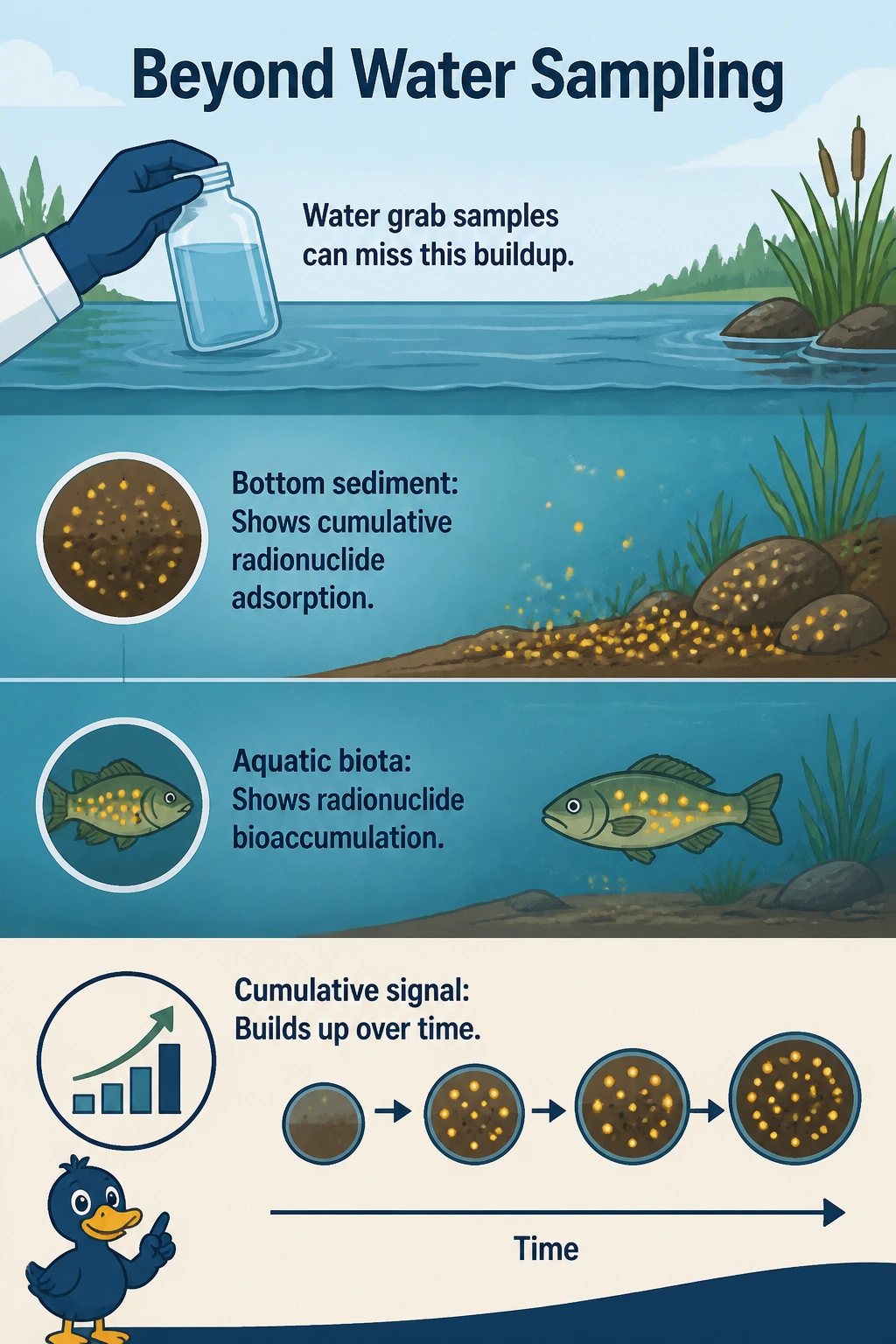
A water grab sample is just a snapshot of a moving river, whereas sediment and fish act like a long-term sponge for your facility's releases. The trap is assuming water samples alone tell the whole story when trace radionuclides settle out and concentrate in biota over time.
Full Explanation
Liquid effluents discharged into a river often contain radionuclides at concentrations too low or too intermittent to appear consistently in periodic water grab samples. Sampling downstream sediment and aquatic biota is designed To detect cumulative radionuclide adsorption and bioaccumulation missed by water samples, because suspended particulates scavenge radionuclides onto the riverbed and organisms concentrate specific isotopes through the food chain. Using sediment or fish To measure atmospheric radon progeny depositing onto the river surface is wrong because aquatic biota sampling targets waterborne facility effluents rather than airborne radon decay products. Collecting downstream biota To calibrate the continuous flow-proportional effluent sampler in the outfall is incorrect because sampler calibration relies on known flow rates and standards, not environmental media. Sampling downstream To verify that upstream background activity equals the facility release limit confuses environmental surveillance with regulatory effluent limits, which are never set equal to background. As a caveat, compare downstream results against matched upstream control locations to separate facility contributions from natural or fallout background. As an operational check, record exact GPS coordinates, water depth, and species mass for every sample.
Prefer to study offline? Printable PDF study book + test engine ($7.50, unofficial). These questions stay free here.