
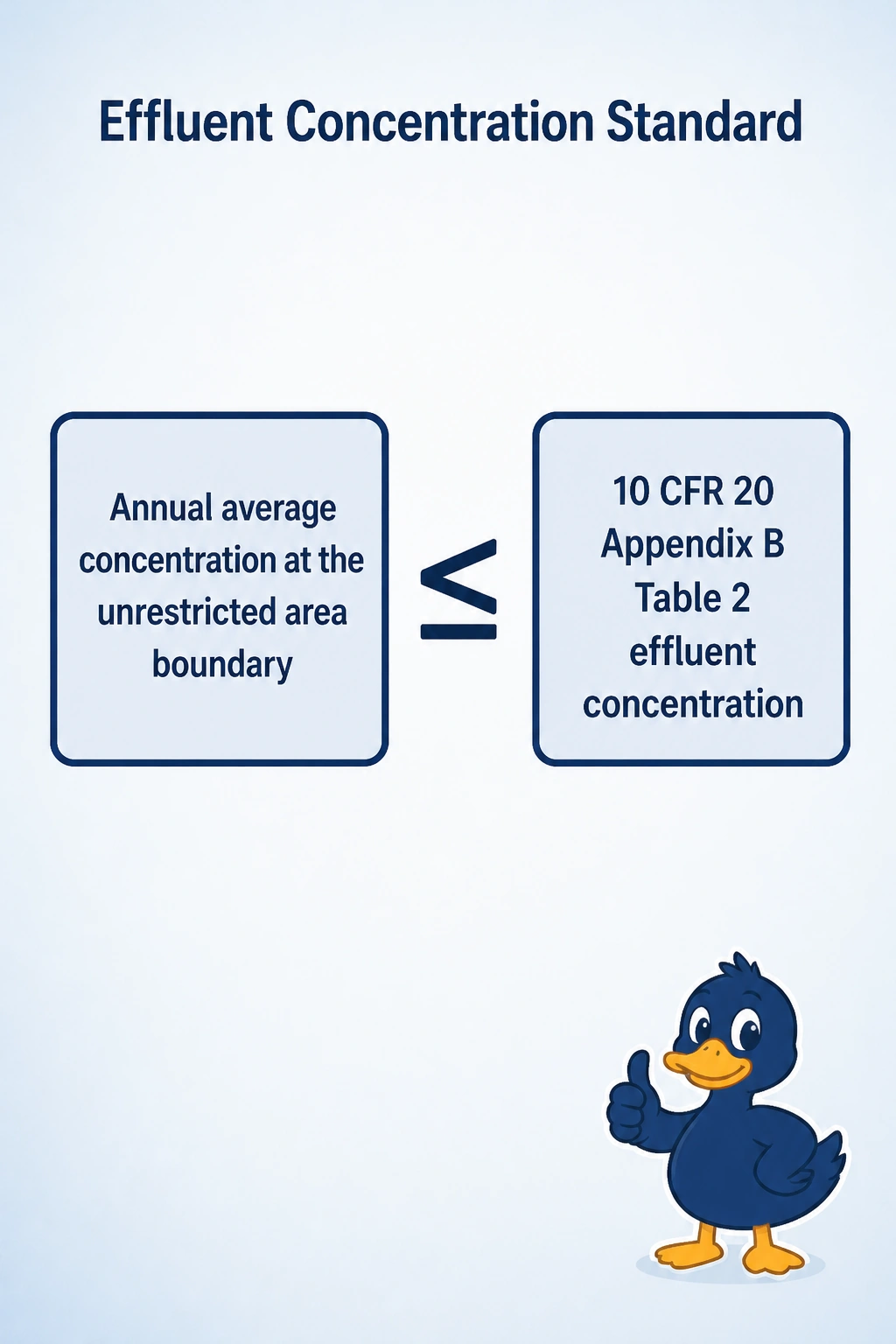
Under NRC 10 CFR 20.1302, when a licensee demonstrates compliance with the annual public dose limit using effluent monitoring rather than site-specific pathway modeling, what must the annual average radionuclide concentrations at the unrestricted area boundary meet?
Select an answer to reveal the explanation.
Short Explanation
Think of Appendix B in 10 CFR 20 as having two different speed-limit columns: one for trained workers inside the plant and a much stricter one for neighbors outside the fence. When you monitor effluents at the boundary, you compare them against Table 2. The trap is grabbing the occupational Table 1 limits or sewerage limits instead.
Full Explanation
Under NRC 10 CFR 20.1302, a licensee may demonstrate compliance with the 100 mrem annual public dose limit by showing that annual average airborne and liquid effluent concentrations at the unrestricted area boundary do not exceed The effluent concentration values in 10 CFR 20 Appendix B Table 2, combined with meeting external dose limits in unrestricted areas. Table 2 concentrations are derived for continuous exposure of members of the public across age groups, making them substantially lower than occupational limits. Conversely, The occupational Derived Air Concentration values in Appendix B Table 1 apply to adult radiation workers over a 2,000-hour work year and would vastly exceed public dose limits if applied at the site boundary. Similarly, The sanitary sewerage monthly average limits in 10 CFR 20.2003 govern soluble or dispersible releases into municipal sewers rather than general atmospheric or surface-water boundary compliance. Finally, The exempt quantity thresholds listed in 10 CFR 30.71 Schedule B define small possession quantities exempt from certain licensing rules rather than continuous effluent concentration limits. Exam caveat: if multiple radionuclides are discharged, apply the sum-of-fractions rule across all isotopes in Table 2. Operational check: verify that effluent sample flow rates and analytical minimum detectable concentrations are low enough to quantify fractions of Table 2 limits.
Prefer to study offline? Printable PDF study book + test engine ($7.50, unofficial). These questions stay free here.