
An environmental technician collects a weekly particulate air filter from a perimeter monitoring station and waits several days before performing gross alpha and gross beta counting. What is the primary reason for this holding period?
Select an answer to reveal the explanation.
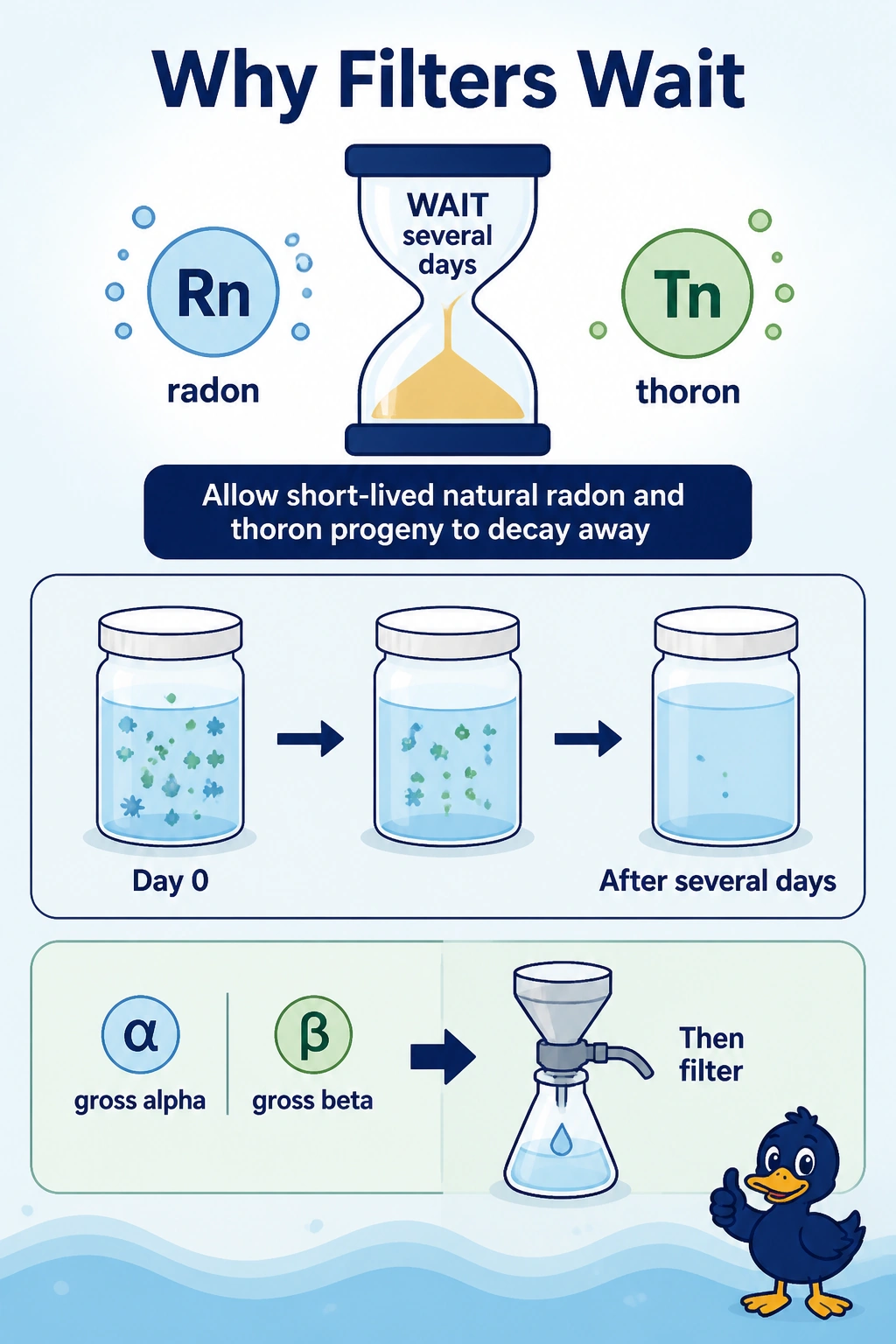
Short Explanation
You wait so short-lived natural radon and thoron progeny can decay, reducing their contribution to the filter’s counts. You’re not waiting for long-lived fission products to build up; you’re letting natural background fade.
Full Explanation
Outdoor air carries radon and thoron progeny attached to dust, and these short-lived products can contribute substantial initial gross alpha and beta counts on a freshly collected filter. Holding the filter for several days lets those progeny decay, reducing natural background in the measurement. Evaporating trapped moisture to prevent attenuation of gamma photons is not the purpose: gross alpha and beta counting measures alpha particles and beta particles, not gamma photons. Allowing long-lived fission products to reach secular equilibrium is also not the purpose; several days is not enough for long-lived products to establish that equilibrium, and the hold is intended to reduce interference from short-lived background. Preventing static charge buildup on the glass-fiber filter is unrelated to the radioactive decay period. An exam caveat is that the appropriate holding time depends on the monitoring protocol and the progeny being allowed to decay. As a practical check, record the collection stop time and counting start time so the elapsed hold can be verified and any required decay correction applied.
Prefer to study offline? Printable PDF study book + test engine ($7.50, unofficial). These questions stay free here.