
An environmental air-monitoring station outside a nuclear facility uses a two-stage sampling head containing a glass-fiber particulate filter followed by an impregnated activated charcoal cartridge. Why is the charcoal cartridge positioned downstream of the particulate filter?
Select an answer to reveal the explanation.
Short Explanation
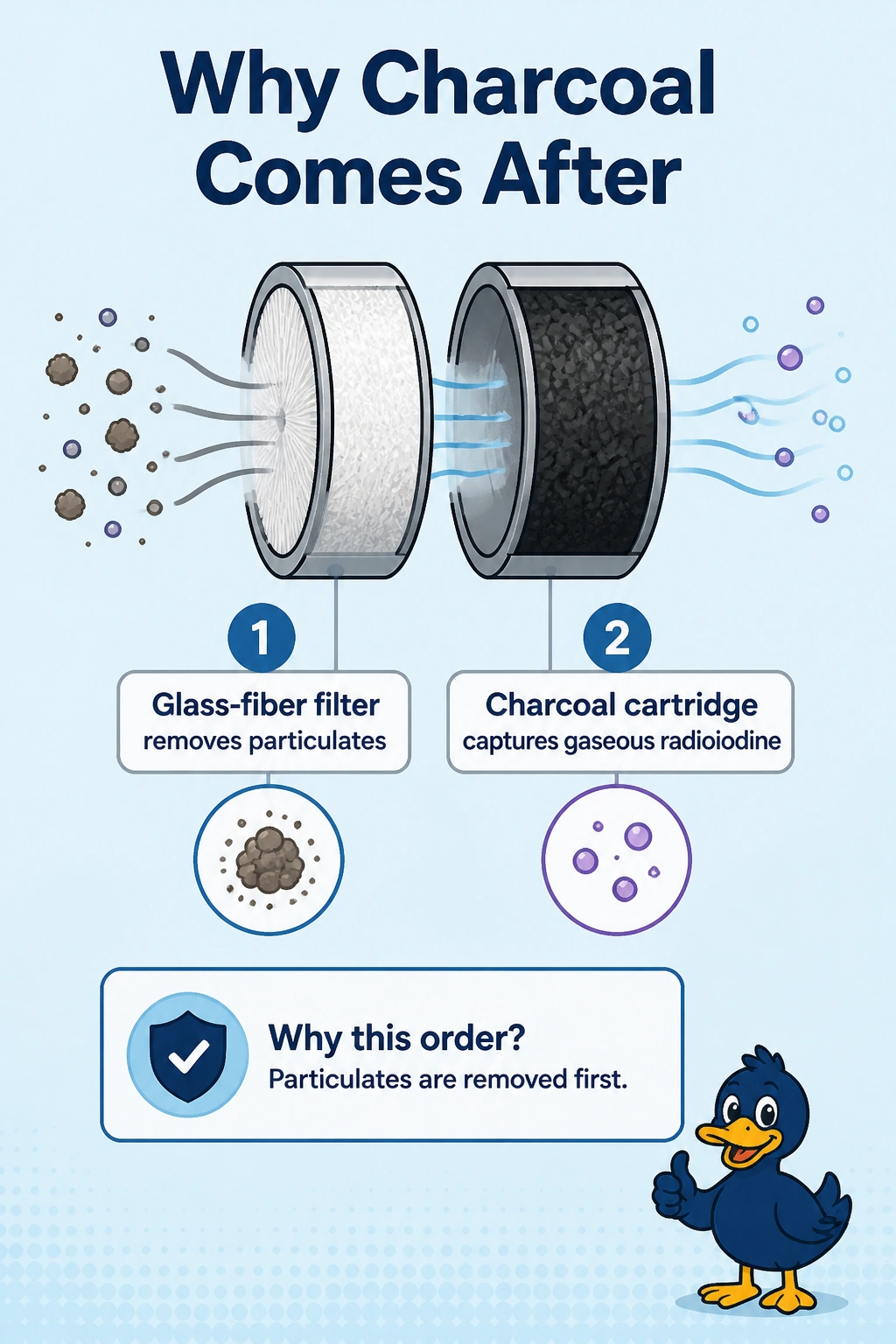
Imagine straining soup through a mesh colander before catching the aroma in a sponge. If you put the charcoal cartridge first, airborne dust would clog it and mix particulate activity with the gaseous radioiodine you are trying to isolate.
Full Explanation
Environmental air-sampling heads place the glass-fiber particulate filter first and the impregnated activated charcoal cartridge second To capture gaseous radioiodine after airborne particulates have been removed. Particulate radionuclides—including particle-bound iodine and fission products—deposit on the front filter, while volatile elemental and organic radioiodine vapors pass through the filter and adsorb onto the treated charcoal for separate gamma spectroscopy. To neutralize acidic stack gases that would corrode the air pump is not the radiological purpose of the charcoal stage. To trap radon decay progeny before they reach the particulate filter is backward both in order and physics, because radon progeny attach to ambient aerosols and are collected on the upstream particulate filter. To dry ambient moisture from the air stream before flow measurement describes a desiccant trap, whereas high humidity actually degrades charcoal iodine-retention efficiency. As an analytical caveat, if the particulate filter tears or leaks around its gasket, particulates will contaminate the charcoal cartridge and bias the gaseous iodine measurement. Operationally, inspect the filter gasket seating during each weekly sample changeout and count the particulate filter and charcoal cartridge separately.
Prefer to study offline? Printable PDF study book + test engine ($7.50, unofficial). These questions stay free here.