
When calculating the dose rate behind a thick concrete shield for a broad-beam gamma source, why does the simple exponential attenuation formula underestimate the actual transmitted dose rate unless a buildup factor is included?
Select an answer to reveal the explanation.
Short Explanation
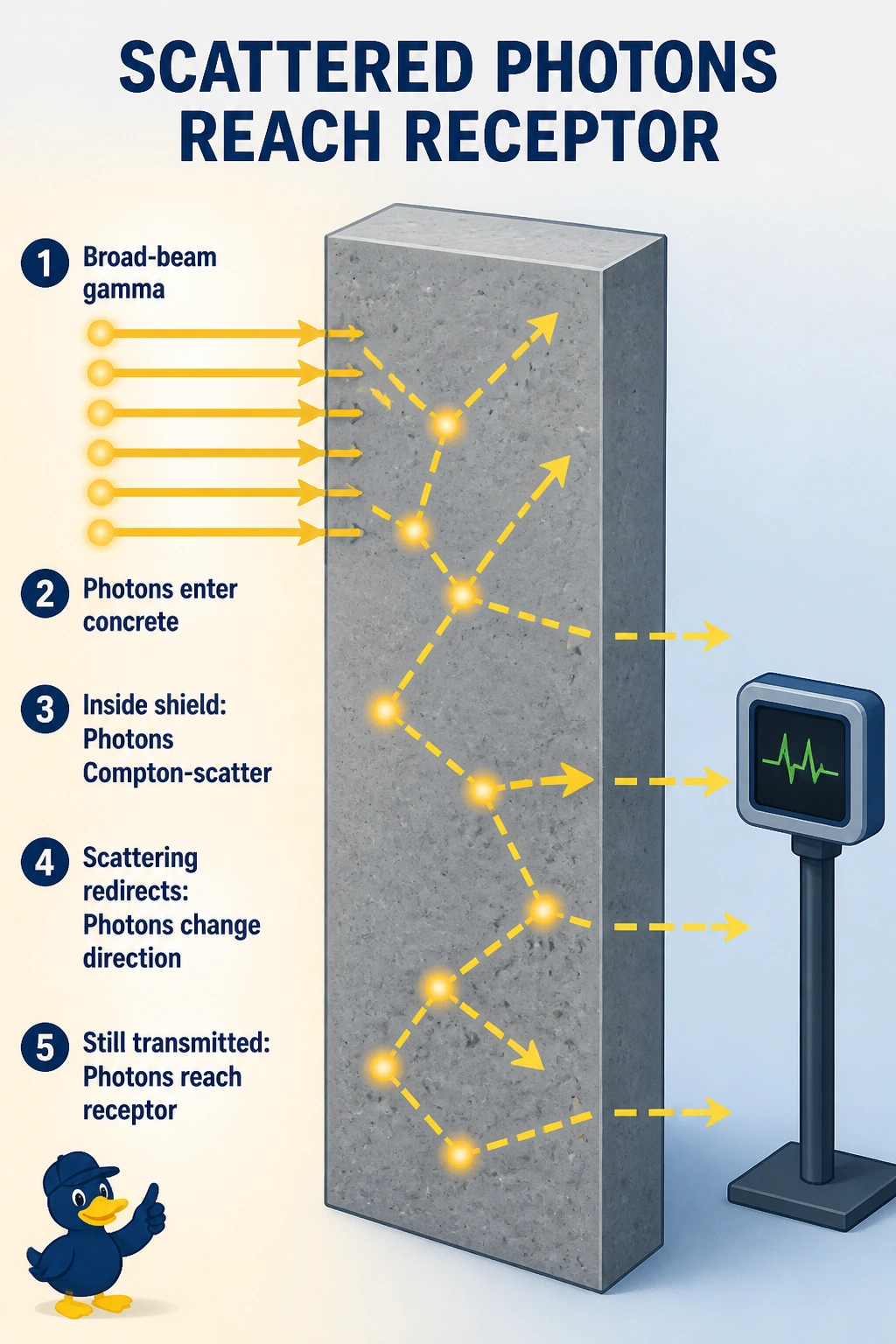
Simple exponential attenuation treats every photon that scatters inside a wall as if it vanished forever. The trap is forgetting that in a wide beam, scattered photons can bounce right back toward the person on the far side. Including a buildup factor lets you capture those redirected photons before your shield comes up short.
Full Explanation
Narrow-beam exponential attenuation counts any interaction as total removal, whereas in broad-beam geometry Compton-scattered photons redirected inside the shield still reach the receptor and add to the transmitted dose rate. A dimensionless buildup factor greater than or equal to one scales the uncollided exponential term to include this scattered radiation. Concrete undergoes neutron activation and emits delayed beta particles from the outer wall is incorrect because gamma photons at typical isotopic energies do not induce neutron activation in concrete. Primary gamma photons gain energy as they pass through the electron clouds of concrete violates energy conservation; scattered photons always lose energy in Compton collisions. Exponential attenuation assumes all incident photons are absorbed by pair production alone is false because the linear attenuation coefficient sums photoelectric absorption, Compton scattering, and pair production together. As a caveat, buildup factors depend on photon energy, shield material, shield thickness in mean free paths, and source geometry, so tables for lead differ from concrete. For an operational check, always verify broad-beam shielding calculations with an ion chamber survey on the occupied side after source installation.
Prefer to study offline? Printable PDF study book + test engine ($7.50, unofficial). These questions stay free here.