
An environmental health physicist sets up a continuous particulate air sampler inside a facility ventilation exhaust stack. Why must the sampling nozzle operate under isokinetic conditions, where air velocity entering the probe matches the velocity of the stack gas?
Select an answer to reveal the explanation.
Short Explanation
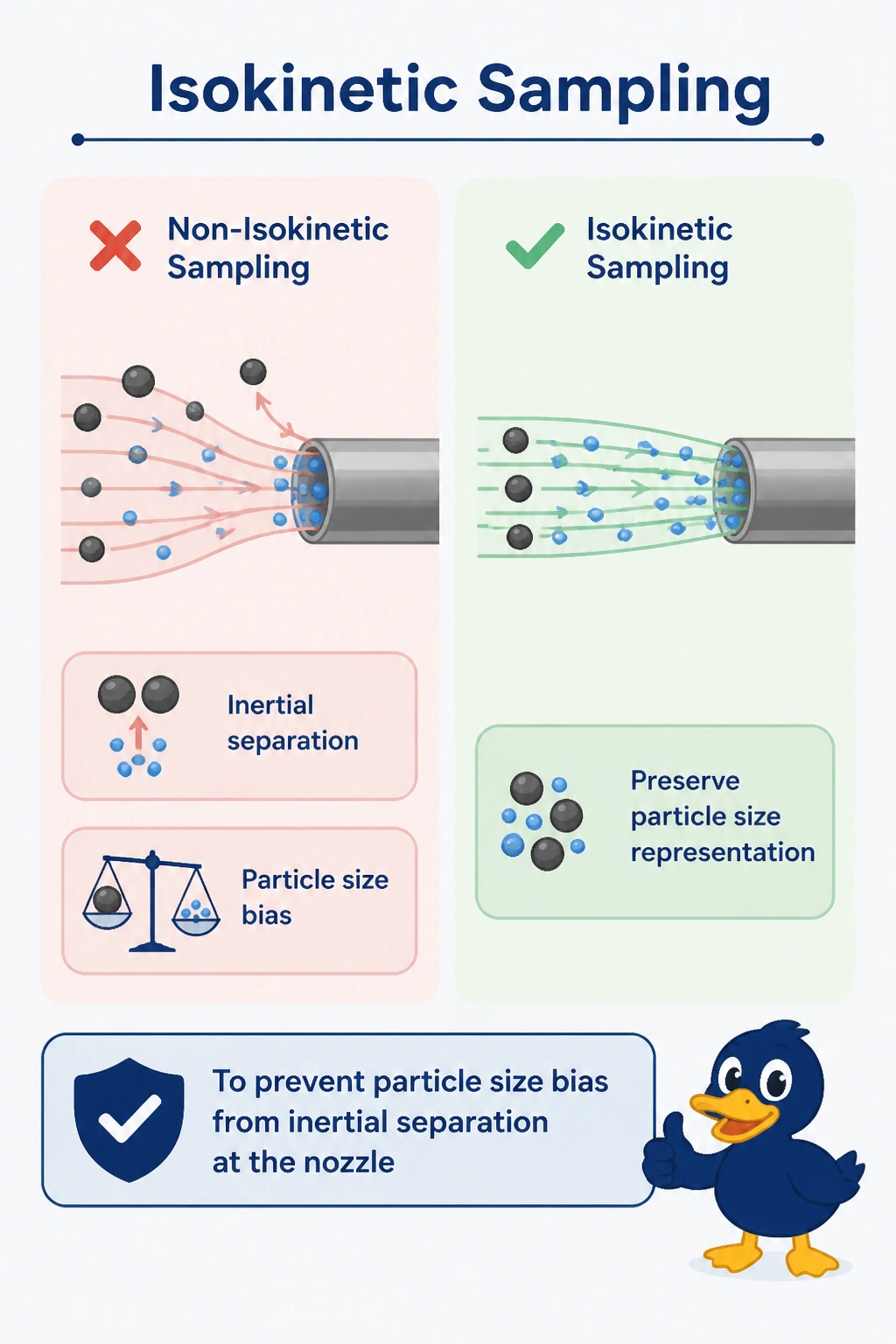
Sampling a fast-moving stack without matching its speed is like trying to catch baseballs and ping-pong balls with a vacuum cleaner—heavy particles overshoot or get sucked in differently. Your goal is a true snapshot of the plume, and the trap is thinking faster flow always gives better data.
Full Explanation
Isokinetic sampling matches the linear velocity of gas entering the sharp-edged sampling nozzle to the undisturbed linear velocity of the stack stream at that point. Operating under this condition is required "To prevent particle size bias from inertial separation at the nozzle": if probe velocity is lower than stack velocity, streamlines diverge around the nozzle and heavy particles with high inertia overshoot into the probe, overestimating concentration; if probe velocity is higher, streamlines converge and heavy particles miss the nozzle, underestimating concentration. Matching velocities is not intended "To eliminate radon progeny interference on the collection filter media", which depends on radioactive decay discrimination or alpha spectroscopy rather than nozzle aerodynamics. Isokinetic sampling is also not used "To maximize the total air volume drawn across the filter each hour", because exceeding the matched stack velocity distorts sample representativeness. Nor is a small sampling probe designed "To maintain negative pressure across the entire exhaust ductwork", which is the job of the main exhaust blowers. Note that gaseous effluents such as noble gases or tritium do not exhibit inertial separation and do not require isokinetic nozzles. As an operational check, measure the stack velocity profile with a Pitot tube and match the nozzle diameter and pump flow rate before starting effluent collection.
Prefer to study offline? Printable PDF study book + test engine ($7.50, unofficial). These questions stay free here.