
An environmental health physicist is establishing an off-site air-sampling network around a nuclear fuel fabrication facility to quantify airborne uranium releases. Where should the reference background air-monitoring station be positioned?
Select an answer to reveal the explanation.
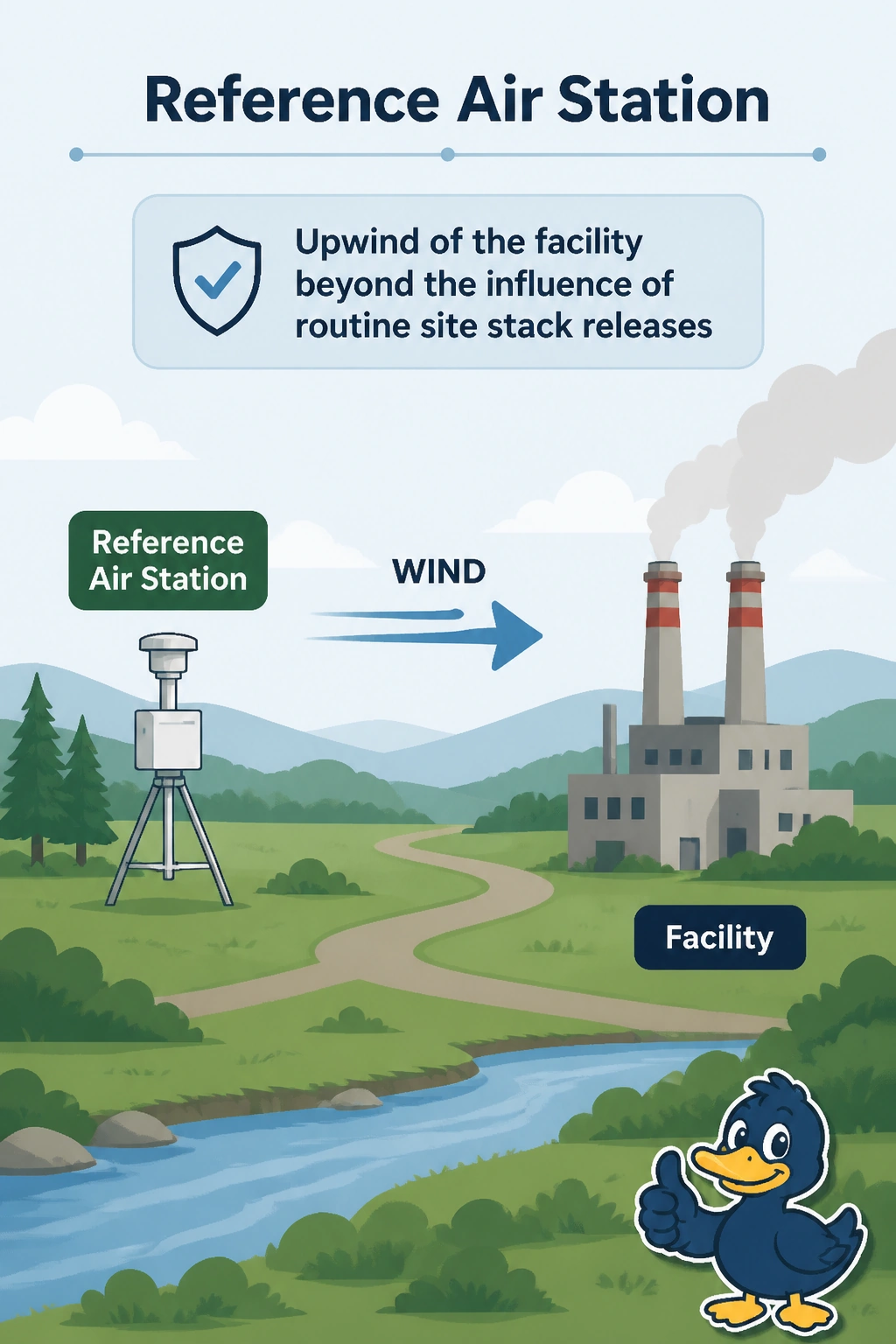
Short Explanation
Think of a reference station as the clean baseline on your scale before you weigh anything. Placing it upwind and outside the plume's reach lets you subtract natural radon progeny and regional fallout, while the trap is putting it downwind where facility emissions already mix in.
Full Explanation
To measure a facility's true airborne radiological impact, an environmental monitoring program must separate site releases from natural background and regional sources. Positioning the reference station Upwind of the facility beyond the influence of routine site stack releases ensures the sampler collects ambient air unaffected by facility operations, providing an accurate baseline to subtract from perimeter measurements. Placing the reference sampler Directly downwind at the site boundary where the modeled plume concentration is highest captures the maximum facility contribution rather than background, which would mask actual releases if used as a control. Sampling Inside the main ventilation exhaust plenum prior to the final HEPA filtration bank measures pre-filtration effluent concentration, not ambient environmental air. Monitoring At the nearest public drinking-water intake downstream of the liquid discharge evaluates the aqueous pathway rather than airborne particulates. As a caveat, local wind roses can shift seasonally, so a single upwind station may occasionally experience brief plume reversals under calm or variable meteorological conditions. For an operational check, review quarterly meteorological wind-rose data against filter gross-alpha results to confirm that the upwind station consistently records baseline levels without elevated facility signatures.
Prefer to study offline? Printable PDF study book + test engine ($7.50, unofficial). These questions stay free here.