
A newly licensed medical facility plans to issue passive optically stimulated luminescence dosimeters (OSLDs) to technologists for routine occupational monitoring. Under NRC 10 CFR 20.1501, what qualification must the laboratory that processes and evaluates these dosimeters hold?
Select an answer to reveal the explanation.
Short Explanation
Think of dosimetry processing like a certified forensic lab where your legal dose record must stand up to regulatory scrutiny. Under NRC rules, you must use a lab accredited by NVLAP, not just a vendor with general quality paperwork.
Full Explanation
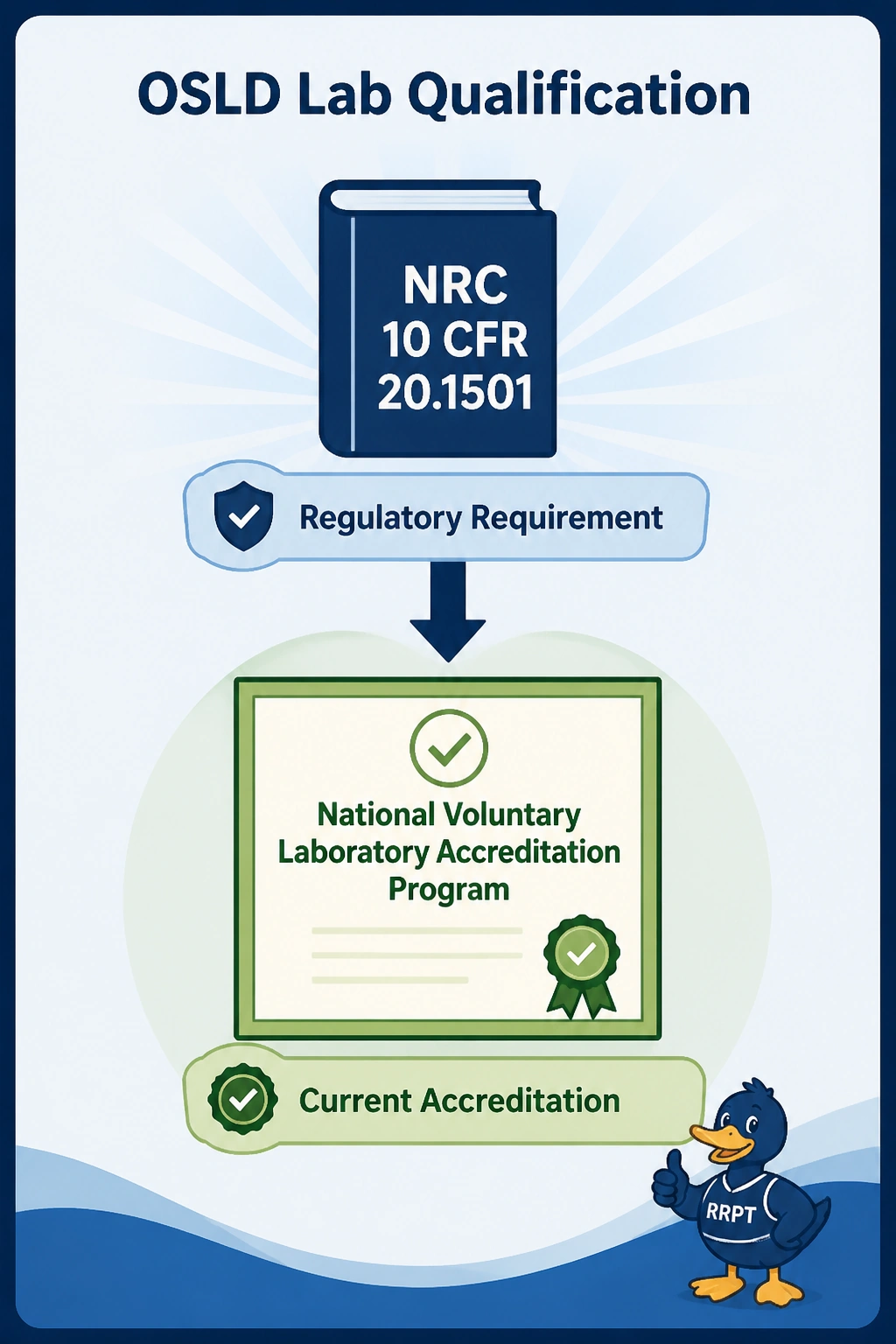
Under NRC 10 CFR 20.1501, any personnel dosimeter that requires processing to determine radiation dose—such as an OSLD or TLD—must be processed and evaluated by a dosimetry processor holding Current accreditation from the National Voluntary Laboratory Accreditation Program (NVLAP) administered by NIST. NVLAP accreditation verifies through blind proficiency testing and quality audits that the processor accurately reports doses across specific radiation categories. Current ISO 9001 quality management registration from an independent commercial registrar demonstrates general quality processes, not radiological dose-evaluation accuracy. Formal calibration certification from the original dosimeter badge manufacturer covers hardware specifications rather than the ongoing analytical performance of the processing laboratory. State occupational safety agency approval for routine clinical badge processing does not substitute for the federal NVLAP requirement on NRC-licensed facilities. As a regulatory caveat, direct-reading pocket dosimeters and electronic dosimeters that do not require laboratory processing are exempt from this processor rule, though they still require periodic calibration. Operationally, verify the processor's current NVLAP certificate and accredited radiation categories before issuing badges to workers.
Prefer to study offline? Printable PDF study book + test engine ($7.50, unofficial). These questions stay free here.