
A technician wearing a direct-reading quartz-fiber pocket ionization chamber drops it onto a concrete floor while working in a 5 mrem/hr area. Checking the eyepiece immediately afterward shows an off-scale high reading, while the technician's electronic personal dosimeter reads 2 mrem. What most likely caused the off-scale pocket chamber reading?
Select an answer to reveal the explanation.
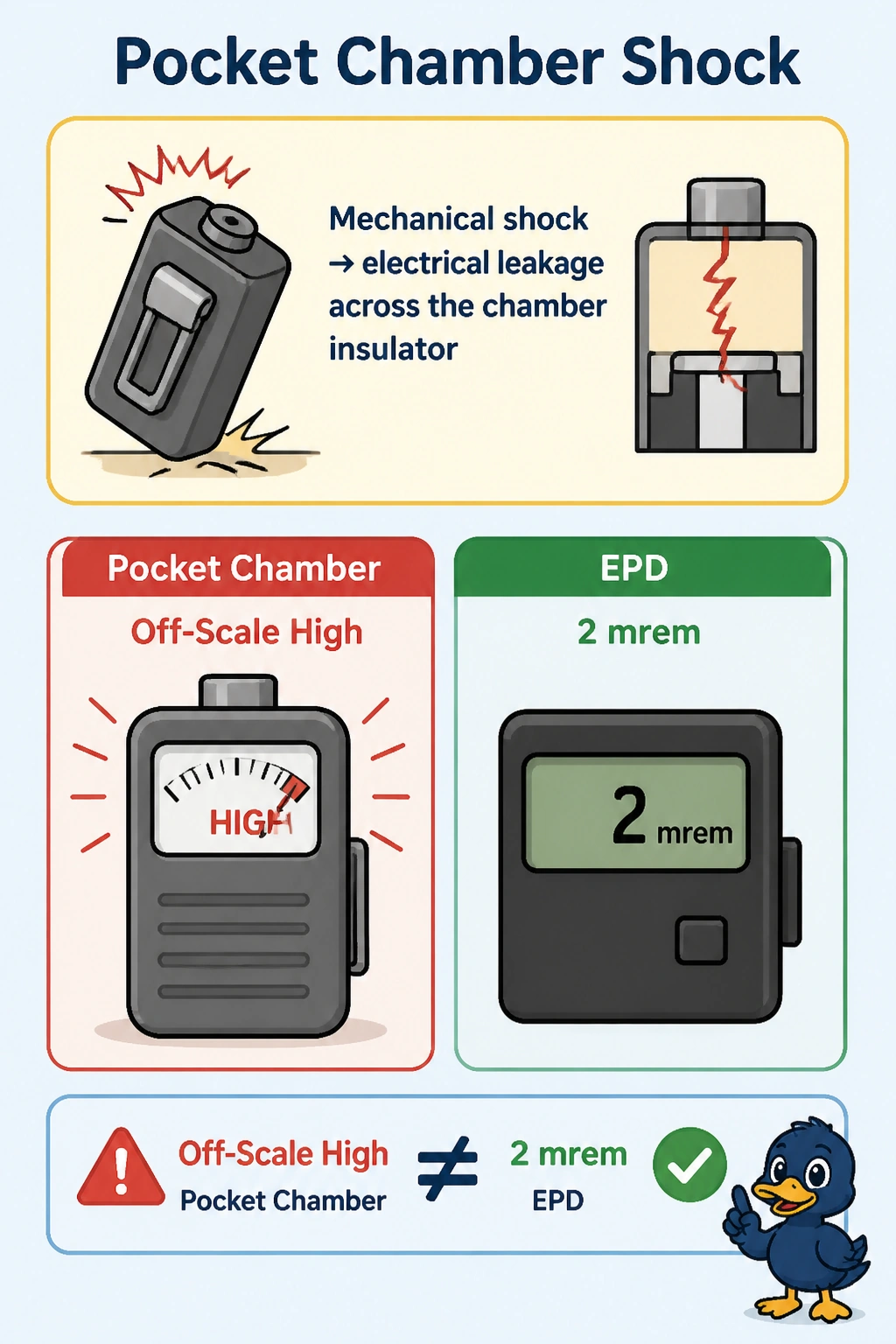
Short Explanation
Your quartz-fiber pocket chamber holds an electrostatic charge, and a hard drop can disrupt it. When the reading jumps off-scale after impact but your electronic dosimeter reads 2 mrem, mechanical shock is the likely cause—not a radiation burst.
Full Explanation
A direct-reading quartz-fiber pocket ionization chamber holds an electrostatic charge on a central electrode. Ionizing radiation discharges the capacitor, moving the quartz fiber upscale across a calibrated reticle. Dropping the instrument onto concrete can jar the fiber or momentarily bridge the high-resistance insulator, causing electrical leakage and driving the hairline off-scale even though the electronic dosimeter reads 2 mrem. A sudden localized burst of neutron radiation striking only the pocket chamber is implausible: standard pocket ion chambers have low neutron sensitivity, and a real field would also register on adjacent dosimetry. Failure of the electronic personal dosimeter to integrate low-energy gamma photons is unlikely because the drop immediately precedes the off-scale reading while the area rate is only 5 mrem/hr. Humidity condensing on the eyepiece lens might blur or magnify the hairline, but it cannot shift the fiber’s physical position off-scale. As an exam caveat, moisture or dirt on the charging pin can also cause slow upscale drift. In practice, re-zero and inspect a dropped pocket dosimeter, then compare its reading with your electronic and passive dosimeters.
Prefer to study offline? Printable PDF study book + test engine ($7.50, unofficial). These questions stay free here.