
Following a routine atmospheric release of radioiodine (I-131) near agricultural land, why does an environmental monitoring program prioritize sampling local dairy milk over relying solely on soil samples?
Select an answer to reveal the explanation.
Short Explanation
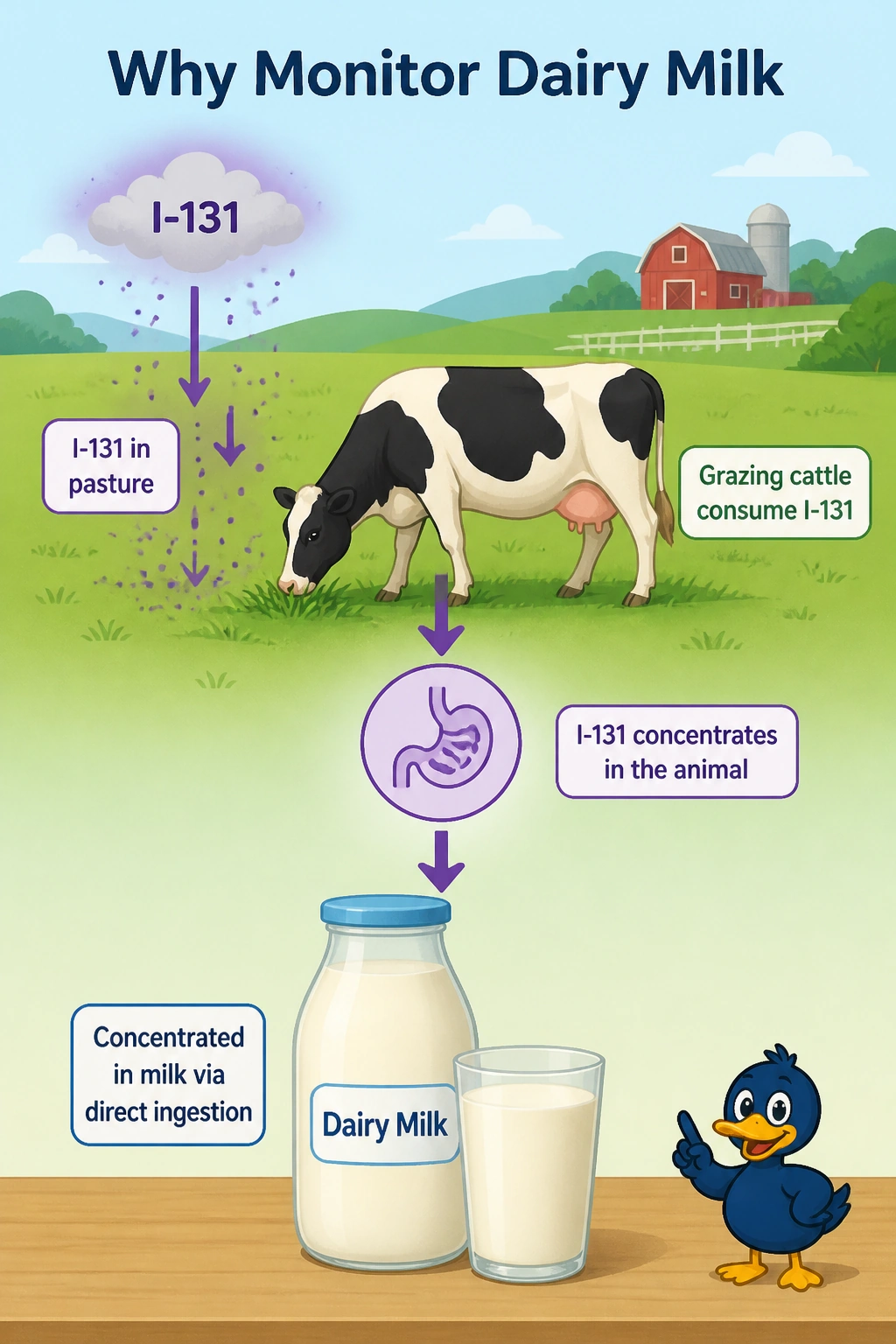
A dairy cow acts like a biological vacuum cleaner, sweeping across acres of pasture and funneling trace radioiodine straight into a single milk tank for you to sample. The trap is thinking soil cannot be counted or that iodine vanishes before landing, when milk is really the fastest shortcut to human thyroid dose.
Full Explanation
Environmental monitoring programs prioritize dairy milk after a radioiodine release because Grazing cattle concentrate radioiodine from large pasture areas into a direct ingestion pathway. Cows graze over wide areas of grass each day, ingesting deposited I-131 and secreting a fraction of it into milk, which creates a concentrated, bioavailable food-chain pathway directly to the human thyroid, especially for infants and children. Soil samples cannot be analyzed accurately by gamma spectroscopy is false because soil samples are routinely counted by high-purity germanium gamma spectroscopy, though dilution across soil depth lowers sensitivity. Radioiodine decays completely before depositing on pasture grass is incorrect because I-131 has an 8-day physical half-life, giving it ample time to deposit onto forage and enter the food chain. Dairy cattle metabolize and excrete all other fission products is inaccurate because cattle also absorb and transfer other nuclides such as cesium-137 and strontium-90 into milk. As a caveat, environmental programs still collect air, vegetation, and soil samples to track plume deposition patterns. As an operational check, preserve fresh milk samples promptly with an approved stabilizer and analyze them for I-131 gamma peaks before significant decay occurs.
Prefer to study offline? Printable PDF study book + test engine ($7.50, unofficial). These questions stay free here.