
An environmental monitoring program places thermoluminescent dosimeters (TLDs) around a facility perimeter and also keeps matched control TLDs in a shielded, low-background location away from the site. Why are the control TLDs included?
Select an answer to reveal the explanation.
Short Explanation
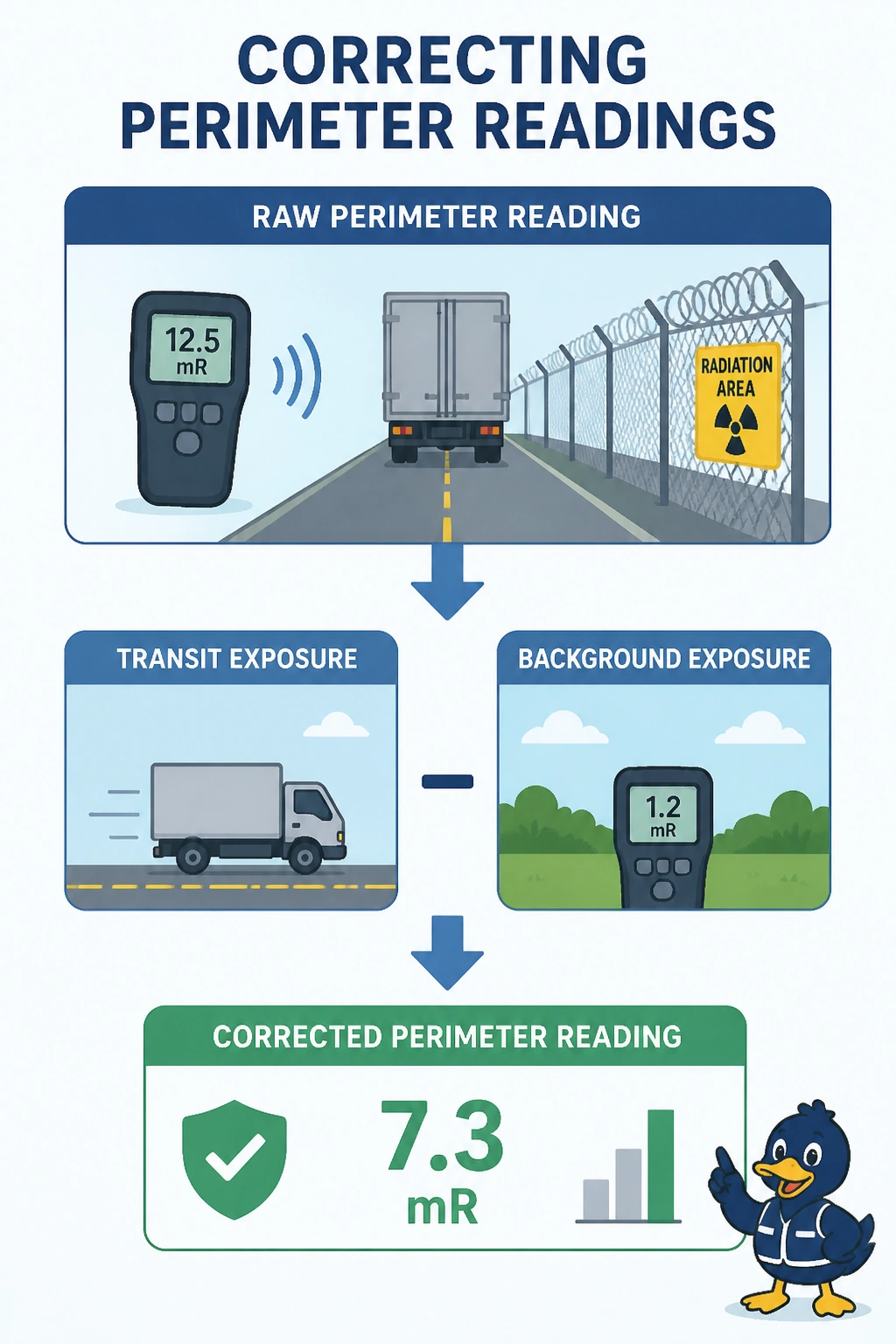
Environmental badges pick up cosmic rays and shipping exposure before they ever reach the fence line, so you need a baseline to isolate what the plant actually added. Matched control TLDs measure that transit and background dose so you can subtract it from perimeter results. The trap is confusing control badges with calibration sources or air samplers.
Full Explanation
Perimeter TLDs accumulate dose from natural terrestrial and cosmic background as well as during shipping and handling, not solely from facility operations. Matched control dosimeters are included To quantify transit and background exposure for subtraction from perimeter readings so that any net dose attributable to the facility can be accurately evaluated. Choosing To calibrate the energy response of the perimeter TLDs against a certified Cs-137 source describes laboratory calibration of dosimeter batches, whereas control TLDs are kept unexposed to calibration sources to measure ambient baseline. Selecting To serve as backup dosimeters if perimeter TLDs exceed the annual public dose limit misunderstands their purpose, because a shielded control badge in another location cannot substitute for a field measurement at the fence line. Picking To measure airborne radioiodine concentrations along the facility's prevailing wind path describes charcoal or silver-zeolite air sampling media rather than passive external gamma dosimeters. As an environmental monitoring caveat, transit controls that travel with field badges must be stored in a documented low-background area while field badges are deployed to avoid skewing the net calculation. As an operational check, review control TLD readings each quarter for unexpected spikes that could indicate shipping X-ray exposure or storage contamination.
Prefer to study offline? Printable PDF study book + test engine ($7.50, unofficial). These questions stay free here.