
After a radiation worker turns in a lithium fluoride thermoluminescent dosimeter (TLD) for quarterly processing, the dosimetry laboratory heats the crystal and measures the emitted light. What happens to the dosimeter's stored radiation signal during this thermal readout?
Select an answer to reveal the explanation.
Short Explanation
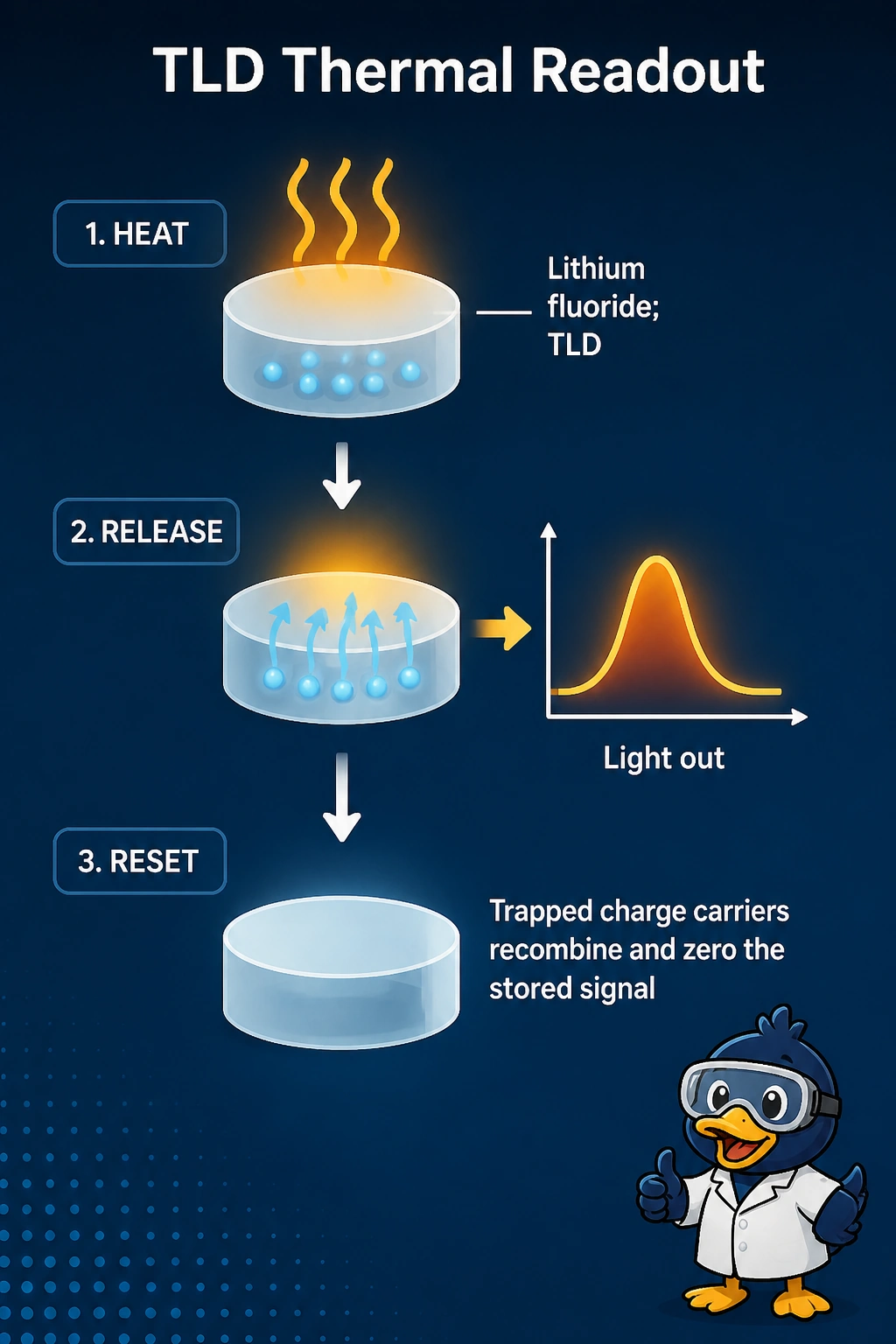
Heating a TLD empties its electron traps in a single flash of light, which resets the crystal like erasing a whiteboard after you copy the notes. The trap is confusing TLDs with OSLDs, which use light stimulation and let you re-read the same dose.
Full Explanation
When ionizing radiation strikes a lithium fluoride TLD crystal, electrons are excited and held in metastable lattice traps until controlled heating supplies enough thermal energy to release them. As the electrons return to ground state, trapped charge carriers recombine and zero the stored signal while emitting visible light proportional to the absorbed dose. The claim that the crystal remains permanently sensitized so the dose reading can be repeated is false because thermal readout empties the dosimetric traps and destroys the original signal. The option stating that laser stimulation reads the traps while preserving the full dose record describes optically stimulated luminescence dosimeters (OSLDs), not heated TLDs. Finally, induced radioactivity in the lithium lattice decays to emit proportional light is incorrect because photon and beta exposures do not activate the crystal; luminescence comes from electronic trap transitions rather than nuclear decay. As an operational caveat, once a TLD is read out, the raw glow curve and integrated charge record must be archived securely because the crystal cannot be re-evaluated. Before reissuing the badge, verify that post-readout annealing returns residual background counts to baseline.
Prefer to study offline? Printable PDF study book + test engine ($7.50, unofficial). These questions stay free here.