
A radiopharmacy technologist prepares high-activity beta-gamma syringes behind an L-block shield and is issued a thermoluminescent ring dosimeter for extremity monitoring. Where should the technologist wear the ring dosimeter to obtain a valid shallow dose equivalent measurement?
Select an answer to reveal the explanation.
Short Explanation
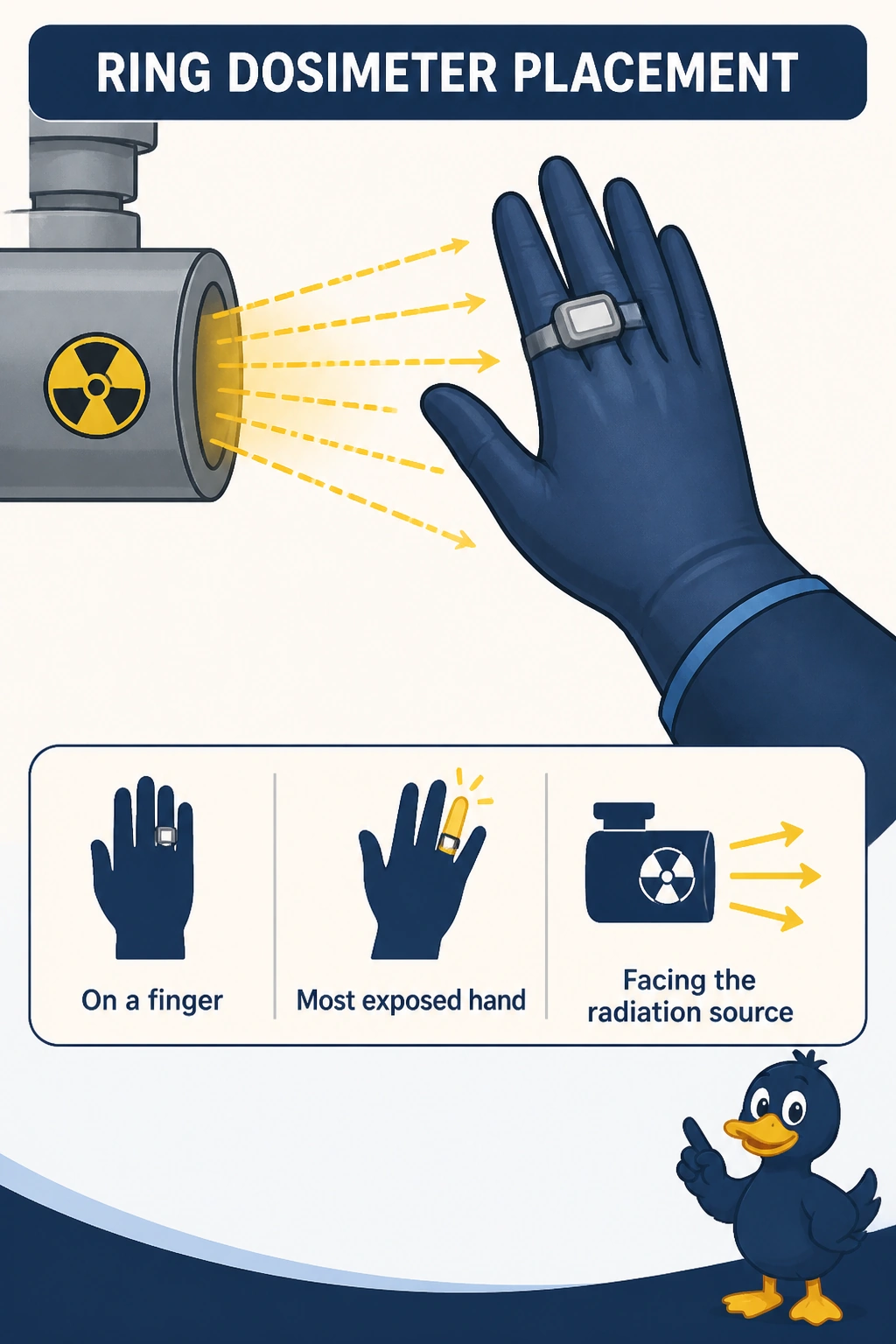
You’ll get a valid shallow dose equivalent measurement when you wear the ring on a finger of your most exposed hand with its sensing element facing the radiation source. Keep the dosimeter oriented toward the source; turning its chip toward the back of your hand lets your finger tissue shield the reading.
Full Explanation
Under NRC 10 CFR 20.1201 and standard extremity-monitoring practice, your ring dosimeter should measure the highest dose to the skin of your hand or fingers. Wearing it on a finger of your most exposed hand facing the radiation source places its thin sensing element on the palm side of the dominant or closest finger, minimizing self-shielding by finger tissue and capturing steep inverse-square dose gradients near vials and syringes. An outer-wrist position on the non-dominant hand facing away from the source can drastically underestimate fingertip dose: the wrist is farther from the syringe, and the hand blocks low-energy betas and photons. A dosimeter clipped to the front collar outside a protective lead apron is used for whole-body or lens-of-eye monitoring when wearing lead, not extremity dose. A badge inside the lab-coat chest pocket behind the primary badge measures trunk exposure through clothing and misses localized hand exposure. Note that you should wear the ring underneath disposable surgical gloves to keep it free of radioactive contamination during handling. As an operational check, inspect your hand before gloving to verify the labeled sensing window faces the palm side of your working finger.
Prefer to study offline? Printable PDF study book + test engine ($7.50, unofficial). These questions stay free here.